
The hospital says your parent is going home. You're not sure they're ready.
Your parent fell, had a stroke, or broke a hip — and now a discharge planner is talking about sending them home in 48 hours. You're Googling "hospital discharge rights" at 2 AM, trying to figure out whether you can push back, who to call, and what happens if they fall again the day they get home.
The hospital staff means well. But their job is to move patients through the system efficiently. Your job is to make sure your parent lands safely — and those are not the same thing.
The Discharge Navigation System — a step-by-step advocacy playbook for Washington families
This isn't a pamphlet of general tips. It's a structured binder built around Washington's specific statutes (RCW 70.41.320, RCW 70.41.322), DSHS administrative rules, and Medicare appeal procedures — translated into plain-English action plans you can follow while managing the crisis in real time.
Where hospital handouts give you a phone number and wish you luck, this guide gives you the worksheets, scripts, and checklists that turn each decision point into a concrete next step.
What's inside
- Observation Status Decoder — the classification that quietly disqualifies your parent from Medicare-covered rehab, and exactly how to challenge it before they leave the building
- Three-Midnight Tracking Sheet — a day-by-day log that proves whether your parent has accumulated enough qualifying inpatient nights for SNF coverage
- Unsafe Discharge Appeal Scripts — word-for-word language for calling Acentra Health (Washington's BFCC-QIO) to halt a premature discharge, including the critical noon filing deadline
- 14-Day Readmission Leverage Template — an email to the discharge planner citing WAC 182-550-2950, putting the hospital on notice that an inadequate plan will be reported as a preventable event
- SNF Admission Contract Audit Checklist — the specific "responsible party" and "guarantor" clauses to cross out before signing, so you don't accidentally create personal liability for your parent's care costs
- CARE Assessment Preparation Workbook — worksheets that teach you how to document your parent's daily needs using the exact scoring language DSHS assessors use (Supervision, Limited, Extensive, Total) to determine care hours
- 7-Day Observation Window Tracker — a structured diary for the week before the CARE assessment, ensuring every qualifying need is recorded at least three times (the threshold the scoring tool requires)
- COPES & CFC Eligibility Worksheet — fill-in income limits, asset thresholds, the Community Spouse Resource Allowance, and the steps to hire a family member as a paid caregiver under Community First Choice
- Notice and Finding of Responsibility Appeal Template — a drafted letter challenging DSHS's "participation" calculation within the 30-day statutory deadline
- Medicaid Estate Recovery Protection Guide — how Washington's expanded-estate rules work, when the family home is exempt, and how to apply for mandatory deferrals
Who this is for
You're the adult child — probably the daughter, statistically — who became the unpaid care coordinator the moment your parent was admitted. You might be managing this from Seattle, or you might be coordinating from Portland or San Francisco. Either way, you're making decisions under pressure with incomplete information, and nobody at the hospital is going to tell you what you don't know to ask.
This guide is for families who need to:
- Understand whether their parent's hospital classification (inpatient vs. observation) will cost them tens of thousands of dollars in uncovered rehab
- Challenge a discharge they believe is premature or unsafe
- Navigate a skilled nursing facility admission without signing away personal financial liability
- Prepare for the DSHS CARE assessment that determines how many monthly care hours the state will fund
- Apply for COPES or Community First Choice so a parent can stay home with paid support instead of entering a facility
Why free tools won't get you there
The DSHS website contains thousands of pages of administrative code. It will show you the rules. It will not show you how to prepare for them.
State agencies are legally bound by administrative neutrality — they cannot advise you on how to maximize care hours, position your parent's deficits in the terminology the CARE tool scores, or structure assets to protect the family home from estate recovery. Washington LawHelp publishes excellent legal education materials, but they're static text written for low-income clients who qualify for civil legal aid — not structured action plans for the acute crisis of a hospital discharge.
Placement agencies like A Place for Mom will call you within minutes of a hospital admission. Their service is "free" because they collect referral fees from the facilities they recommend — which means they have a structural incentive to steer your parent toward private-pay residential care, not toward the public home-support programs that might be a better fit.
This guide has no facility partnerships, no referral fees, and no reason to steer you anywhere except toward the safest, most cost-effective transition your parent qualifies for.
What it costs — and what it replaces
An elder law attorney in Washington charges $300 to $500 per hour. A professional care manager charges $150 to $250 per hour. The hospital's discharge planner will hand you a list of phone numbers and a pamphlet.
For , you get the structured transition binder that replaces hours of professional consultation — the checklists, worksheets, appeal scripts, and eligibility calculators that let you manage the process yourself or arrive at an attorney's office with organized documentation instead of a box of unsorted papers.
Your parent deserves a safe landing
The hospital discharge is not the end of the crisis. It's the beginning of a longer transition that determines whether your parent recovers at home with support, enters a facility that matches their needs, or bounces back to the ER within two weeks because the plan was rushed.
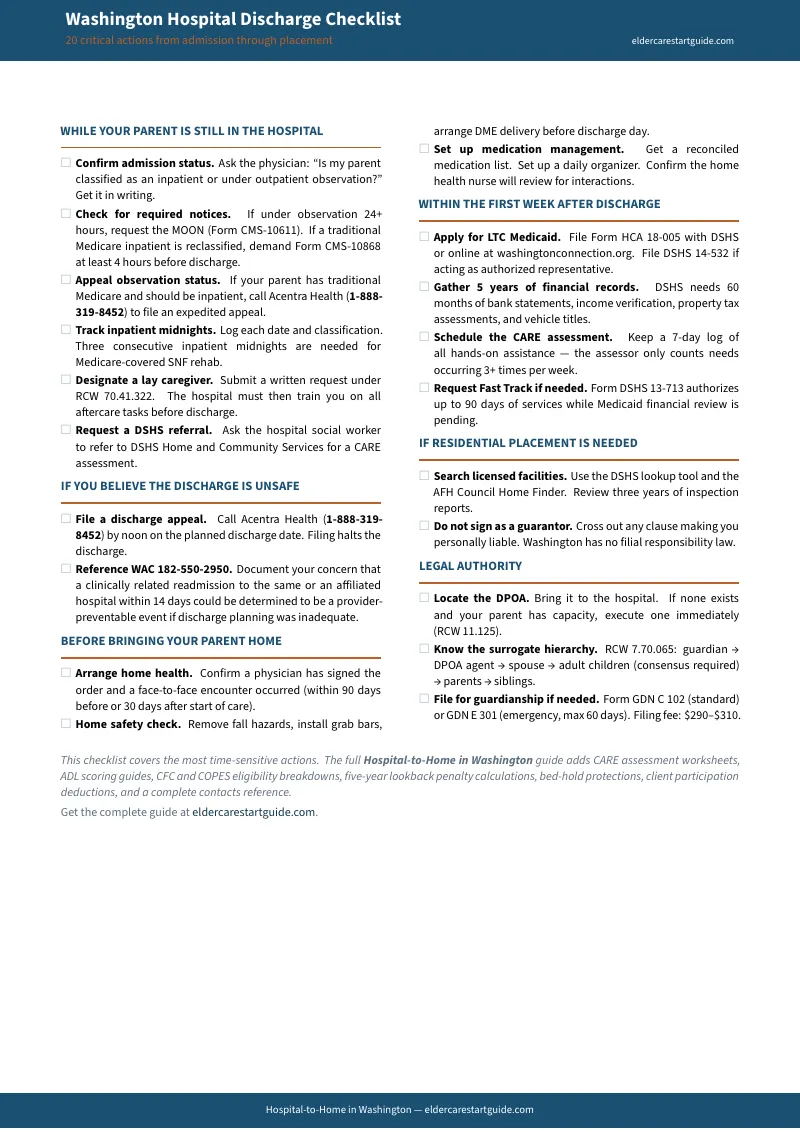
The free checklist gives you the overview. The full guide gives you the tools to execute it.