
Your Parent Wants to Stay Home. Washington Has the Programs. You Need the Playbook.
Right now, somewhere in Washington, an adult child is sitting in a hospital hallway being told their parent needs to be discharged in 48 hours. They're handed a list of agencies and told to choose. No one explains how the agencies connect, what the state will pay for, or how to avoid draining their parent's savings on private-duty care that costs $28 to $38 per hour.
Meanwhile, DSHS publishes thousands of pages of administrative code. The Health Care Authority manages a separate Medicaid system. Thirteen regional Area Agencies on Aging each run their own intake process. And Consumer Direct Care Network Washington handles the paperwork if you want to get paid for the care you're already providing. The information exists — but it's scattered across four different bureaucracies, written for caseworkers, not families.
The Washington Home-Care Navigation System
This guide connects what the government separates. It maps the entire pathway from first call to paid care in the order you'll actually walk it — not organized by agency, but by the decisions you face at each stage.
Most families lose weeks bouncing between the wrong offices because they don't understand a basic structural fact: DSHS handles the clinical assessment, but the Health Care Authority handles the money. Call the wrong one first and you wait. Call the right one — your regional AAA — and they route everything for you.
That's what this guide does. It sequences every phone call, every form, every decision point so you stop circling and start moving.
What's Inside
The CARE Assessment Prep Kit — The CARE assessment is the single event that determines how many paid care hours your parent receives. State caseworkers score your parent's ability to perform daily activities, and the number they record sets the ceiling on everything else. The problem: parents routinely minimize their difficulties during the interview. This chapter gives you a 7-day deficit-mapping ledger so you walk into the assessment with documented evidence of what your parent actually needs, not what they claim they can still do.
CFC + COPES Decoded — Washington delivers home care through two programs that work in tandem, but nobody explains the relationship clearly. Community First Choice is an entitlement with no waitlist — if your parent qualifies, they get personal care hours. COPES wraps around CFC and adds adult day care, home modifications, transportation, and specialized equipment. This chapter explains which services come from which program, what triggers enrollment in each, and the monthly-use requirement that can cause COPES disenrollment if you're not paying attention.
The Paid Family Caregiver Roadmap — If you're already providing daily care for your parent, Washington will pay you for it. This chapter walks you through the entire CDWA Individual Provider onboarding sequence: the background check, the 5-hour safety orientation, the 30-hour basic training, the SEIU 775 union enrollment, and the EVV timesheet system that trips up new providers. Current pay: $23.54 to $27.28 per hour, with health insurance and retirement benefits through the union.
Medicaid Financial Navigation — The five-year lookback terrifies families into inaction. This chapter replaces fear with math. It walks you through the countable-vs-exempt asset classification using Washington's specific rules, the monthly penalty divisor calculation, the $2,000 individual resource limit, the spousal impoverishment protections, and the income rules that trip up families who assume Medicaid works the same way in every state.
Estate Recovery — The Real Rules — Washington pursues Medicaid estate recovery aggressively under RCW 43.20B.080, using an expanded estate definition that reaches beyond probate to joint tenancies and living trusts. But recovery is legally deferred whenever a surviving spouse, a minor child, or a disabled child lives in the home. The equity exemption is $1,130,000. This chapter separates the legitimate concerns from the myths so you can make enrollment decisions based on your family's actual situation.
Home Modification Resources by County — COPES environmental adaptation benefits, TSOA minor modification allowances, USDA Section 504 repair grants, and local programs like Sound Generations Minor Repairs in King County. Organized so you find the program that matches your parent's county and situation.
Hospital Discharge Defense — Scripts, checklists, and regulatory citations for the 48-hour window when your parent is being sent home after a crisis. How to request an expedited in-hospital CARE assessment, how to document an unsafe discharge, and how to use Roads to Community Living transition services.
WA Cares Fund Integration — Washington's new public long-term care insurance ($36,500 lifetime benefit, starting July 2026) works alongside Medicaid programs and fills gaps they can't — including paying a spouse as caregiver. This chapter shows how to stack WA Cares benefits with CFC/COPES coverage.
Legal Authority Toolkit — Washington's Durable Power of Attorney under RCW 11.125 doesn't survive incapacity unless the document includes specific statutory language. "Hot powers" like gifting and trust amendments are excluded by default unless explicitly granted. This chapter walks you through auditing existing documents and covers Washington's less-restrictive alternatives under UGCOPAA, including Supported Decision-Making agreements.
Regional Agency Directory + Forms Index — Every AAA contact number, ADRC intake line, DSHS HCS office, and CDWA portal — organized by county. Plus the form numbers and filing instructions for the applications, appeals, and authorizations you'll need at each stage.
Who This Guide Is For
- The crisis coordinator — Your parent was just hospitalized and you have 48 hours to figure out what happens next
- The unpaid caregiver — You're already providing daily care and want to get paid through CDWA without losing your parent's benefits
- The long-distance child — You live out of state but your parent is in King, Pierce, Snohomish, or Spokane County and you need to manage their care remotely
- The financial planner — You're trying to get your parent's Medicaid application right the first time without triggering a lookback penalty
- The proactive family — Your parent is managing fine now, but you can see the trajectory and want to set up legal authority and benefits before a crisis forces your hand
Why Not Just Use the Free Government Resources?
You absolutely can. DSHS, HCA, and the AAAs publish extensive information online. The problem is that those resources are designed for caseworkers evaluating eligibility, not for families trying to build a care plan.
The DSHS Long-Term Care Manual alone runs hundreds of pages of administrative code organized by WAC section numbers. The HCA publishes separate eligibility rules in a different format. Your local AAA has its own intake process that isn't documented in either place. And CDWA's onboarding requirements are on yet another website.
This guide doesn't replace those resources — it sequences them. It tells you which office to call at which stage, which form to file before which assessment, and which program pays for which service. The information is free. The organization costs families weeks of phone calls and dead ends.
What You Get
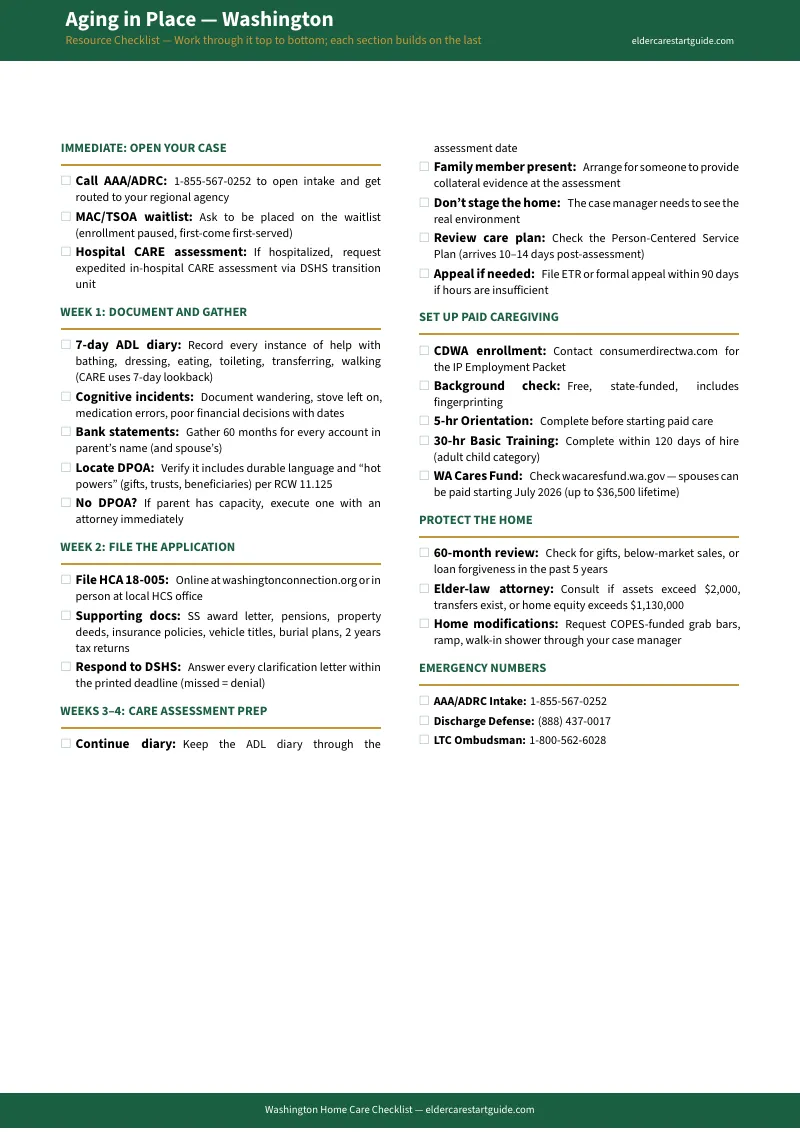
The complete guide (13 chapters, 70+ pages), a 20-item quick-action checklist, and 11 standalone worksheets — CARE Assessment Preparation, Medicaid Financial Inventory, Estate Recovery Protection, Legal Document Audit, Hospital Discharge Defense Scripts, Paid Caregiver Onboarding Tracker, Home Modification Resources, Regional Directory & Forms Index, Cost Comparison, Week-by-Week Action Plan, and Application Document Checklist — all specific to Washington State law and programs as of mid-2026.
Free option: Download the Washington Aging-in-Place Resource Checklist — a one-page starting point with the key contacts, deadlines, and first steps.
Full guide: — less than one hour of an elder law attorney's time, covering the administrative prep that would otherwise cost you several billable hours.
Every dollar figure, form number, phone number, and deadline comes from Washington State sources. When a number changes annually (Medicaid income limits, spousal allowances, WA Cares Fund caps), the guide notes the update cycle so you know when to re-verify.