Your parent needs more help than you can give alone. Washington's care system has answers — but it won't hand them to you.
You already know something has to change. The falls, the forgotten medications, the call from a neighbor who found your parent confused in the driveway. What you don't know is which care setting is right, what it actually costs in Washington, or whether the state will help pay for any of it.
The free resources exist — buried across DSHS manuals, WAC citations, and county agency websites that haven't been redesigned since 2012. The national referral sites will call you within hours, eager to steer you toward facilities that pay them a commission. And elder-law attorneys in Seattle and Spokane bill $300 to $500 an hour to explain the same regulatory framework that this guide puts in your hands.
The Washington Care Decision Roadmap is the structured system that sits between "I need to figure this out" and "I'm confident we made the right call." It gives you the clinical framework, financial thresholds, facility vetting process, and legal authority steps — all specific to Washington's rules — in one organized sequence instead of dozens of browser tabs and panicked phone calls.
What's inside
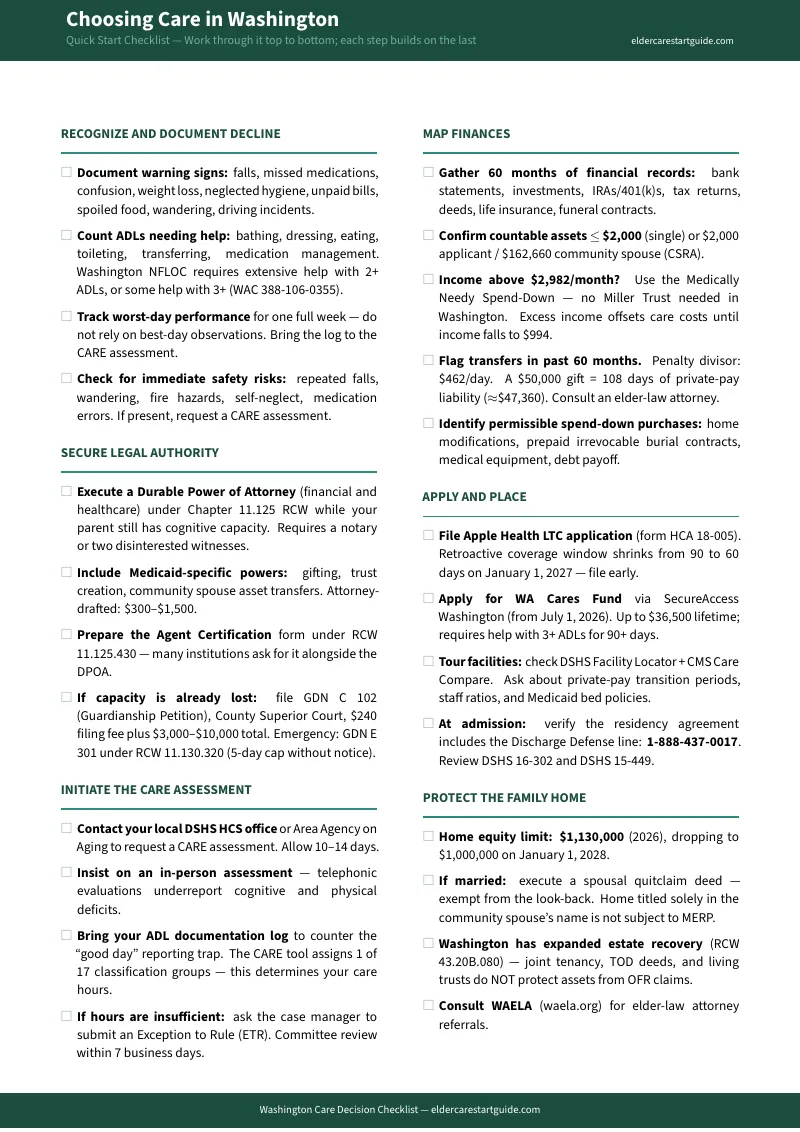
- The CARE Assessment Preparation System — Washington's Comprehensive Assessment Reporting Evaluation determines everything: how many care hours your parent gets, which programs they qualify for, and what the state will pay. The guide walks you through each of the six ADLs the assessor evaluates, explains the 17 classification groups that drive reimbursement rates, and shows you how to document your parent's worst-day performance so the assessment reflects reality, not a "good day" performance that leads to denied or under-allocated hours.
- Washington's Four Care Settings, Compared — a side-by-side breakdown of home care agencies, Adult Family Homes (2–6 residents, typically $5,500–$7,500/month), Assisted Living Facilities (7+ residents, $7,600/month statewide median, $9,500–$14,000+ in Seattle), and skilled nursing facilities ($13,155–$15,969/month). For each setting: the licensing WAC, what's included, what's extra, Medicaid acceptance policies, and the specific questions to ask before signing an admission agreement.
- The Medicaid Financial Eligibility Calculator — a step-by-step workbook for 2026: the $2,982 monthly income threshold, the $2,000 asset limit, and why Washington's medically needy spend-down pathway means you do not need a Miller Trust (unlike 37 other states). Includes countable vs. exempt asset breakdowns, the spousal Community Resource Allowance (up to $162,660), and a worked dollar-by-dollar example of the spend-down calculation.
- CFC and COPES Waiver Navigator — Community First Choice is an entitlement (no waitlist). COPES wraps additional services around CFC. MAC and TSOA are paused for new enrollments as of December 2025. The guide maps which program covers which services, the Exception to Rule (ETR) process for getting more hours than your classification authorizes, and what the enrollment pause means for your family's options right now.
- The MERP Asset Protection Checklist — Washington runs one of the most aggressive Medicaid estate recovery programs in the country. OFR pursues not just probate assets but joint tenancy property, TOD accounts, community property agreements, and living trusts. The guide explains the spousal quitclaim deed strategy, the five-year look-back penalty calculation ($462/day divisor), exempt transfers, and the 2028 home equity cap reduction from $1,130,000 to $1,000,000 that will affect families in the Seattle metro area.
- The DPOA and Sibling Alignment Kit — Washington's Uniform Power of Attorney Act requirements (notary or two disinterested witnesses, no facility staff), the Agent Certification form under RCW 11.125.430, the surrogate decision-maker hierarchy that requires unanimous sibling consent when no DPOA exists, and the guardianship filing process ($240 filing fee plus $3,000–$10,000 in total costs) when capacity is already gone.
Who this guide is for
You're an adult child in Washington — or with a parent in Washington — who needs to make a care decision. Maybe the decline has been gradual and you're planning ahead. Maybe a hospital discharge planner just told you the 48-hour clock is ticking. Either way, you need Washington-specific answers, not generic "10 tips for choosing senior care" articles written for national SEO.
This guide is especially built for families who are:
- Comparing care settings for the first time and overwhelmed by the options
- Preparing for the DSHS CARE assessment and determined to get an accurate result
- Trying to figure out whether Medicaid will help — and what happens to the family home if it does
- Managing sibling disagreements about care levels and looking for an objective decision framework
- Facing the legal authority gap: handling logistics without the legal power to sign anything
Why this exists instead of free alternatives
Free information about elder care in Washington is abundant and fragmented. DSHS publishes the regulations but not the strategy. The Area Agency on Aging answers questions during business hours but doesn't hand you a decision system. National referral sites like A Place for Mom give you a "free advisor" who earns commission from the facilities they recommend — so the advice is structurally biased toward the most expensive private-pay options, not the Medicaid waivers that could save your family tens of thousands of dollars.
This guide is paid because it has no other revenue source. No referral partnerships, no affiliate links, no facility sponsorships. The incentive is to give you the most accurate, useful information possible — because that's the only thing generating a second sale or a recommendation to another family.
What you get
Your purchase includes the full guide plus standalone worksheets and templates you can print, fill in, and bring to assessments, facility tours, and family meetings:
- The Complete Guide — 12 chapters covering every stage from recognizing decline through facility placement, Medicaid qualification, estate recovery protection, and legal authority
- CARE Assessment Preparation Worksheet — document your parent's worst-day ADL performance before the assessor arrives
- Facility Vetting Checklist — the specific questions to ask during tours of AFHs, ALFs, and nursing homes, with spaces to score and compare
- Medicaid Financial Eligibility Workbook — calculate whether your parent qualifies, map out the spend-down strategy, and track the asset conversion timeline
- MERP Protection Checklist — step through each asset type to identify what's exposed to Washington's expanded estate recovery
- DPOA Requirements Checklist — witness, notary, and execution requirements under Chapter 11.125 RCW so the document holds up when you need it
- Sibling Decision Framework — a structured template for family meetings that allocates responsibilities, sets decision-making authority, and prevents the paralysis that unanimous-consent rules create when no DPOA exists
- Agency Communication Log — track every call, meeting, and submission to DSHS, HCS, and care agencies so you have a paper trail if a dispute arises
- Medicaid Application Document Checklist — every document required for HCA Form 18-005, organized by category so nothing delays your application
Try it risk-free
Download the free CARE Assessment Decision Checklist first — a printable one-pager covering the six ADLs, the documentation strategy, and the key questions to ask before requesting an assessment. If the checklist is useful, the full guide goes deeper into every dimension: facility comparison, Medicaid math, estate protection, and legal authority.
If the full guide doesn't give you the clarity you need, email [email protected] and we'll make it right.