
Medicare Runs Out in 100 Days. Virginia's Nursing Home Bill Is $9,825 a Month. Now What?
Your parent just hit a "functional plateau" in rehab. The discharge planner says Medicare coverage is ending. The facility billing department wants you to sign a financial responsibility form — today. And the private-pay rate for a semi-private room in Virginia is $8,669 a month.
You searched "Virginia Medicaid nursing home" and found that your parent needs to be below $2,000 in countable assets. Their savings are five times that. You read something about a five-year lookback. Someone mentioned a Miller Trust — but Virginia doesn't use those, and nobody told you why. The state website has 47 pages of regulations and zero instructions on what to do first.
Meanwhile, the clock is running at $289 a day.
The Virginia Medicaid Asset Protection Playbook
This is not a pamphlet of eligibility limits you can find on Cover Virginia. It is the process around the limits — the part that $300–$500/hour elder law attorneys explain in billable consultations and that free government portals never cover.
The guide covers every financial threshold, every legal mechanism, every waiver program, and every asset protection strategy available under Virginia law — organized in the order you will actually need them, from the first hospital discharge through Medicaid approval to estate recovery after your parent passes.
What's Inside
- The Medically Needy Spend-Down Advantage — Virginia is not an income-cap state. If your parent earns more than $2,982/month, they do not need a Miller Trust. They qualify by spending down excess income on care costs — and this guide shows you the exact formula, the regional income thresholds ($410–$615/month depending on locality), and how to document every expense for your caseworker. This single chapter can save your family $1,500–$3,000 in attorney fees to set up a trust you never needed.
- Spousal Protection Worksheets — When one spouse enters a nursing home, the healthy spouse at home keeps between $32,532 and $162,660 of the couple's combined assets (the Community Spouse Resource Allowance) and a monthly income of at least $2,643.75 (the MMMNA). The guide walks through the snapshot date calculation, the Excess Shelter Allowance formula using Virginia's $551 standard utility allowance, and when to request an administrative hearing to increase the community spouse's income allocation — because most families never learn they can ask.
- 60-Month Look-Back Audit Prep — Virginia's local DSS reviews five years of financial records for every gift, transfer, and sale. Violations trigger a penalty calculated at $9,703/month in Northern Virginia and $7,324/month in the rest of the state. The guide explains which transfers are exempt (caregiver child exception, disabled child transfers, home equity transfers), the small-gift documentation pattern, and the critical difference between giving $5,000 to a grandchild and prepaying $5,000 on an irrevocable funeral contract.
- Probate-Only Estate Recovery — After your parent passes, Virginia's Medicaid Estate Recovery Program (MERP) can only pursue assets in the probate estate. Assets held as joint tenants with right of survivorship, in tenancy by the entirety, through Transfer-on-Death deeds, or with POD/beneficiary designations are completely shielded. The guide maps every asset class to its vulnerability status and shows you how to restructure ownership before the application — not after it is too late.
- CCC Plus Waiver and Auxiliary Grant — Standard Virginia Medicaid does not pay for assisted living room and board. The CCC Plus Waiver funds in-home care, adult day programs, and assistive technology for people who meet nursing-facility level of care but want to stay home. The Auxiliary Grant helps cover ALF costs for those who meet strict limits. The guide covers eligibility for both programs, the LTSS screening process, consumer-directed vs. agency-directed care options, and paying a family member as a caregiver through the legally responsible individual rules.
- Legal Spend-Down Strategies — Every Virginia-approved method to legally reduce countable assets without triggering a single day of penalty: prepaid irrevocable burial contracts, home modifications for safety, vehicle replacement, debt payoff, personal care agreements at fair market value, and the caregiver child home transfer exception. Each strategy includes the documentation standard your caseworker expects.
- Cardinal Care Application Walkthrough — The complete application sequence: CommonHelp online portal, Cover Virginia call center, or local DSS office. Which documents to gather (60 months of bank statements, Appendix D, Appendix E for over-income applicants), the 45-day processing timeline, how to request retroactive eligibility for up to 3 months, and the information request response protocol that prevents administrative denials.
- VA Aid and Attendance Benefits — If your parent is a veteran or surviving spouse, they may qualify for $1,558–$2,874/month in pension benefits to cover care costs while the Medicaid application is pending. The guide covers the clinical and financial requirements, the simultaneous application strategy, and how VA benefits interact with Medicaid patient pay calculations.
Plus: 9 Standalone Printable Worksheets
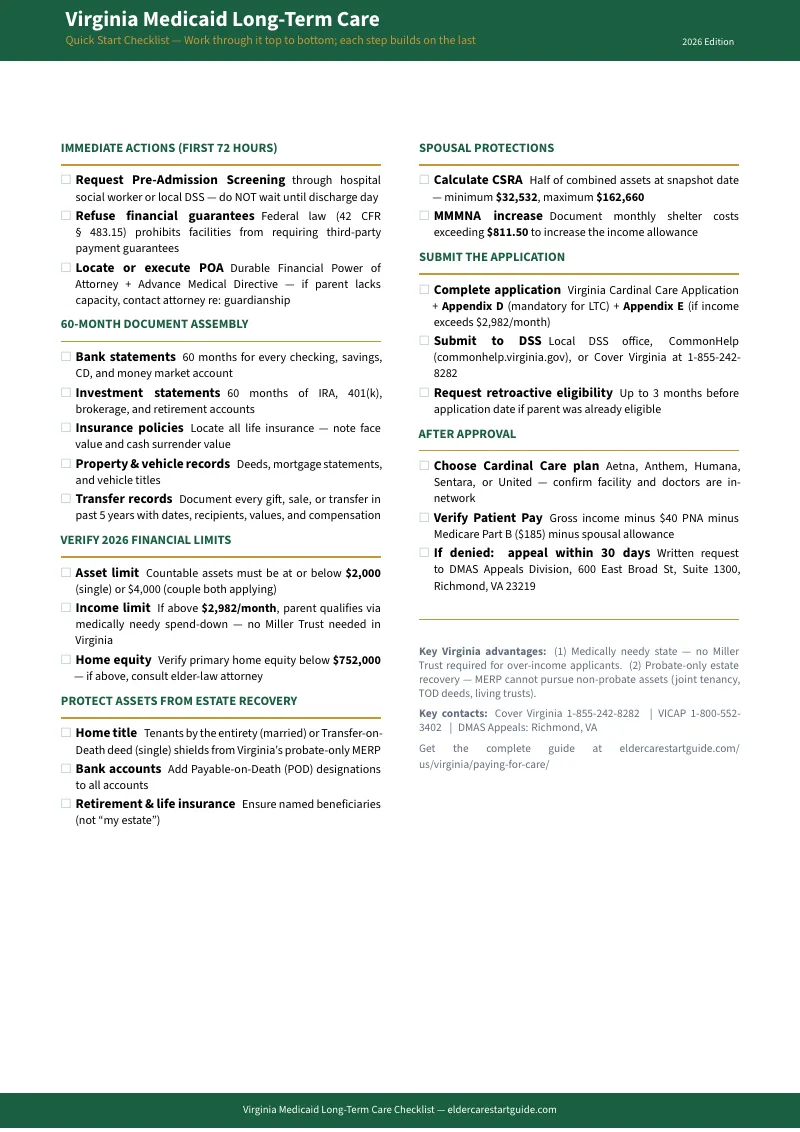
- Virginia Medicaid LTC Eligibility Checklist — A one-page action list with the 20 most critical items: secure legal authority, assemble 60 months of financial records, calculate countable assets, verify income against medically needy thresholds, protect assets from estate recovery, submit the application.
- Asset Inventory Worksheet — Map every account, property, vehicle, and insurance policy as countable or exempt before filing.
- Eligibility Calculator — Fill-in calculator for Virginia's 2026 asset and income thresholds with your medically needy spend-down result.
- Spousal Protection Calculator — Step-by-step CSRA and MMMNA worksheets with the Excess Shelter Allowance formula.
- 60-Month Look-Back Audit — Transfer log with Virginia's regional penalty divisors and exempt-vs-penalized transfer reference.
- Penalty-Free Spend-Down Planner — Every Virginia-approved strategy to reduce countable assets, with amount and date tracking.
- Estate Recovery Worksheet — Asset-by-asset MERP vulnerability map showing which titles bypass probate.
- Application Document Checklist — Complete document list for the Cardinal Care application with all required forms and records.
- Patient Liability Calculator — Calculate what your parent owes the facility each month after Medicaid approval.
Who This Is For
- Adult children whose parent is being discharged from the hospital and someone needs to figure out who is paying $8,669 a month for nursing care
- Families whose parent earns more than $2,982/month and they were told they do not qualify — but nobody explained Virginia's medically needy spend-down alternative
- Spouses trying to avoid impoverishment when one partner enters a nursing home and the couple's combined savings are at risk
- Families who made gifts or property transfers in the past five years and need to understand the look-back penalty before it is calculated for them
- Caregivers hoping to keep a parent at home through the CCC Plus Waiver instead of a nursing facility
- Out-of-state siblings coordinating Virginia Medicaid applications remotely and drowning in acronyms
- Anyone who has been told "it's too late to protect anything" and wants to know what Virginia law actually allows
Why Not Free Government Resources?
Cover Virginia publishes eligibility limits. The local Area Agency on Aging offers options counseling. Medicaid planning websites list state-by-state thresholds.
Here is what none of them provide:
- A step-by-step asset protection plan using Virginia's probate-only estate recovery limitation — not a generic "consult an attorney" note
- The medically needy spend-down calculation with Virginia's regional income thresholds, so families stop panicking about a Miller Trust they do not need
- A complete spend-down strategy list distinguishing penalty-free moves from penalized transfers — including the personal care agreement documentation that prevents look-back violations
- The CSRA and MMMNA worksheets with the Excess Shelter Allowance formula and the administrative hearing request that most families never know about
Government sites administer rules. Elder law firms explain them for $300 to $500 per hour. This guide bridges the gap — translating hundreds of pages of state policy into a sequence you can execute in an evening.
Satisfaction Guarantee
If the guide does not give you a clearer path forward, email [email protected] and we will make it right.
— Less Than One Hour of an Elder Law Attorney's Time
An initial consultation with a Virginia elder law attorney runs $300 to $500. A full Medicaid planning engagement can cost $6,000 to $15,000. A guardianship proceeding adds $2,000 to $5,000 in court costs and legal representation.
This guide will not replace an attorney for complex trust litigation or multi-million dollar estate planning. But for the asset mapping, spend-down documentation, spousal protection calculations, and application process that most Virginia families need, it covers 90% of the work at a fraction of the cost — and if you do need an attorney, you will walk in with a fully organized file instead of a box of unsorted bank statements.
Start with the free checklist to see if the approach fits your situation. The full guide goes deeper — every threshold, every strategy, every form, every phone number.