
The hospital says your parent is being discharged tomorrow. You have until noon to stop it.
Your parent is in a Virginia hospital bed. A case manager just told you the discharge is happening — maybe to a skilled nursing facility you have never visited, maybe straight home with no support lined up. You have questions about rehab coverage, observation status, Medicaid eligibility, and whether anyone is going to help you figure out what happens after the hospital doors close. The case manager is already moving on to the next patient.
The information you need exists. It is scattered across Medicare.gov bulletins, the Code of Virginia, DMAS policy manuals written for caseworkers, and the fine print of your parent's Cardinal Care managed care plan. Assembling it yourself — under the pressure of a discharge deadline — is not a realistic option.
The Virginia Discharge Navigation System
This is not a generic caregiving guide. It is a step-by-step administrative system built specifically for Virginia families managing a parent's hospital discharge, skilled nursing transition, or long-term care eligibility process. Every script, template, and checklist is keyed to Virginia statutes, DMAS regulations, and the Cardinal Care MCO structure that governs your parent's care options.
The guide walks you through the entire transition pipeline — from the moment your parent is admitted to the day you have a funded, compliant care plan in place — so you are never relying on a case manager's verbal assurances or a nursing home's financial pressure to make decisions.
What's Inside
- Discharge appeal scripts and timelines — the exact words to say and forms to file with Commence Health to legally freeze an unsafe discharge under federal Medicare rules and Virginia's five-day advance notice requirement
- Observation status diagnostic — how to verify your parent's admission classification, understand the financial consequences of outpatient observation billing, and challenge a reclassification that blocks SNF coverage
- SNF transition roadmap — Medicare's three-midnight rule, PASRR screening requirements, co-insurance rates by day, and how to evaluate facilities during a compressed decision window
- CCC Plus waiver preparation kit — a self-scoring guide to the Uniform Assessment Instrument (UAI) that determines whether your parent qualifies for home-based care under Virginia's primary Medicaid waiver, including the consumer-directed option that lets family members be paid as caregivers
- Medicaid spend-down worksheets — Virginia's $2,000 asset limit, the medically needy income pathway (no Miller Trust required), spousal impoverishment protections up to $162,660, and compliant strategies for the 60-month lookback period
- Estate recovery protection matrix — which assets Virginia's expanded recovery program can and cannot reach after your parent's death, with the statutory safe harbors that permanently block claims
- Legal authority audit — why standard powers of attorney get rejected by nursing homes and banks, and what provisions your parent's documents need to authorize Medicaid planning, asset transfers, and public benefits applications
- Caregiver designation templates — printable forms referencing Code of Virginia § 32.1-137.03 that legally require the hospital to include you in the discharge plan, demonstrate care tasks, and provide written instructions
Who This Is For
This guide is for adult children in Virginia who are managing a parent's hospital discharge and need to make financial and clinical decisions they were never trained for. You may be facing an immediate discharge deadline, navigating a transition from hospital to skilled nursing facility, trying to bring your parent home with waiver-funded support, or staring at a Medicaid application you do not understand. The guide meets you wherever you are in that process.
It is not for families dealing with simple, uncomplicated discharges where the patient goes home healthy. It is built for the situations where the system works against you — where observation status blocks rehab coverage, where the nursing home is pushing you to sign as a financial guarantor, where your parent's assets are at risk, and where nobody has explained what happens when the Medicare days run out.
Why Not Just Use Free Resources?
Virginia publishes the rules. The DMAS manual is online. Medicare.gov has its discharge rights page. The problem is not that the information is hidden — it is that the information is written for caseworkers and compliance officers, not for a daughter who just found out her mother's three-day inpatient stay was actually billed as observation. Official sources tell you what the law says. They do not tell you what to say to the case manager who is pressuring you to accept a discharge plan you believe is unsafe, or how to calculate your father's patient pay obligation during the Medicaid pending period, or which assets the community spouse can shelter before the 60-month lookback window opens.
Elder law attorneys can answer those questions — at $300 to $500 per hour. For straightforward transitions, this guide replaces those introductory consultations entirely. For complex estates, it ensures you walk into the attorney's office with an organized clinical and financial profile instead of paying for four hours of discovery that this guide completes in an evening.
What You Get
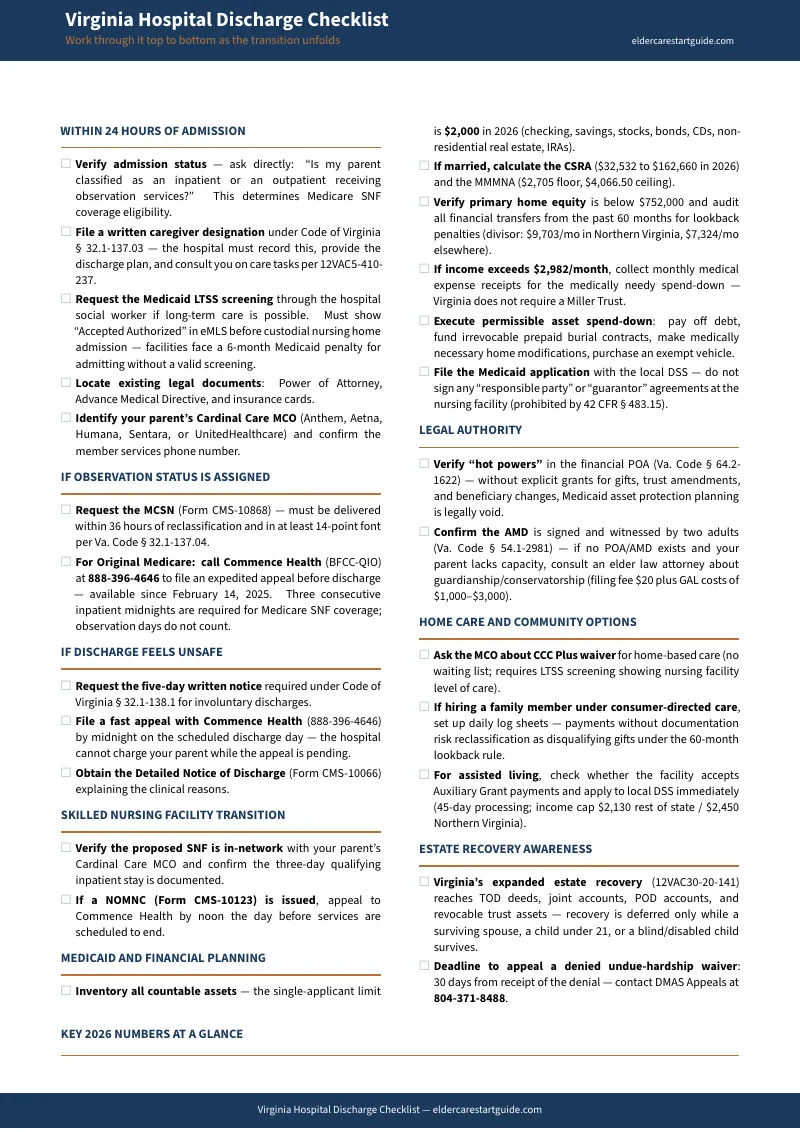
Your download includes 12 PDFs. The 47-page guide covers the full transition system: discharge rights, observation status, SNF transitions, CCC Plus waiver eligibility, Medicaid financial planning, estate recovery, and legal authority requirements. The 25-item checklist is a sequential action list you can print and work through from the first 24 hours of admission through a funded care plan. You also get 10 standalone printable worksheets — a discharge planner meeting log, observation status decision tree, UAI screening preparation worksheet, caregiver designation letter, monthly spend-down tracker, spousal impoverishment worksheet, asset inventory and spend-down planner, lookback transfer audit, legal document readiness checklist, and estate recovery exposure assessment.
Every Virginia-specific statute, regulation, and program referenced in the guide is current as of 2026. The Cardinal Care MCO roster, co-insurance rates, asset limits, spousal allowances, and penalty divisors reflect the latest published figures.
100% Satisfaction Guarantee
If the guide does not deliver the clarity and structure you expected, email us for a full refund. No forms, no time limit, no questions.
Start Protecting Your Parent Today
The hospital's discharge clock is already running. Every day without a plan is a day where decisions get made for your family instead of by your family.
Download the free Virginia Hospital Discharge Checklist to see the sequential action steps. When you are ready for the full system — scripts, templates, worksheets, and the complete Virginia-specific legal and financial framework — get the full guide and take control of this transition.
The price of a single lunch. The value of knowing exactly what to do, who to call, and what to say — before the discharge deadline hits.