
Virginia's Home Care System Has Every Answer Your Family Needs — Buried Across 30 Agencies
Your parent needs help at home. The fall happened, the diagnosis came, or you've simply watched them struggle with bathing, cooking, and managing medications for months. You started searching. You found the Department of Medical Assistance Services. Cover Virginia. The Department for Aging and Rehabilitative Services. Your local Department of Social Services. Five different Cardinal Care managed care plans. Twenty-five separate Area Agencies on Aging. Dozens of PDFs that contradict each other or show last year's numbers.
Every answer exists somewhere in that maze. The CCC Plus waiver that covers in-home care at zero cost. The Consumer-Directed option that lets a family member get paid to provide care. The $5,000-per-year home modification benefit. The spend-down rules that qualify your parent even when their income is over the limit. But nobody assembled the pieces into a single sequence — because every agency owns one fragment and refers you elsewhere for the rest.
Meanwhile, private home-care agencies charge $24 to $38 an hour. That's $4,800 to $8,500 a month out of pocket. And the lead-generation sites that show up first on Google? They're paid commissions by those same agencies. They won't mention the CCC Plus waiver because there's no referral fee in a state program.
The Virginia Home Care Navigation System
The Aging in Place in Virginia Guide is a complete administrative navigation system for the adult child coordinating a parent's home care in the Commonwealth. It consolidates every program, threshold, form, and contact into one manual — organized in the order you'll actually need it, with the exact steps that government portals bury across dozens of disconnected pages.
This isn't a list of links. It's the execution sequence: which office to call first, what to say, which form to request, which box to check, and what to do when the managed care plan tries to minimize your parent's authorized hours.
What's Inside
CCC Plus Waiver Eligibility and Application System — The Commonwealth Coordinated Care Plus waiver is Virginia's primary home-care benefit, and unlike the DD waivers, it has no waitlist. The guide walks through the full application: requesting an LTSS screening, preparing for the UAI clinical assessment, navigating the financial application through CommonHelp or your local DSS, and the critical Appendix D request that routes your application to the HCBS waiver queue instead of the general Medicaid pile.
UAI Pre-Scoring Worksheet — Virginia's Uniform Assessment Instrument is the clinical gate between your parent and funded home care. If your parent has a "good day" during the assessor's home visit — standing straighter, insisting they're fine — you risk an immediate denial. The pre-scoring worksheet lets you document your parent's functional decline across every ADL and cognitive domain on their worst day, so the official assessment reflects reality.
Medicaid Spend-Down Calculator and Tracker — Virginia is a "medically needy" state. If your parent's income exceeds $2,982 per month, they aren't disqualified — they qualify through a monthly spend-down of documented medical expenses. But HCBS waiver members must submit receipts for incurred bills, not projections. The tracker organizes co-pays, supplies, and out-of-pocket costs into a monthly submission system so your parent doesn't lose coverage over a paperwork gap.
Cardinal Care MCO Comparison and Negotiation Scripts — After CCC Plus approval, your parent is enrolled in one of five MCOs: Aetna, Anthem HealthKeepers, Humana, Sentara, or UnitedHealthcare. The guide compares network coverage by region, explains the care coordinator's role, and provides scripts for requesting clinical exceptions above the 56-hour weekly soft cap — because care coordinators are incentivized to authorize fewer hours, and knowing how to push back can mean the difference between 20 and 40 hours of weekly care.
Consumer-Directed Services Enrollment Guide — Virginia lets family members get paid to provide care through the CCC Plus waiver. Under the permanent LRI rules effective July 2025, adult children can be paid without restriction; spouses can be paid for extraordinary care up to 40 hours per week. The guide covers Fiscal/Employer Agent enrollment (PPL or CDCN), regional pay rates, the Employer of Record rules, and the critical distinction between routine and extraordinary care that determines whether a spouse qualifies.
Estate Protection and Spend-Down Strategy — The fear of losing the family home stops many Virginia families from even applying. The guide explains exactly how the primary home stays exempt (equity under $752,000, Intent to Return documented), how the spousal impoverishment rules protect up to $162,660 in joint assets, and how to convert countable resources into exempt assets — home modifications, prepaid burial, vehicle — completely legally. It also covers the Medicaid Estate Recovery protections that apply after death.
POA and Legal Authority Audit — A dementia diagnosis doesn't automatically strip your parent's capacity to sign a power of attorney. The guide includes an audit checklist for existing documents, flags the specific clauses Virginia banks and hospitals require, and explains the difference between updating documents during a lucidity window versus the $350-to-$500-an-hour Circuit Court guardianship path.
Home Modifications Funding Stack — The CCC Plus Environmental Modifications benefit covers up to $5,000 per year through the MCO. The Virginia Livable Homes Tax Credit adds up to $6,500. USDA Section 504 grants cover rural homeowners. VA housing grants cover veterans. The guide stacks every available source and ties each to specific modifications — grab bars, walk-in showers, wheelchair ramps, stairlifts — with the billing codes and contractor requirements the MCO needs.
25-Region AAA Directory and Resource Map — Every Virginia city and county mapped to its Area Agency on Aging, with direct contact numbers, service areas, and the non-Medicaid programs each administers: Meals on Wheels, senior transportation, legal aid, respite grants, and caregiver support coalitions.
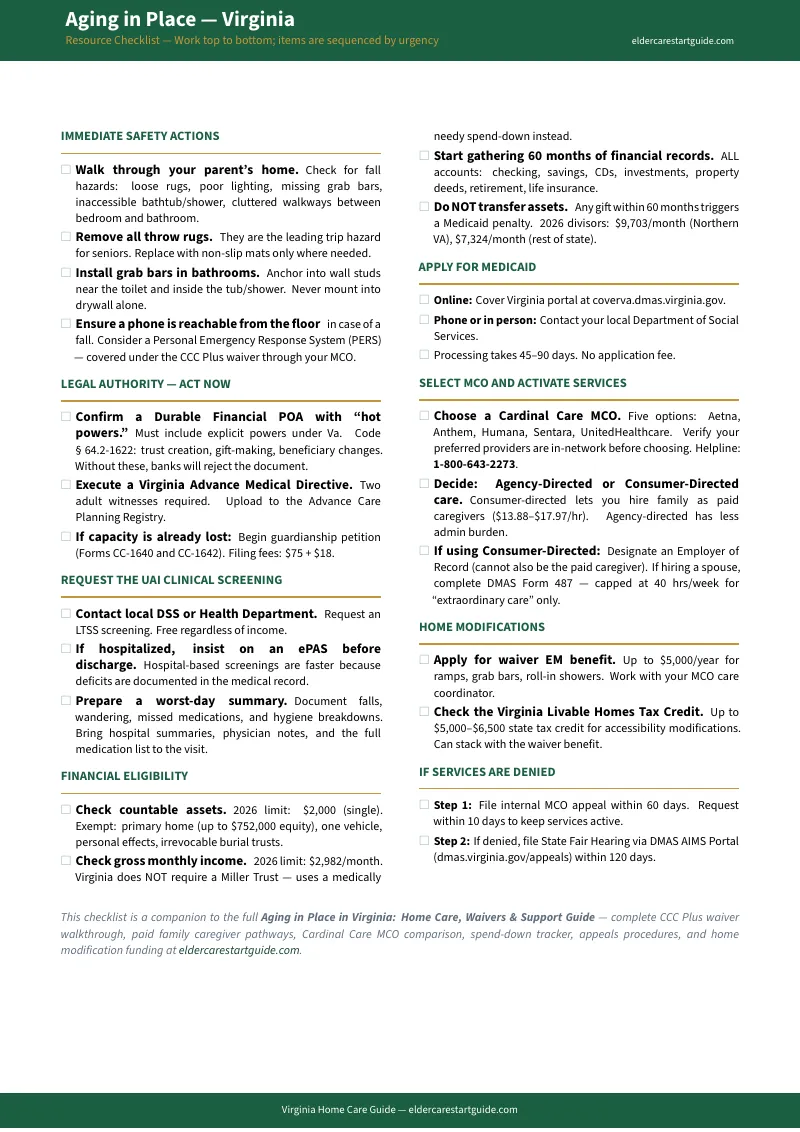
The Virginia Aging in Place Checklist — A one-page action plan covering the full sequence from initial crisis through funded home care — every call, form, deadline, and phone number at a glance.
Who This Is For
The adult child whose parent just came home from the hospital without a care plan. The discharge planner said your parent can't be alone. You have days to figure out home care before the next fall or readmission. This guide gives you the exact sequence — LTSS screening, UAI assessment, CCC Plus application — so you're not starting from zero against a discharge clock.
The family member providing unpaid care and approaching burnout. You've been handling bathing, medications, and meals for months with no financial support. Virginia's Consumer-Directed option lets you be paid through the CCC Plus waiver — the guide covers the full enrollment path, the pay rates, and the paperwork.
The out-of-state adult child coordinating from a distance. Your parent lives in Richmond or Hampton Roads; you live in New York or D.C. You can't visit the DSS office in person. The guide maps every phone number, form, and online portal so you can coordinate their care remotely.
The family watching private-pay costs drain their parent's savings. At $32 an hour, 40 hours a week, your parent's savings will be gone in months. The guide shows you exactly how to qualify for the CCC Plus waiver before the money runs out — and how to execute a legal Medicaid spend-down if your parent is over the income limit.
Why Not Free Government Websites?
The rules are public. They're scattered across DMAS, Cover Virginia, DARS, 25 AAAs, five MCOs, and dozens of PDFs — many with outdated thresholds. The DSS site explains financial eligibility but doesn't link it to the MCO care coordination process. The MCO sites explain their networks but don't explain how to prepare for the UAI screening that determines whether your parent qualifies in the first place. Cover Virginia's phone system routes you through menus that assume you already know which program you need.
This guide isn't a list of links. It's the execution sequence that connects every fragment into one path — with pre-scoring worksheets, negotiation scripts, spend-down trackers, and deadline maps that the government sites were never designed to provide.
Why Not an Elder-Law Attorney?
For complex asset restructuring or contested guardianship, you need one. Virginia elder-law firms charge $350 to $500 an hour, with comprehensive planning packages running $3,000 to $10,000. This guide makes those billable hours dramatically cheaper. Attorneys spend their first expensive hours gathering documents, explaining thresholds, and reviewing the same eligibility rules you could have understood beforehand. Walk in with your parent's financial records organized, their UAI pre-scored, and their legal documents audited — and the attorney starts on strategy instead of education.
100% Satisfaction Guarantee
If the guide doesn't help your family navigate Virginia's home-care system, email [email protected] for a full refund. No questions, no time limit.
— Less Than One Hour of Home Care
A single hour of private-pay home care in Virginia costs $24 to $38. The CCC Plus waiver covers that same care at zero cost — if you know how to apply. Download the free Virginia Aging in Place Checklist to see the full action sequence, or get the complete guide with every worksheet, template, and script your family needs to navigate the system.