Your Parent Needs More Help. Virginia's Care System Has Four Agencies and Nobody Gave You the Map.
Your parent fell last week. Or maybe it wasn't a fall — maybe it was the third burned pot on the stove this month, or the neighbor called because your parent was wandering the cul-de-sac at dusk. Something shifted, and now you're awake at 2 AM searching "assisted living in Virginia" while trying to figure out how any of this works.
You called the Department of Social Services about assisted living. They told you to contact the Department of Health for nursing homes. You called DMAS about Medicaid waivers and got transferred twice. You discovered that Virginia has four separate agencies overseeing different parts of the care system — DSS, VDH, DMAS, and DARS — and none of them explain how to navigate the others. You found out your parent might qualify for the CCC Plus waiver, but nobody mentioned the Auxiliary Grant that covers assisted living room and board. And a "free" senior placement service called you back within minutes — because they earn thousands in commissions from every facility referral and have zero incentive to tell you about public programs.
Meanwhile, the hospital discharge planner wants your parent's facility preferences by tomorrow morning. The care decisions you make in the next few weeks will shape their quality of life and your family's finances for years.
The Virginia Care Decision Navigation System
This is not a list of phone numbers you can find on the DARS website. It is the decision process around the system — the part that elder law attorneys explain for $300 to $500 an hour and that state agency portals scatter across four separate websites.
The guide walks you through every decision in the order it actually arrives: recognizing when your parent's needs have outgrown their current situation, understanding what each care level provides and costs in Virginia, evaluating facilities using the state's own inspection records, navigating Medicaid Cardinal Care eligibility and the CCC Plus waiver, protecting family assets through the medically needy spend-down, and securing the legal authority you need before a crisis removes your options. Every threshold, every deadline, every contact is specific to Virginia.
What's Inside
- How Virginia's Four-Agency System Actually Works — DSS licenses assisted living facilities. VDH certifies nursing homes. DMAS runs Medicaid and the CCC Plus waiver. DARS coordinates the Auxiliary Grant and Long-Term Care Ombudsman. Understanding which agency handles what before you pick up the phone saves weeks of dead-end calls and transfers. The guide maps the complete regulatory landscape so you know exactly where to go for every question.
- At-Home UAI Pre-Screening Worksheet — A printable structured tool modeled on Virginia's Uniform Assessment Instrument (UAI). Document your parent's IADL and ADL deficits, cognitive safety concerns, and hours of daily care needed — so you walk into the state assessment with accurate data instead of underreporting your parent's needs and getting screened out of programs they qualify for.
- Care Setting Comparison — What Virginia Licenses at Each Level — Home care versus home health. Assisted living (Residential versus Assisted Living tiers under 22VAC40-73). Memory care "safe, secure environments" with their specific staffing and exit-security requirements. Skilled nursing facilities under VDH. The guide explains what each setting covers, what it costs, and which Virginia rules govern it — including the prohibited conditions that disqualify someone from ALF placement and trigger a nursing facility transfer.
- Facility Safety Inspector Matrix — Questions Administrators Hope You Don't Ask — A printable tour sheet: night and weekend staffing ratios, involuntary discharge criteria and appeal rights, medication management, Auxiliary Grant acceptance, CCC Plus participation, and the annual UAI re-evaluation. Plus the contract provisions to insist on before signing — because the marketing brochure and the admission agreement are not the same document.
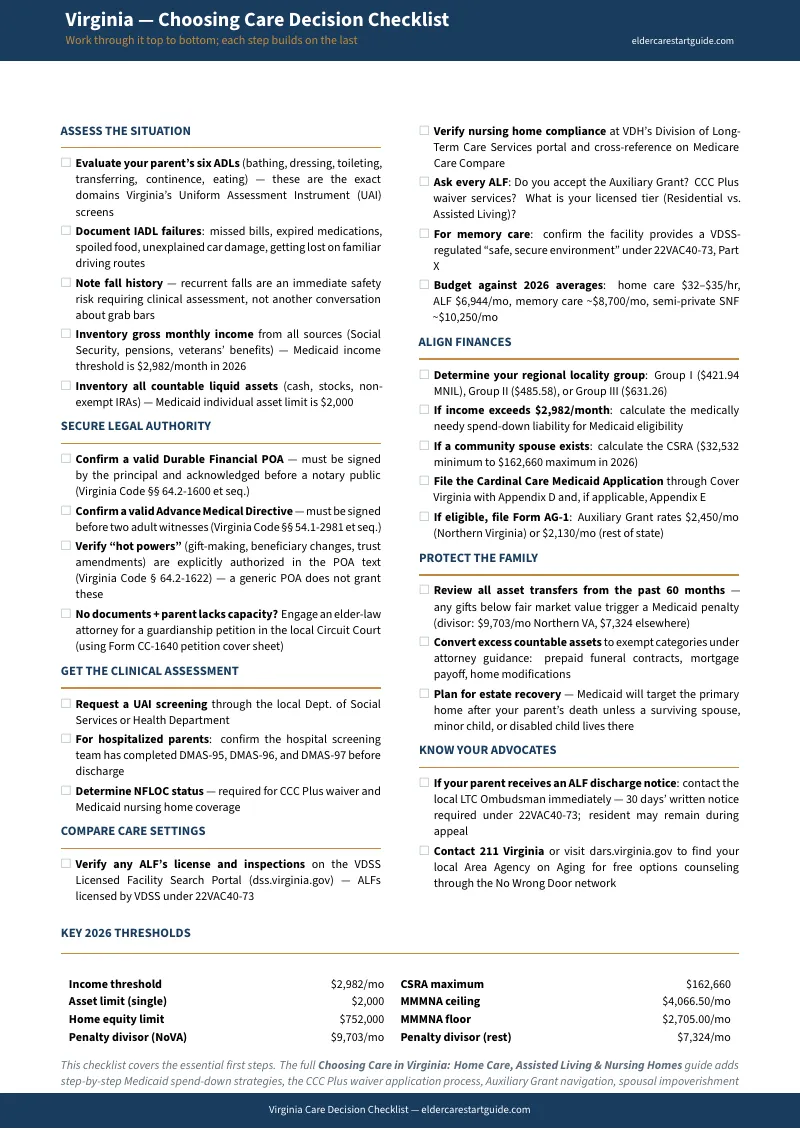
- 2026 Cost Breakdown by Care Setting — Current median costs for home care ($6,100–$6,700/month at 44 hours/week), assisted living ($6,944/month), memory care ($8,700/month), and skilled nursing ($10,250/month). Regional cost disparities — Harrisonburg at $3,725/month for assisted living versus Blacksburg at $7,282. The Facility Comparison Tracker lets you log costs, licensing, Auxiliary Grant acceptance, and CCC Plus network status for up to six facilities — because many families overpay for in-home care when residential care would be both safer and cheaper.
- CCC Plus Waiver — Virginia's Primary Home Care Funding — The complete eligibility walkthrough: the $2,982 monthly income cap, the $2,000 asset limit, the nursing-facility-level-of-care functional requirement. Service caps (56 hours per week for personal care, 480 hours per year for respite, $5,000 per year for environmental modifications). The difference between agency-directed care (coordinated through a licensed provider) and consumer-directed care (you hire and manage the caregiver directly — often at significantly lower hourly rates). Understanding this program before talking to a placement agency matters, because placement agencies earn commissions from facilities and have no financial incentive to tell you about public home care alternatives.
- The Auxiliary Grant — Assisted Living for Low-Income Families — Virginia's state-funded supplement that covers room and board in licensed ALFs. The 2026 maximum monthly rate is $2,130 statewide and $2,450 in Planning District 8 (Northern Virginia), plus an $87 personal needs allowance. The 90-day residency requirement and its family-member waiver, and the $2,000 asset limit, still apply. Most families never hear about this program from placement agencies because Auxiliary Grant rates pay less than private-pay rates. The guide shows you how to find ALFs that accept the grant and how to apply through your local DSS office.
- Medicaid Spend-Down — Virginia's More Favorable Path — Virginia is a medically needy spend-down state, which means there is no Miller Trust requirement. If your parent earns more than $2,982 per month, they can still qualify for Medicaid by spending the excess on qualifying medical and care expenses. The guide covers which expenses count, how the monthly patient pay calculation works, and how the spend-down interacts with spousal impoverishment protections — the $162,660 Community Spouse Resource Allowance, the $2,705 Minimum Monthly Maintenance Needs Allowance, and the shelter cost adjustment.
- Asset Protection and the 60-Month Look-Back — Virginia enforces a strict five-year look-back period. Any assets transferred below fair market value within that window trigger a penalty period of Medicaid ineligibility. The guide covers the penalty divisor ($9,703/month in Northern Virginia, $7,324 in the rest of the state), the limited gifting exception ($4,000/year for established patterns), the home equity exemption ($752,000 cap with intent-to-return rules), and the estate recovery program. These are the numbers your parent's planning decisions depend on — and getting them wrong can cost the family home.
- Legal Authority — POA, Advance Directives, and Guardianship — If your parent still has capacity: the Durable Financial Power of Attorney under Virginia's Uniform Power of Attorney Act (presumed durable, notarized, effective immediately) and the Advance Medical Directive under the Health Care Decisions Act (two witnesses, neutral parties preferred). If capacity is already gone: the full guardianship and conservatorship petition process in Circuit Court — including the costs, timeline, and ongoing reporting obligations that make court proceedings a last resort.
- Crisis Timeline — The Hospital Discharge Sequence — Your parent's right to appeal a discharge, what to demand from the hospital social worker, how to expedite a hospital-based LTSS screening, and how to bridge the gap when home care services or facility placement aren't immediately available. This chapter exists because most families face their biggest care decision during the worst possible moment — a 48-hour discharge window with no plan in place.
Who This Is For
- Adult children whose aging parent is declining and who need to determine the right care level — home care, assisted living, memory care, or skilled nursing — under Virginia's specific regulatory system
- Families trying to qualify a parent for Medicaid long-term care and navigating the medically needy spend-down, the CCC Plus waiver, or the Auxiliary Grant
- Caregivers who need to evaluate assisted living or nursing home facilities and want to verify licensing through DSS or VDH, read inspection histories, and ask the right questions on tours
- Families facing a hospital discharge and needing to make placement decisions under pressure — with no existing care plan
- Anyone who needs legal authority to manage a parent's care and finances but isn't sure whether a Power of Attorney is still possible or if guardianship is the only option
- Distance caregivers outside Virginia trying to coordinate care in a state system they don't understand — often after discovering during a holiday visit that their parent is concealing decline
Why Not Free Government Resources?
DSS publishes licensing standards. DMAS has waiver fact sheets. DARS lists Auxiliary Grant eligibility rules. The No Wrong Door network offers options counseling.
Here is what none of them provide:
- A decision sequence that tells you what to evaluate first, what to apply for second, and what documents to have ready at each step — not four separate agency websites organized by department
- The CCC Plus waiver explained alongside the Auxiliary Grant so you understand that one pays for care services and the other pays for room and board — and that most families need both for an assisted living placement to be affordable
- The medically needy spend-down process explained in plain language — which expenses qualify, how the patient pay is calculated, and how the process differs from states that require a Miller Trust
- A facility evaluation framework that uses the same licensing standards DSS and VDH enforce — so you can read inspection reports, identify recurring violations, and ask questions administrators would rather you didn't
- The complete spousal impoverishment protection analysis — CSRA, MMMNA, shelter cost adjustment, and home equity exemption — so the community spouse isn't left with nothing
State agencies administer programs. Elder law attorneys explain them at $300 to $500 per hour. This guide bridges the gap — translating hundreds of pages of Virginia Administrative Code, DMAS manuals, and DSS licensing standards into a sequence you can work through in an evening.
Satisfaction Guarantee
If the guide doesn't give you a clearer path forward for your parent's care in Virginia, email [email protected] for a full refund — no time limit.
— Less Than One Hour of an Elder Law Attorney's Time
An initial consultation with a Virginia elder law attorney runs $300 to $500. A Medicaid planning engagement can exceed $5,000. A guardianship proceeding adds thousands more in court costs and legal fees.
This guide won't replace an attorney for complex trust litigation or multi-state asset restructuring. But for the care-level assessment, facility vetting, Medicaid eligibility analysis, waiver applications, and Auxiliary Grant process that most Virginia families need, it covers the full navigation at a fraction of the professional cost — and if you do need an attorney, you'll walk in with organized records and the right questions instead of starting from zero.
Start with the free checklist to see if the approach fits your situation. The full guide goes deeper — every threshold, every contact, every strategy, every agency.