Your Parent Needs Long-Term Care in Vermont. The System Won't Tell You How to Pay Without Losing Everything.
You're staring at nursing home bills of $13,000 to $15,000 a month. Your parent's savings will vanish in under a year. And somewhere between the state agency forms, the caseworker voicemails, and your sibling's opinion, you need to figure out whether Medicaid will help — and whether applying will cost you the family home.
Vermont's Choices for Care program can cover nursing homes, assisted living, and home-based care under one Medicaid waiver. But the state's own website won't tell you how to structure your parent's finances to qualify. Caseworkers are legally prohibited from advising you on asset protection. And elder-law attorneys charge $300 to $500 an hour for what often starts as basic document gathering.
The Choices for Care Transition Blueprint
This guide is a chronological, step-by-step system for navigating Vermont Medicaid long-term care — from your first eligibility screening through application approval, spousal protections, and estate recovery shielding. It's the bridge between the raw policy on DVHA's website and the $5,000 attorney retainer you're trying to avoid.
Instead of piecing together fragments from state agency PDFs, you get a single action sequence: assess eligibility, organize 60 months of financial records, calculate your exact spend-down, protect the community spouse's income, submit a clean application, and shield the family home from post-death recovery.
What's Inside — 10 PDFs
- Complete 11-Chapter Guide (guide.pdf) — Choices for Care tiers, financial eligibility, the 60-month lookback, spend-down strategies, spousal protections, Form 202LTC walkthrough, estate recovery shielding, care settings comparison, legal authority, and professional referral
- Eligibility Calculator (eligibility-calculator.pdf) — Fillable worksheet for income and asset calculations against 2026 Vermont thresholds, with Vermont's spend-down model explained
- Spousal Protection Calculator (spousal-protection-calculator.pdf) — Step-by-step CSRA and MMNA worksheets for married couples, with 2026 floor/ceiling reference
- Five-Year Lookback Audit (lookback-audit.pdf) — Transfer log, penalty calculation worksheet, and common lookback traps specific to Vermont's $417.84 daily penalty divisor
- Penalty-Free Spend-Down Planner (spend-down-planner.pdf) — Checklist of Vermont-approved strategies to reduce countable assets without triggering penalties
- Estate Recovery Worksheet (estate-recovery-worksheet.pdf) — Asset vulnerability assessment for probate-only recovery, homestead exemption checklist with DVHA Forms 13/14/15 references, and the 2026 Rule 4.108 changes
- Care Settings Comparison Matrix (care-settings-comparison.pdf) — Side-by-side comparison of nursing facilities, ALRs, RCHs, home-based care, Adult Family Care, and Moderate Needs services
- Asset Inventory Worksheet (asset-inventory-worksheet.pdf) — Categorized inventory of liquid assets, retirement accounts, real property, vehicles, and insurance with countable/exempt status
- Application Document Checklist (application-document-checklist.pdf) — Every document needed for Form 202LTC, organized by category with filing channel contacts
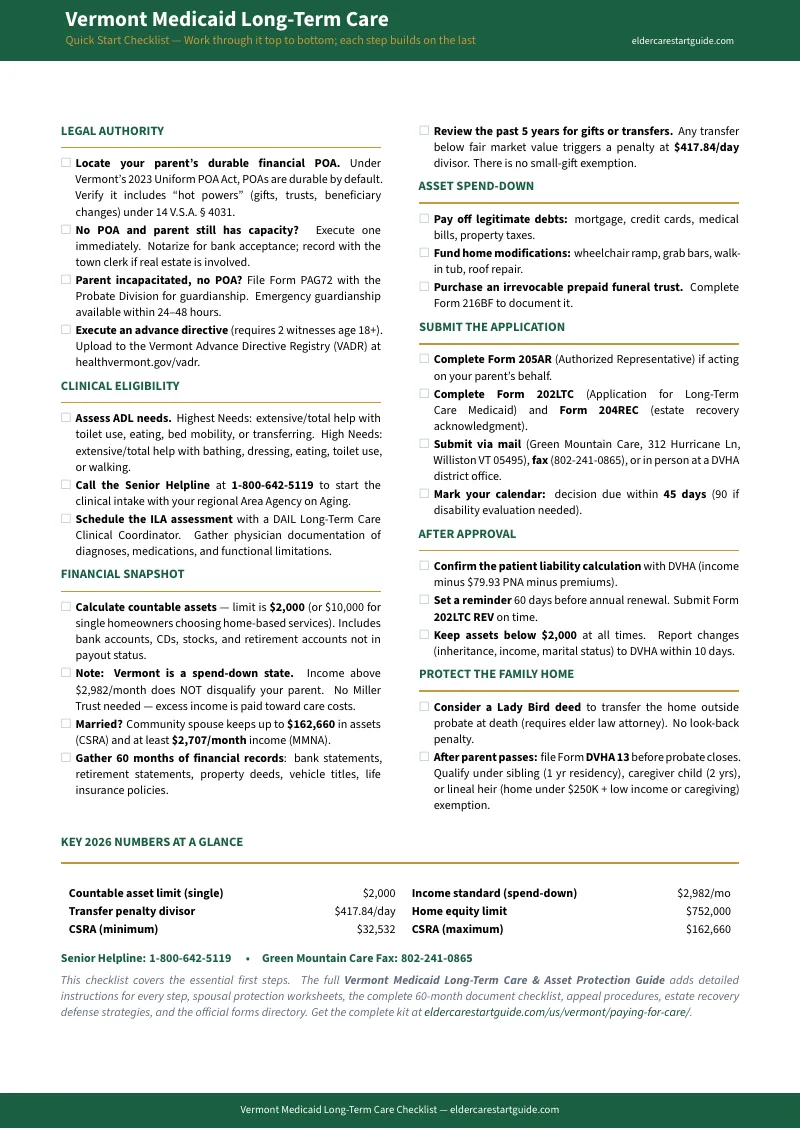
- Quick-Start Checklist (checklist.pdf) — 20-item action checklist across 8 steps, from eligibility screening through application submission
Who This Is For
- Adult children managing a parent's transition to nursing home, assisted living, or home-based long-term care in Vermont
- Spouses trying to protect household income and savings when a partner enters a facility
- Families who discovered the 60-month lookback after making gifts or transfers they didn't realize would trigger penalties
- Anyone hitting the Medicare Day 100 cliff and facing sudden private-pay rates with no plan
Why the State Website Isn't Enough
DVHA publishes the raw forms and eligibility rules. What they don't provide:
- A chronological action plan that tells you what to do first, second, third — not just what the rules are
- Strategic guidance on how to legally structure a spend-down (caseworkers cannot advise on this — it's outside their role)
- The 2026 estate recovery rule changes and how the new exemption forms actually work in practice
- Annotated walkthroughs of the 202LTC application — the state PDF is 12 pages of fields with no context
- Spousal protection calculations specific to your income and asset situation
National directories like Medicaid Planning Assistance and Caring.com provide templated overviews that lag behind Vermont's regulatory changes. The March 2026 estate recovery rewrite (Rule 4.108) introduced a $7,500 estate floor and new exemption forms that most generic guides haven't incorporated.
60-Day Satisfaction Guarantee
If the guide doesn't give you a clear path forward within the first week, email us and we'll refund every cent. No forms, no justification required.
Start With the Free Eligibility Checklist
Download the Vermont Choices for Care Triage Checklist — a one-page clinical and financial eligibility assessment you can complete in 15 minutes. It covers the clinical level-of-care criteria, 2026 financial thresholds, and submission contact information. No email sequence, no sales pressure — just clarity on whether your parent might qualify.
When you're ready for the full transition blueprint — the annotated application walkthrough, spend-down strategies, spousal worksheets, and estate recovery shielding kit — the complete guide is .