
Your Parent's Capacity Is Fading. Vermont's Legal System Won't Wait for You to Figure It Out.
The hospital discharge planner needs someone authorized to choose a facility and sign the admission contract. The bank branch manager won't let you access your parent's checking account to pay for home care. The DVHA caseworker is ready to process the Choices for Care Medicaid application — but she needs an authorized representative to sign the 202LTC and attend the DAIL clinical assessment. You don't have a power of attorney. Nobody brought it up when things were stable.
Now you're Googling "power of attorney Vermont" at 11 PM, and the free forms you're finding don't explain the execution requirements, the real estate witness-and-notary split, or what happens when the bank rejects the document anyway. An elder law attorney in Burlington charges $300 an hour. And if your parent has already lost capacity, you're looking at a probate court guardianship that takes weeks, strips your parent of civil rights, and permanently disqualifies you from being paid as their caregiver under Flexible Choices.
— The Vermont Legal Authority Sequence
This is the Vermont Legal Authority Sequence — a step-by-step guide that takes you from "I need legal authority over my parent's affairs" through every document, filing, and institutional acceptance barrier specific to Vermont. It's not a stack of blank forms. It's the complete procedural roadmap: which documents to execute, how to execute them under Vermont's exact statutory requirements, how to get institutions to accept them, and what to do when capacity is already gone.
It bridges the four agencies that Vermont families have to navigate separately — the Vermont Ethics Network for healthcare directives, the Legislature's statutory portal for financial POA law, DVHA for Choices for Care applications, and the Vermont Judiciary for guardianship packets — into one sequential process organized by what you need to do next.
What's Inside
- Durable Financial POA Execution Walkthrough — Vermont's Uniform Power of Attorney Act (14 V.S.A. Chapter 127) step by step. Which powers to grant. How Vermont treats all POAs as durable by default. The mandatory agent acceptance of appointment under § 4051 — without which the agent has no legal authority. The notary acknowledgment for the statutory presumption of genuineness. And the real estate exception: if the agent will sell or mortgage property, the document must be notarized, witnessed by at least one person (who is not the notary), and recorded in the town clerk's land records under 27 V.S.A. § 305.
- Advance Directive for Health Care — Vermont does not recognize a standalone "medical power of attorney." Medical decision-making is integrated into a unified Advance Directive under 18 V.S.A. Chapter 231. The kit covers the execution requirements: two or more adult witnesses who cannot be the appointed agent, alternate agent, spouse, parent, sibling, child, or grandchild. Plus the nursing home explanation rule — if your parent is being admitted to or resides in a care facility, the directive is legally ineffective unless an ombudsman, clergy member, Vermont attorney, or probate court designee explains it and signs a statutory affirmation.
- Bank Acceptance Enforcement Kit — Vermont banks routinely demand their own proprietary POA forms. Under 14 V.S.A. § 4020, they cannot reject a validly executed, acknowledged POA. They must accept it or request a certification within seven business days, then accept within five days after receiving it. Wrongful refusal exposes the bank to a court order and liability for your attorney's fees. The kit includes the exact statutory citations and escalation language to force compliance without hiring a lawyer.
- Choices for Care Signing Authority Map — which POA powers unlock which state benefits applications. How to sign the 202LTC long-term care Medicaid application as the authorized representative. How to navigate the $2,000 asset limit ($5,000 with the homeowner disregard), the $752,000 home equity exemption, and the spend-down strategy for income above the $2,982 monthly threshold. Community Spouse Resource Allowance protections up to $162,660. Monthly Maintenance Needs Allowance of at least $2,705 (effective July 2026).
- Flexible Choices Caregiver Pay Trap Avoidance — the kit's most financially consequential section. Vermont's Flexible Choices converts a Choices for Care allocation into a monthly cash allowance that can hire family members as paid caregivers. But court-appointed guardians and spouses are permanently disqualified. A valid POA preserves eligibility. Guardianship destroys it. The kit shows exactly how to structure co-agents and successor POAs to maintain legal authority without losing thousands in monthly caregiver compensation.
- Co-Agent and Sibling Safeguard Provisions — under Vermont law, co-agents can act independently by default. The kit covers how to use special instruction clauses to restrict self-dealing, limit gifting authority under § 4047, and mandate monthly financial reporting to siblings — turning potential conflict into structured accountability.
- Probate Court Guardianship Process Guide — when capacity is gone and no POA exists, the only path is involuntary guardianship under 14 V.S.A. Chapter 111. The kit covers total vs. limited guardianship, Guardian of the Person vs. Guardian of the Estate, the court-appointed attorney and mental health evaluation requirements, bonding obligations, annual reporting, and emergency guardianship under § 3069 for situations involving immediate danger (30-day ex parte orders).
- Capacity Assessment Framework — a dementia diagnosis does not destroy legal capacity in Vermont. The standard is whether the principal understands the nature of the document and can identify the person they're appointing. The kit provides a practical assessment protocol, guidance on scheduling the signing during the parent's best time of day, and documentation strategies to protect the document's validity.
- Decision Flowchart and Timeline Planner — can your parent still sign? Execute POA now. Cannot sign? Evaluate emergency vs. full guardianship. POA exists but the bank is rejecting it? § 4020 escalation path. Week-by-week timeline planner with every step, deadline, and filing location.
- 9 Standalone Printable Worksheets — capacity assessment pathway worksheet, document readiness tracker, bank acceptance enforcement kit (bring to the bank), guardianship court process map, Choices for Care application checklist, forms and fees reference, Vermont agency contact directory (keep by the phone), POA vs. guardianship comparison card, and a visual decision flowchart.
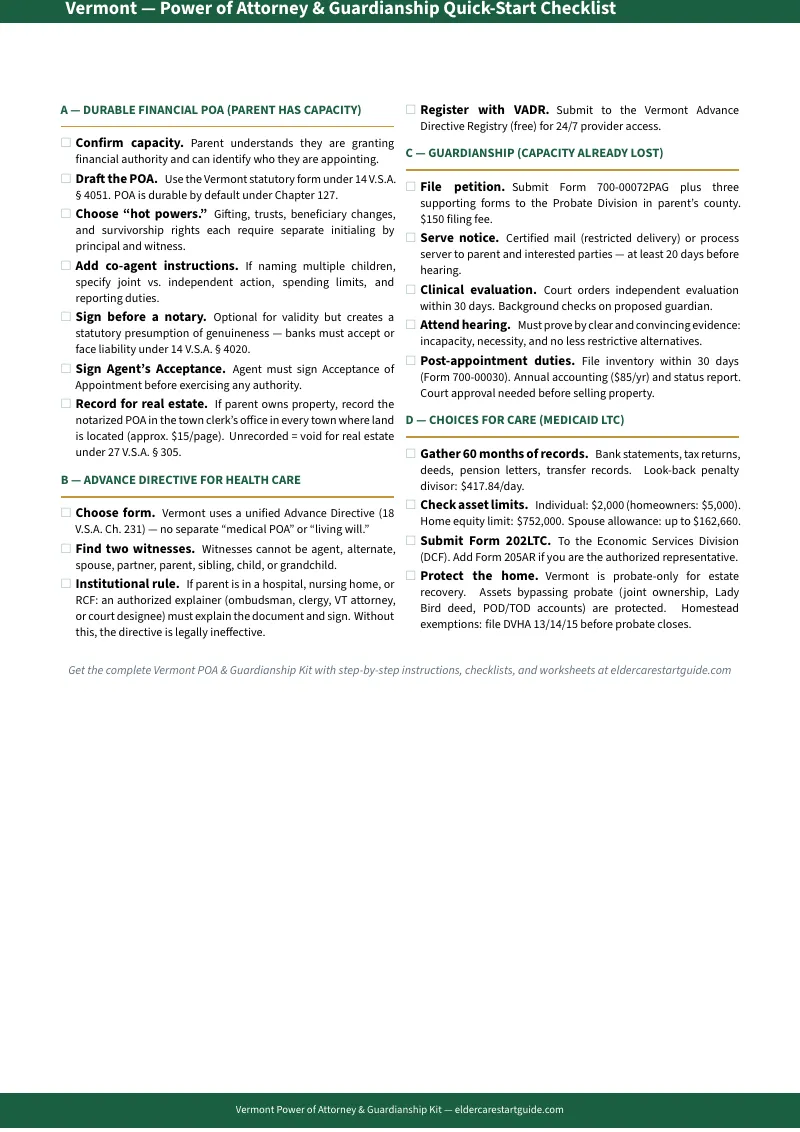
- Free Quick-Start Checklist — a one-page overview of the 20 critical steps from recognizing the need for legal authority through execution, institutional acceptance, and Medicaid enrollment.
Who This Is For
- Adult children who need legal authority to manage an aging parent's finances, healthcare decisions, real estate, or state benefits applications in Vermont
- Families facing a parent's declining capacity who want to avoid the cost, delay, and civil rights loss of probate court guardianship
- Caregivers applying for Choices for Care who need signing authority for the 202LTC and DAIL clinical assessments
- Adult children dealing with bank refusals, hospital bureaucracy, or institutional resistance to valid POA documents
- Family caregivers who need to preserve Flexible Choices paid caregiver eligibility while maintaining legal authority over a parent's affairs
Why Not Just Use Free Vermont Resources?
You can find pieces of this information across Vermont's state websites. Healthcare advance directive forms are on the Vermont Ethics Network. Financial POA statutes are on the Legislature's portal. Choices for Care applications are on the DVHA site. Guardianship petition forms are on the Vermont Judiciary portal. Each agency covers its own piece. None of them explain how the pieces connect — when you need which document, in what order, and what happens when an institution refuses to accept it.
National form aggregators like eForms charge $39 per month for generic templates that miss Vermont-specific requirements — the real estate notary/witness split under § 305, the nursing home explanation rule for advance directives, the agent acceptance of appointment under § 4051. A missing step doesn't show up until a bank rejects the document or a court questions the directive's validity.
Local elder law attorneys provide comprehensive guidance — at $250 to $400 per hour. For complex estates, contested family situations, or irrevocable trust planning within the 60-month look-back window, that's money well spent. For standard family caregiving situations where the parent has capacity and the family is in agreement, this kit covers the same ground for a fraction of the cost of a single consultation.
Satisfaction Guarantee
If the kit doesn't help you navigate Vermont's legal authority process more confidently, email us within 30 days for a full refund. No forms, no questions.
Get Started Now
Download the free Quick-Start Checklist to see the 20 critical steps at a glance. When you're ready for the full process — the POA execution walkthrough, the bank acceptance enforcement kit, the Choices for Care signing authority map, and the guardianship avoidance guide — get the complete Vermont Legal Authority Sequence.