
Vermont's elder care system wasn't designed for you to figure out alone
Your parent needs help at home. Maybe it started with a fall, or the dishes piling up, or a diagnosis that changed everything overnight. Now you're staring at a maze of state programs — Choices for Care, Moderate Needs Group, Attendant Services — each with its own income limits, asset rules, clinical assessments, and waitlists. One wrong step and you're looking at a 90-day application delay, a missed waitlist priority window, or an estate recovery claim against the family home.
The state's free resources give you pieces. A PDF here, a helpline number there, a form with no instructions. What they don't give you is a system — a single place that connects every Vermont-specific rule, calculation, and deadline into a sequence you can actually follow.
The Vermont Home Care Navigator — every waiver, exemption, and hiring step in one workbook
This is the guide families use to stop researching and start acting. It walks you through the full Choices for Care system — from the initial ILA clinical assessment through financial eligibility to choosing among Traditional Home-Based, Flexible Choices, Adult Family Care, and Enhanced Residential Care settings. Every threshold, every formula, every form reference is Vermont-specific and current for 2026.
What's inside
- Choices for Care eligibility walkthrough — the exact 2026 income ($2,982/month) and asset ($2,000 individual, $10,000 for single homeowners choosing HCBS) limits, plus how the clinical assessment determines your parent's tier
- Medically Needy spend-down tracker — Vermont has no rigid income cap for long-term care Medicaid, and you don't need a Miller Trust. The guide includes a monthly worksheet to track medical expenses against the Protected Income Level ($1,375 outside Chittenden County, $1,483 inside)
- Moderate Needs Group calculator — the state's exact adjusted-income formula (divide countable assets above $10,000 by 12, add to monthly income, then deduct medical expenses) with a step-by-step worksheet so you can estimate eligibility before applying
- Consumer-directed hiring toolkit — how to set up care through ARIS Solutions as fiscal agent, who can and cannot be a paid caregiver (friends and adult children yes, spouses and legal guardians no), sample employment agreement, and background check instructions
- Caregiver vetting checklist — because Vermont doesn't license non-medical home care agencies, the guide walks you through checking the Adult Abuse Registry, Child Protection Registry, VCIC criminal records ($30), and DMV driving records yourself
- Estate recovery protection kit — which DVHA forms to file (13, 14, 15) to secure the Caregiver Child Exemption, Sibling Exemption, or Low-Income Lineal Heir Exemption, plus how the proposed Rule 4.108 rewrite changes the hardship floor from $2,000 to $7,500
- Home modification funding guide — HAP ($15,000 lifetime cap), Sue Williams Freedom Fund ($1,500), USDA Section 504 ($10,000 for 62+), and the CFC $777/year allowance, with a prioritized application sequence
- Respite grant navigator — Dementia Respite Grants (up to $1,500), NFCSP grants ($1,000–$2,000), CFC respite allocation, and VA respite (30 days/year), with draft application language
- Community resource directory — SASH program enrollment, AAA contacts for all five regions, Meals on Wheels, E&D transportation, Trualta caregiver training platform, and crisis helplines
Who this is for
- Adult children helping a parent stay safely at home in Vermont — whether you're managing from across town or across the country
- Families navigating a first Choices for Care application or dealing with a waitlist for High Needs or Moderate Needs services
- Caregivers hiring private-duty help and needing to vet candidates in a state that doesn't require agency licensing
- Anyone worried about protecting the family home or camp from Medicaid estate recovery
Why the free resources aren't enough
Vermont's Area Agencies on Aging publish directories. DVHA posts forms. Elder-law firms explain the rules in $300-to-$500-per-hour consultations. But none of these sources connect the dots for you. The AAA directory doesn't tell you how to calculate your MNG adjusted income. The DVHA forms don't explain which exemption applies to your situation. The law firm's blog stops at general principles — the specifics cost a retainer.
This guide sits in the gap. It takes the same information those professionals use and organizes it into worksheets, calculators, and step-by-step instructions you can work through at your kitchen table. It doesn't replace an attorney for complex asset restructuring — but it means you walk into that consultation prepared, saving hours of billable time explaining the basics.
The free checklist gets you started tonight
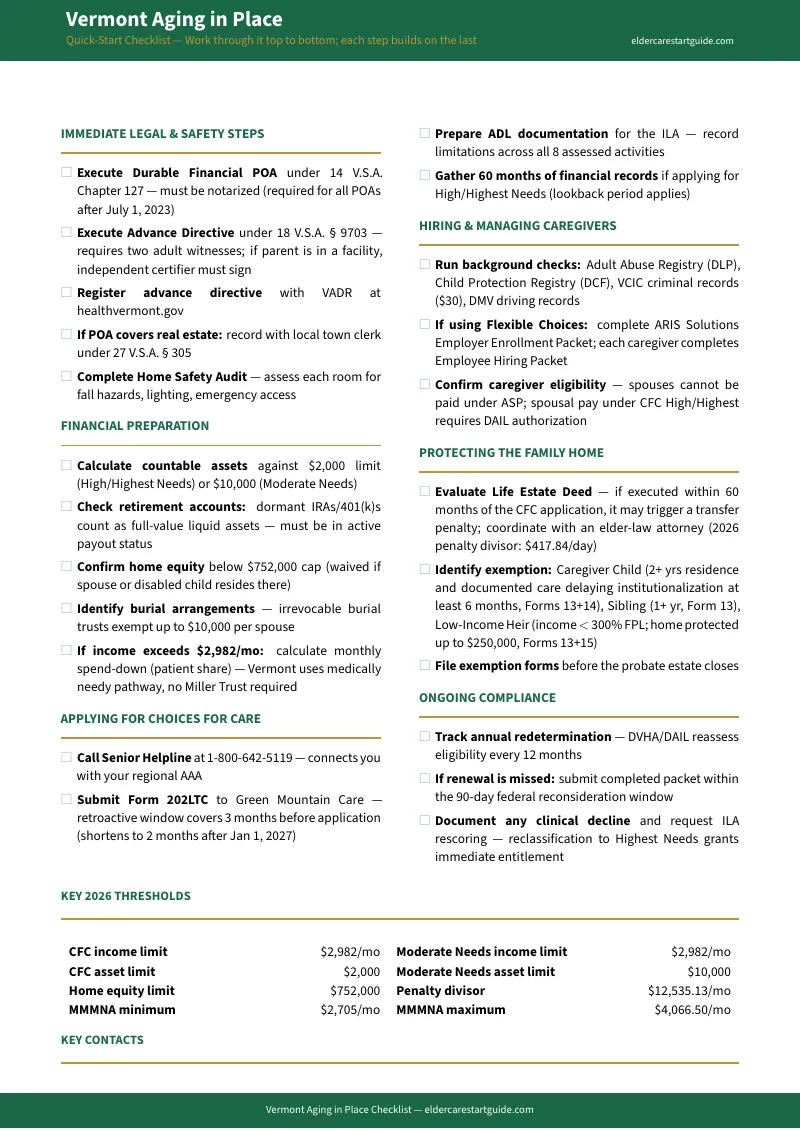
Download the free Vermont Aging in Place Resource Checklist — a one-page summary of the key programs, contacts, and first steps. It covers the essentials: which helpline to call, what documents to gather, and how to start a basic home safety audit. When you're ready for the full system — the calculators, the hiring toolkit, the estate protection forms — the complete guide picks up where the checklist leaves off.
Satisfaction guarantee: If the guide doesn't help you build a clearer plan for your parent's care, email us and we'll refund you. No forms, no waiting period.
Your parent's safety plan shouldn't depend on how many browser tabs you can keep open. Get the toolkit and turn scattered state resources into a single action plan — for less than one hour of a care manager's time.