Your parent needs more care than you can provide alone — and Vermont's elder care system is split across agencies that don't talk to each other.
Maybe a hospital discharge planner just told you your parent cannot go home safely. Maybe you have been managing care at home for months and the arrangement is falling apart — the aide hours are not enough, the wandering is getting worse, the family is arguing. Either way, you are now expected to navigate a system that runs through DAIL, DVHA, five separate Area Agencies on Aging, the Division of Licensing and Protection, and the Long-Term Care Ombudsman — with no single guide that tells you what to do first.
The "free" referral services are not going to help. A Place for Mom, CarePatrol, and the local placement advisors earn commissions from the facilities they recommend — often the equivalent of a full month's rent. They will steer you toward expensive, private-pay communities in their partner networks. They will never mention the Choices for Care waiver, the Moderate Needs Group that can cover services before your parent hits the nursing home threshold, or the Adult Family Care shared-living model that could keep your parent in a home setting at a fraction of facility costs.
The Vermont Care Transition System — every agency, threshold, and deadline mapped into one sequential plan.
The Choosing Care in Vermont Guide replaces the scattered government websites, the contradictory advice, and the conflicted referral calls with a single, independent roadmap. It is organized in the order you will actually need it: assess your parent's care needs using functional ADL criteria, compare every care setting with Vermont-specific cost data, navigate the Choices for Care waiver application step by step, vet facilities using DLP inspection records, and protect the family home from Medicaid estate recovery.
No placement commissions. No data harvesting. No sales calls. Just the information you need, in the order you need it, for .
What's Inside
- The complete guide (guide.pdf) — the 12-chapter Vermont Care Transition System: warning signs, every care setting under Vermont's consolidated licensing rules (ALR, Level III RCH, Level IV RCH, SNF), the Choices for Care waiver pipeline, Medicaid eligibility and spend-down, look-back penalties, estate recovery, advance directives and the VADR, hospital discharge QIO appeals, facility quality vetting, cost comparisons, worksheets, and key contacts.
- Care Needs Assessment Framework — printable ADL/IADL scores for a typical day and a worst day, with incident documentation prompts to prepare for the DAIL clinical assessment.
- Care Setting Comparison Worksheet — license-class match across home care, adult day, Level III RCH, Level IV RCH, ALR, memory care, and nursing home, with a write-in quote comparison using Vermont rates.
- Monthly Care Cost Projection — home care vs assisted living vs nursing home side by side, plus months-of-private-pay runway before Medicaid becomes necessary.
- Medicaid Eligibility Pre-Screen — 2026 Vermont thresholds ($2,000 assets / $2,982 income), excluded assets, the medically needy spend-down to the Protected Income Level, spousal protections (CSRA $162,660), and the CFC Moderate Needs adjusted income formula.
- 60-Month Look-Back Audit — transfer log and penalty months using the 2026 divisor of $12,535.13, plus the caregiver-contract trap that catches families off guard.
- Choices for Care Pipeline Tracker — step-by-step tracker from AAA intake through the DAIL clinical assessment, financial application, tier determination, and service activation — plus the document checklist for each stage.
- Facility Evaluation Checklist — one copy per tour: DLP survey and complaint records, CMS Care Compare ratings, staffing questions, consolidated-regulation compliance checks, and admission agreement audit points.
- Hospital Discharge Triage Map — 48-hour action sheet covering inpatient vs observation verification, the midnight BFCC-QIO appeal deadline, and placement calls under pressure.
- Legal Authority Audit — document hunt for Durable Financial POA (Vermont Uniform Act), Advance Directive with witness exclusion rules, VADR registration, and guardianship filing checklist for the Probate Court.
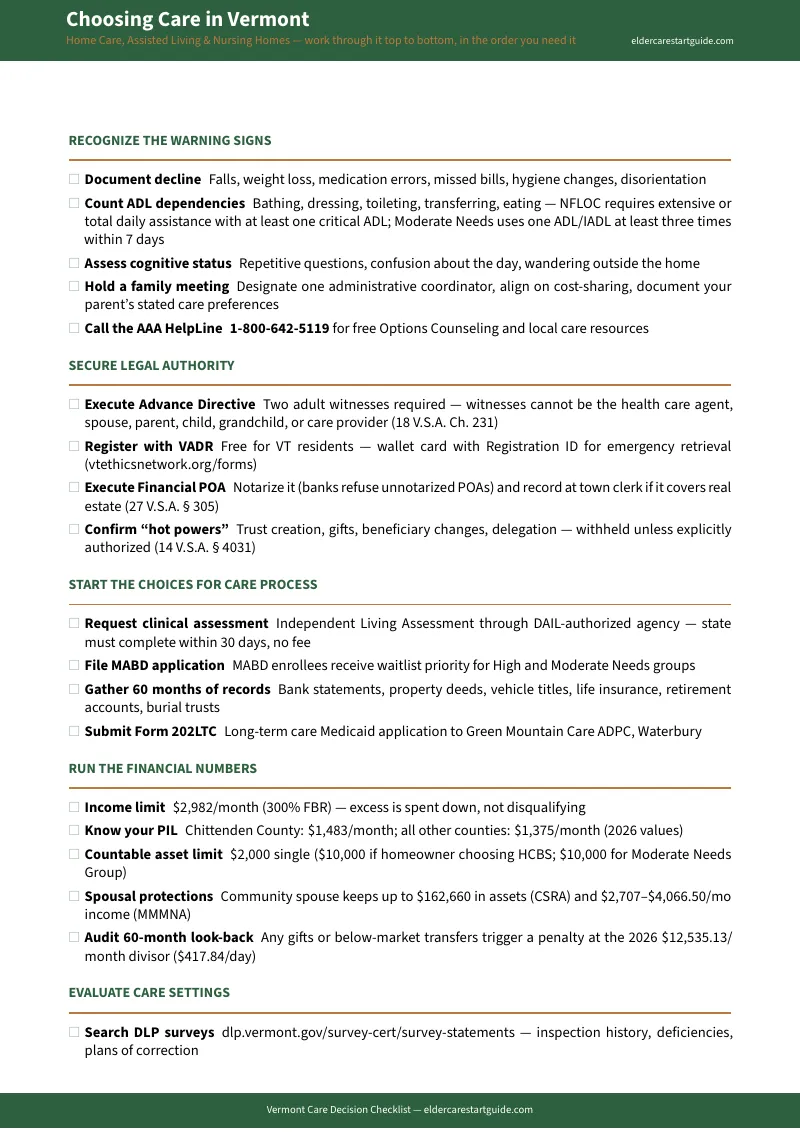
- Vermont Elder Care Decision Checklist (checklist.pdf) — printable action list with contacts, regulation references, and deadlines from the initial safety assessment through placement.
Who This Is For
- The adult child facing a hospital discharge deadline. Your parent is in a Vermont hospital and the social worker says they cannot go home. You need to compare post-acute rehab and long-term placement, evaluate facilities in days, and understand discharge rights — all before the pressure forces a decision you have not researched.
- The family caregiver approaching burnout. You have been managing your parent's care at home and the arrangement is no longer sustainable. The guide walks through the Choices for Care waiver tiers, the AAA options counseling process, the Adult Family Care model, and how to initiate a planned transition before a crisis forces one.
- The out-of-state adult child coordinating from a distance. Your parent lives in Vermont and you are managing their care from New York, Massachusetts, or Connecticut. The guide maps the five regional AAAs, the DAIL intake process, key contacts, and the DLP facility inspection portal so you can coordinate everything remotely.
- The sibling group that cannot agree on what to do. The guide provides a cost-comparison framework and a structured decision process that moves the conversation from opinions to data — including the estate recovery implications each sibling is worried about.
- The family navigating Medicaid for the first time. Your parent's private-pay resources are running out and you need to understand the Choices for Care waiver, the medically needy spend-down, spousal protections, and the application sequence — in plain language, not regulatory code.
Why Not Free Tools?
Government websites give you fragments. DAIL publishes the CFC waiver brochure. DVHA lists Medicaid eligibility rules. DLP posts facility licensing directories. The five AAAs each run their own intake lines with different phone numbers and coverage areas. But no single government source connects these pieces into a sequence you can follow — and none of them explain the strategic decisions around spend-down timing, asset titling for estate recovery protection, or how to prepare your parent's documentation to meet the Nursing Facility Level of Care threshold on the DAIL clinical assessment.
The "free" placement services fill that gap with conflicted advice. They are paid by facilities, not by you. They will never recommend the Choices for Care waiver, the Adult Family Care shared-living model, or a non-partner community that accepts Medicaid — because those options do not generate a commission. When you enter your contact information on their sites, your phone number is immediately broadcast to competing facility sales departments under the industry's "speed-to-lead" model.
The Choosing Care in Vermont Guide is completely independent. It covers every licensed option in Vermont — including the ones the referral services will never mention — and it keeps your contact information private.
Satisfaction Guarantee
If the guide does not help you navigate your parent's care transition, email [email protected] for a full refund. No forms, no justification, no time limit.
Get Started
Download the free Vermont Elder Care Decision Checklist to see the action items at a glance. When you are ready for the complete system — the full 12-chapter guide plus all nine printable worksheets — get the full kit for .