
You Shouldn't Need a Law Degree to Keep Your Parent at Home
Your parent wants to stay in their own home. You want that too. But between the Aging Waiver, the New Choices Waiver, the Department of Workforce Services, the Division of Aging and Adult Services, and twelve separate Area Agencies on Aging — the system that's supposed to help feels more like a maze built to exhaust you before you find the exit.
A single mistake on a Medicaid application can delay enrollment by 90 days. An accidental asset transfer during the 60-month look-back period can trigger penalties calculated at $4,526 per month. And if you don't document a caregiver arrangement properly, Utah's Estate Recovery Program can pursue your family home after your parent passes — even through trusts and joint tenancies.
The Utah Home Care Navigator System
This guide replaces weeks of scattered research with a single, sequential system. It takes the raw policy rules from three separate state agencies — DWS, DHHS, and DAAS — and translates them into step-by-step checklists you can actually follow during a crisis.
Where free government portals dump dense policy manuals and assume you already know the acronyms, this guide starts where you actually are: confused, pressed for time, and trying to figure out which program your parent qualifies for before the hospital discharges them.
What's Inside
- Utah's Dual-Track Waiver System Explained — the Aging Waiver vs. the New Choices Waiver: who qualifies, income limits ($1,330/month vs. $2,982/month), how the waitlists work, and the three 14-day application windows you cannot miss
- Clinical Self-Screening Worksheet — a simplified version of the InterRAI MDS-HC assessment so you can gauge whether your parent meets nursing facility level of care before requesting a formal evaluation
- Financial Eligibility Calculator — fillable worksheets for the $2,000 individual asset limit, spousal impoverishment protections (Community Spouse Resource Allowance up to $162,660), and the medically needy spend-down path
- Estate Recovery Defense Logs — co-residency documentation templates and physician certification formats to build your case for the Caregiver Child Exemption and protect the family home from MERP
- Self-Directed Care Setup — how to use the self-directed waiver option to legally hire and pay family members as caregivers, including the fiscal intermediary enrollment process and the spouse exclusion rule
- Area Agency on Aging Resource Map — county-by-county contacts for all 12 Utah AAAs, with the specific services each one coordinates: homemaker assistance, Meals on Wheels, respite care through NFCSP, and transportation
- Application Tracking System — a sequential checklist that covers every document, every deadline, and every follow-up call from initial intake through enrollment confirmation
- Caregiver Burnout Assessment — the Zarit Burden Scale integrated with a decision tree for when to pursue respite care, when to restructure the care plan, and when to consider professional alternatives
Who This Is For
- Adult children coordinating care for a parent who wants to stay at home in Utah
- Families facing a hospital discharge and needing to understand waiver options quickly
- Caregivers already providing daily care who want to get paid through Medicaid's self-directed option
- Families whose parent's assets exceed the $2,000 Medicaid limit and need a protection strategy
- Anyone trying to navigate Utah's aging services system without hiring an elder law attorney
Why Free Government Resources Aren't Enough
Utah's aging services information is split across three agencies. The DWS handles Medicaid eligibility. The DHHS Division of Aging and Adult Services administers waiver programs. The twelve Area Agencies on Aging coordinate federally funded community services. Each agency's website covers its own slice of the system in its own terminology. None of them gives you a start-to-finish roadmap.
Elder law attorneys fill this gap — for $300 to $500 per hour. Lead-generation sites like Caring.com can point you to local facilities, but their information is generic and steers you toward placement rather than staying at home. This guide sits in the space between free-but-fragmented and professional-but-expensive: a structured walkthrough of the entire process at a fraction of the cost of a single legal consultation.
What You Get
Your download includes 10 PDFs. The main guide covers 18 chapters — from understanding Utah's waiver programs through ongoing care management. Eight standalone worksheets and reference cards are ready to print and bring to meetings, fill in at the kitchen table, or tape to the fridge:
- Financial Eligibility Calculator — income, assets, spend-down, and spousal impoverishment worksheets
- Waiver Comparison Worksheet — Aging Waiver vs. New Choices Waiver side-by-side with a fill-in decision guide
- Clinical Self-Screening Worksheet — gauge nursing facility level of care before the formal assessment
- Estate Recovery Defense Logs — co-residency documentation checklist and daily caregiving log for the Caregiver Child Exemption
- Home Safety Assessment Checklist — room-by-room walkthrough with a priority modifications tracker
- Application Tracking Checklist — every step from AAA intake through Plan of Care activation
- 60-Month Lookback Audit Worksheet — transaction review log with exemption categories
- AAA Resource Map — all 12 Utah Area Agencies on Aging with counties, phone numbers, and services
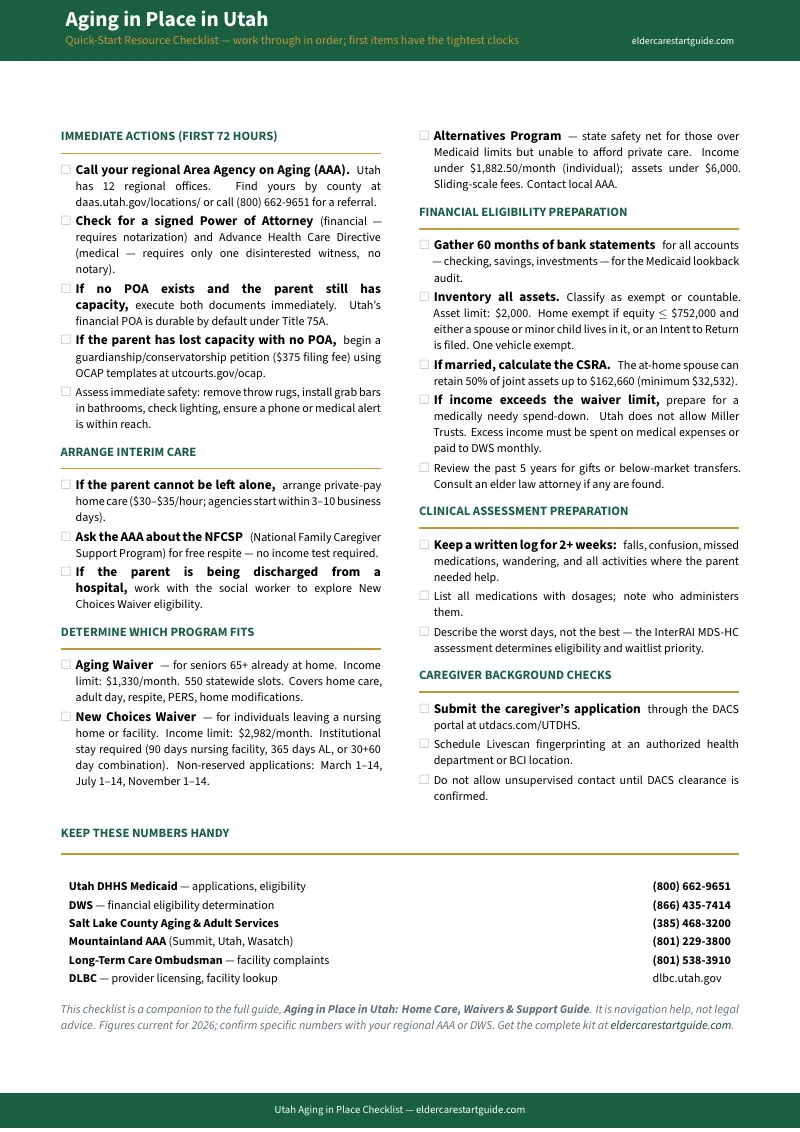
The free resource checklist is a printable quick-start reference you can take to meetings with case managers.
Every worksheet is fillable. Every checklist is sequential. Every contact is current for 2026.
Start With the Free Checklist
Not ready for the full guide? Download the free Utah Aging in Place Resource Checklist — a one-page reference covering the key contacts, first steps, and critical deadlines for keeping your parent safely at home. It's the same checklist included in the full guide, available separately so you can take action tonight.
When you're ready for the complete system — the waiver comparison worksheets, the financial calculators, the estate recovery defense logs, and the 18-chapter walkthrough — the full guide picks up exactly where the checklist leaves off.