
Your Parent's Care Is Too Important for Guesswork — Utah Has Rules That Free Websites Don't Explain
Something changed. Maybe your father fell and you cannot stop replaying the image of him on the floor, unable to get up. Maybe your mother wandered out the front door at 2 AM and you got the call from a neighbor. Maybe a hospital discharge planner just told you that your parent cannot go home — and you have 48 hours to find a bed somewhere.
Whatever the trigger, you are now the person responsible for figuring out what comes next. And Utah's elder care system is not designed to be figured out under pressure.
Home care agencies quote $34 per hour without telling you that 30-plus hours a week costs more than most assisted living facilities. Assisted living ranges from $3,800 a month in Logan to over $5,300 in Salt Lake City — but the real question is not the price, it is whether the facility holds a Type I or Type II license. Place your parent in a Type I when they cannot self-evacuate, and the facility is legally required to discharge them. Medicaid waivers exist that could fund the entire placement, but the application process involves a $2,000 asset limit, a 60-month look-back period, and spousal protection rules that most families learn about only after making an irreversible mistake.
The Utah Care Decision System
This is not a pamphlet of phone numbers. It is a structured decision system — 12 chapters, 45 pages — built specifically for adult children in Utah who are navigating care decisions for an aging parent right now. Every chapter uses 2026 Utah regulatory limits, licensing categories, and benefit thresholds. Every recommendation connects to a specific state agency, statute, or application portal.
The system works because it follows the same sequence an experienced elder law attorney would walk you through — except without the $300-to-$600 hourly billing rate and without the 2-week wait for a consultation. You start with what you can observe. You build the legal foundation. You map the financial landscape. And only then do you choose a care setting — with the data to defend that choice to your siblings, your parent's physician, and the DWS eligibility worker.
What You Get
- Every Utah care setting compared with its legal limits — non-medical home care, skilled home health, adult day care, Type I assisted living (self-evacuating residents), Type II assisted living (24-hour coordinated care), and skilled nursing. You will know exactly which setting matches your parent's clinical needs and which ones are legally prohibited from providing the care they require.
- Two worked financial examples with actual numbers — a spend-down calculation showing how to get from $47,000 in countable assets to the $2,000 Medicaid threshold, and a transfer penalty calculation demonstrating exactly how the 60-month look-back period works and what it costs in months of disqualification.
- The Aging Waiver vs. New Choices Waiver decision framework — side-by-side eligibility comparison, income caps ($1,330/month vs. $2,982/month), entry requirements, and which waiver applies to your parent's current living situation.
- A facility vetting protocol you can execute yourself — how to search the Utah DLBC licensing database, read 36 months of inspection history, cross-reference Medicare Care Compare star ratings, and contact the Long-Term Care Ombudsman for complaint data the public database does not show.
- The legal authority package explained step by step — the Utah Advance Health Care Directive (with the disinterested witness rule that trips up most families), durable financial Power of Attorney with hot powers, and the OCAP guardianship pathway when capacity is already lost.
- Hospital discharge rights and Medicare's post-acute timeline — 100% SNF coverage for days 1–20, daily co-insurance for days 21–100, zero coverage after day 100. Plus how to file a formal discharge appeal when the hospital is pushing your parent out before a safe plan is in place.
- The Caregiver Child Exemption dossier — the exact documentation you need to exempt the family home from Medicaid estate recovery if an adult child provided in-home care that delayed or prevented nursing home placement.
Who This Is For
- You are an adult child — probably the eldest daughter, possibly a son — and you are the one organizing care for an aging parent in Utah
- You may be managing a hospital discharge right now, with a social worker pushing you to pick a facility from a short list
- You may be watching your parent's savings disappear at $5,000-plus per month on private-pay home care and wondering whether Medicaid could help before the money runs out
- You and your siblings may disagree about whether Mom or Dad is safe at home — and you need an objective framework, not another argument
- You may have no Power of Attorney, no Advance Directive, and a parent who is losing the capacity to sign either one
Why Not Just Google It?
You can find fragments of this information scattered across government websites, placement agency blogs, and elder law firm marketing pages. Here is what you will not find:
- Conflict-free guidance. The "free" senior placement services that show up first on Google are paid commissions of 50% to 100% of the first month's rent by the facilities they recommend. They have zero financial incentive to suggest that your parent stay home with a waiver-funded aide. This guide has no facility partnerships, no referral commissions, and no financial relationship with any provider in Utah.
- The connections between systems. Government sites explain the Aging Waiver on one page and the home equity exemption on another — but never explain that a careless asset transfer 18 months ago could disqualify your parent from both. This guide follows the sequence these decisions actually occur in, so you see the downstream consequences before you act.
- Current numbers in one place. The $2,000 asset limit. The $752,000 home equity threshold. The $7,344 monthly divisor for transfer penalties. The $157,920 Community Spouse Resource Allowance. These numbers change annually, they are scattered across dozens of PDFs, and getting one wrong can cost your family months of benefits or tens of thousands in penalties.
What You Get When You Download
Your download includes seven PDFs:
- The complete 45-page guide — 12 chapters covering assessment, care settings, facility evaluation, legal authority, Medicaid eligibility, asset protection, hospital discharge, sibling dynamics, AAA resources, and the ombudsman program
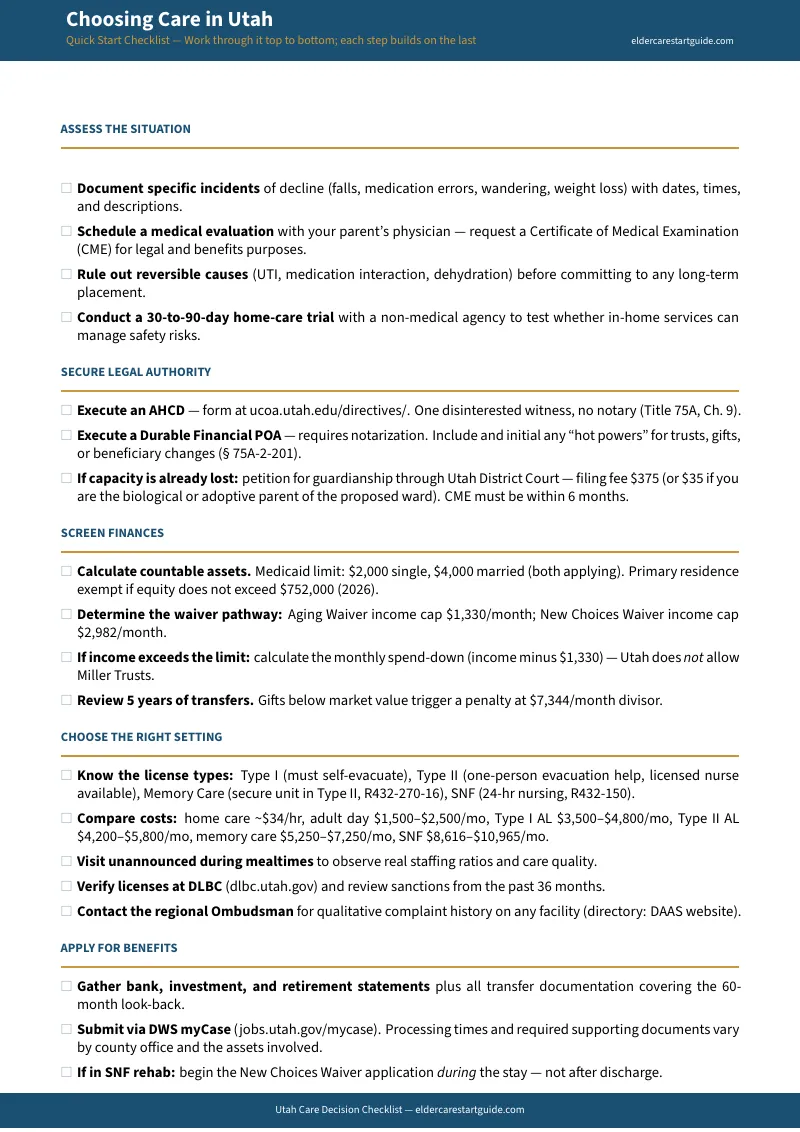
- The decision checklist — 22 action items organized into six phases: Assess the Situation, Establish Legal Authority, Evaluate Placement Options, Assess Financial Eligibility, Apply for Benefits, and Protect the Family Home
- Care Level Decision Worksheet — rate your parent's ADL needs, match them to the right care setting, and compare costs
- Medicaid Pre-Screening Calculator — fill in income, assets, and home equity to see where your parent stands against the 2026 thresholds before contacting DWS
- Facility Comparison Scorecard — evaluate up to three facilities side by side on licensing, cost, staffing, and tour impressions
- Family Responsibilities Worksheet — document each family member's commitments of time, money, and decision authority during the family meeting
- Agency Communication Log — track every call and meeting with DWS, facility administrators, physicians, and the ombudsman
Start with the checklist. It gives you the sequence. When you hit a step that needs more context — how to calculate a spend-down amount, how to verify a facility's license type, how to draft the Caregiver Child Exemption dossier — open the corresponding chapter in the guide.
Your Parent Deserves a Decision Made With Information, Not Under Pressure
Hospital discharge planners, placement agencies, and overwhelmed siblings will all push you toward a fast decision. Some of those decisions cannot be undone — a premature asset transfer triggers a 60-month penalty, an unsigned Advance Directive becomes a guardianship court case, and placing a parent in the wrong facility type means a mandatory discharge within weeks.
This guide gives you the structure to slow down without falling behind. For less than the cost of a single hour of home care, you get the same decision framework that families pay attorneys hundreds of dollars per hour to build.
Get the Utah Care Decision Guide →
The free checklist is available below — 22 action items that give you the sequence. The full guide goes deeper: worked financial examples, facility comparison tools, legal document walkthroughs, and every current threshold and deadline for Utah's care system.