
Your Parent Needs Care. Texas Will Take the House — Unless You Know the Rules.
Your dad fell. Or your mom's dementia is accelerating. Either way, the nursing home just handed you a bill for $7,800 a month, and Medicare's clock is already ticking.
You've spent nights searching "Texas Medicaid long-term care" and found two kinds of answers: state handbooks written for caseworkers that never explain how to protect the family home, and elder law firms offering $9,750 retainers you can't afford right now.
No one tells you that Texas is an income-cap state where earning $50 too much disqualifies your parent entirely — unless you set up a specific bank account that 90% of families don't know about. No one explains that the five-year lookback audit works on a different calendar than the IRS gift exclusion. No one warns you that signing the nursing home's admission papers before understanding "Medicaid pending" status can cost you thousands.
The Texas Medicaid Navigation System
This isn't a summary of federal Medicaid rules with "Texas" pasted in the title. It's 15 chapters built entirely on Texas HHSC rules, STAR+PLUS managed care, and the specific forms, dollar figures, and legal structures that determine whether your family keeps its home or the state takes it back after your parent dies.
Every strategy in this guide works because Texas has unique legal mechanisms — Miller Trusts, Lady Bird Deeds, Consumer Directed Services, and MERP hardship waivers — that exist nowhere else in the same combination. The guide maps them into a decision sequence you can follow from first hospital discharge to final estate protection.
What's Inside
Income: The Cap That Isn't Really a Cap
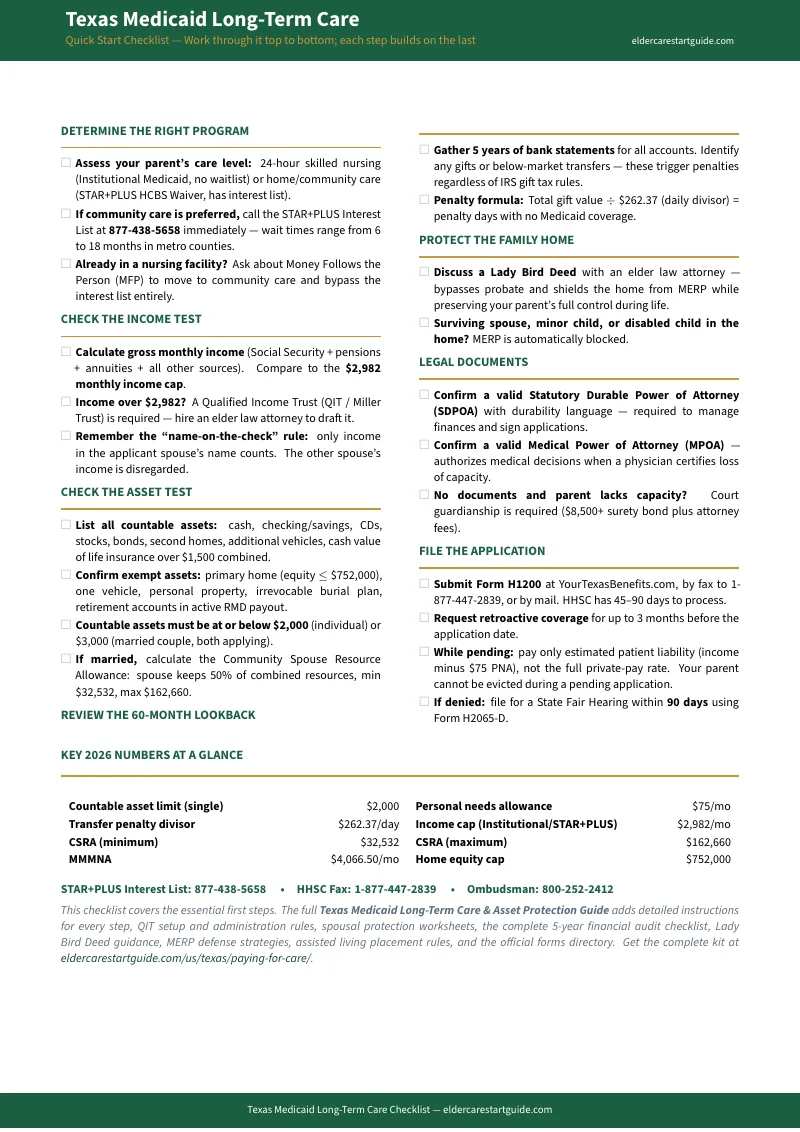
Texas sets a hard monthly income limit of $2,982. If your parent's Social Security and pension exceed that by even one dollar, they're disqualified — unless they establish a Qualified Income Trust (Miller Trust). The guide walks you through opening the dedicated QIT bank account, executing the trust document, routing monthly income correctly, and paying the nursing home from the trust. Most families can set this up without an attorney.
Assets: What Counts, What Doesn't, and How to Move Safely
The $2,000 countable resource limit sounds impossible until you realize Texas exempts the primary home (up to $752,000 equity), one vehicle, irrevocable burial contracts, household furnishings, and retirement accounts in active RMD payout. The guide gives you the complete exempt-vs-countable breakdown and nine legal spend-down strategies — from mortgage payoff to prepaid funeral plans — with the documentation standard HHSC caseworkers require.
The 60-Month Lookback: What You Can't Undo
Texas HHSC audits five years of bank statements, property transfers, and tax returns. Every dollar given away within that window — even gifts under the $19,000 IRS exclusion — triggers a penalty period calculated at $262.37 per day. The guide identifies which transfers are penalized, which are exempt (transfers to a disabled child, certain home equity transactions), and what to do if your parent already made gifts within the window.
Spousal Protections: Your Healthy Spouse Isn't Left With Nothing
When one spouse enters a nursing home, the at-home spouse keeps up to $162,660 in assets (Community Spouse Resource Allowance) and receives a monthly income floor of $4,066.50 (Minimum Monthly Maintenance Needs Allowance). Texas's "Name on the Check" rule means only the applicant spouse's income counts toward the cap — the community spouse's Social Security, pension, and investment income are completely excluded. The guide maps the asset-split calculation and income diversion rules step by step.
MERP: Protecting the Family Home After Death
Texas's Medicaid Estate Recovery Program can reclaim every dollar the state spent on your parent's care — but only from assets that pass through probate. Recording a Lady Bird Deed or Transfer on Death Deed before death passes the home outside probate, making it untouchable. The guide covers the 2026 rule changes under 1 TAC §§373.209 and 373.215, the $10,000 minimum estate threshold, the 60-day response deadline, and hardship waiver qualifications.
STAR+PLUS: Getting Paid to Care for Your Parent at Home
Texas's Consumer Directed Services program lets family members — including adult children — become paid Medicaid caregivers at $10–$17/hour. The catch: metropolitan interest list wait times of 6 to 18 months. The guide explains how to get on the list, what the medical necessity assessment evaluates, and how to navigate the managed care enrollment process.
The Application: Form H1200 Without the Confusion
The nursing home hands you a stack of forms and says "apply for Medicaid." The guide walks through Form H1200, the 30-day consecutive institutional stay requirement, required financial documentation, what "Medicaid pending" means for the facility's billing department, and how to request retroactive coverage for care your parent already received.
Legal Documents: What to Sign Before Your Parent Can't
A Durable Financial Power of Attorney and Medical Power of Attorney must be in place before your parent loses capacity — after that, you're facing a guardianship proceeding in Texas probate court. The guide specifies the exact Medicaid planning clauses the POA must include: gifting authority, trust creation authority, and real estate conveyance rights.
Who This Is For
- Families hitting the Medicare cliff — your parent's skilled nursing coverage is ending in days, not months, and the facility is pushing you to sign papers and pay privately while Medicaid is "pending."
- Exhausted caregivers — you've been providing unpaid care for years and just learned that STAR+PLUS CDS could pay you for the same work, but the waitlist looks impossible.
- "We earn too much" families — you read the $2,982 income cap and assumed your parent doesn't qualify, not knowing that the Miller Trust workaround has been standard Texas practice for decades.
- Proactive planners — your parent just got a diagnosis, and you have months (not weeks) to position assets, execute a Lady Bird Deed, and move transfers outside the lookback window before a crisis forces your hand.
- Families in sibling conflict — you need one document everyone can read that explains the rules neutrally, so decisions are based on what Texas law allows, not who shouts loudest.
Why State Websites and Free Guides Won't Get You There
The Texas HHSC handbook explains what the rules are. It does not explain how to use them. It won't tell you that routing income through a Miller Trust before the application date lets your parent qualify on day one. It won't mention that a $5 Lady Bird Deed can protect a $500,000 home from estate recovery. It won't warn you that adding your child to the home's deed triggers a lookback penalty that could leave your parent ineligible for nursing home coverage for months.
Lead-gen directories like A Place for Mom and AgingCare rank for every search term you've tried, but their business model is matching families with private-pay facilities — not navigating Medicaid. Their content stops exactly where the hard questions start.
This guide picks up where both sources leave off: the specific Texas legal mechanisms, dollar figures, forms, and sequences that turn "I think we're stuck" into "here's exactly what we do next."
100% Satisfaction Guarantee
If the guide doesn't save you time, stress, or money in your first week of using it, email [email protected] for a full refund. No questions, no forms, no waiting period.
— Less Than One Day of the Nursing Home Co-Pay
Medicare's day-21 co-pay is $217. The average Texas elder law consultation starts at $300/hour. This guide covers the same ground for a fraction of either — and you can start using it tonight.
Download the free Medicaid eligibility checklist to see the 20 most urgent action items, or get the complete Texas Medicaid Long-Term Care & Asset Protection Guide with all 15 chapters, 7 standalone worksheets, and contact directories.