
Your Parent Needs Help. Tennessee Won't Let You Give It — Until You Have the Right Documents.
Your parent had a fall. Or the TennCare CHOICES caseworker is ready to process the long-term care application, but she cannot proceed without an authorized representative to sign the intake forms and attend the Pre-Admission Evaluation screening. Or the bank froze your father's checking account after a teller flagged a suspicious transaction, and nobody can pay his mortgage or the assisted living deposit.
You are the one driving to appointments, managing medications, fielding calls from siblings and social workers. But Tennessee law does not care how many hours you put in. Without a legally executed power of attorney, banks will lock you out, hospitals will refuse to share test results, TennCare will reject your application, and the probate court becomes your only path — at $2,500 to $4,500 or more in attorney fees, with a court-appointed Guardian ad Litem, mandatory surety bond, and annual financial accountings filed for every dollar you spend on your parent's behalf.
The Tennessee Legal Authority Roadmap
This kit is not a stack of blank forms. It is the Tennessee Authority Blueprint — the process, the strategy, and the institutional navigation that $300/hour elder law attorneys explain in a one-hour consultation and that government websites scatter across a dozen agencies.
It covers two paths: proactive planning (when your parent can still sign) and court-supervised conservatorship (when capacity is already gone). And it connects both paths to the TennCare CHOICES system you will almost certainly need to navigate — including the Qualified Income Trust that overcomes the strict $2,982 monthly income cap, the Pre-Admission Evaluation that determines whether your parent qualifies for home care or nursing facility placement, and the estate recovery protections that keep the family home outside the state's reach.
What's Inside
The kit includes a 13-chapter, 50-page guide, a printable 2-page quick-start checklist (23 action items), and nine standalone printables — organized in the order you will actually need them:
- Capacity Assessment Framework — A plain-language framework for determining whether your parent can still legally sign. Tennessee law does not equate a dementia diagnosis with incapacity. What matters is whether your parent understands the nature of the document, the identity of the agent, and the scope of the powers being granted at the exact moment of signing. The kit explains the legal standard, provides practical assessment questions, and identifies the exact point where the voluntary path closes.
- Tennessee Durable Financial POA Walkthrough — The Uniform Durable Power of Attorney Act (T.C.A. §§ 34-6-101 to 34-6-112) step by step. Why Tennessee POAs are only durable if they contain the explicit durability clause under § 34-6-102. The critical difference between immediate and springing powers. How to include the "hot powers" under § 34-6-108(c) — gifting, trust creation, beneficiary changes — that generic national forms always miss. And how to execute with notarization so the document is accepted at any Tennessee bank or Register of Deeds office.
- Advance Directive for Health Care — Tennessee's Health Care Decisions Act (T.C.A. § 68-11-1801 et seq.) consolidated the living will and healthcare power of attorney into a single document in 2017. The kit covers the strict witness exclusion rules — no healthcare staff, no facility employees, no heirs — and how to designate a healthcare agent, set treatment preferences, and ensure emergency rooms accept the document on first presentation.
- Bank Acceptance Playbook — Tennessee banks routinely question POA documents. The kit provides a step-by-step escalation strategy — from initial branch presentation with supporting paperwork, to compliance officer escalation, to citing the statutory liability protections that make acceptance safer for the institution than refusal. Most rejections resolve at the escalation stage without litigation.
- TennCare CHOICES Navigation Guide — Tennessee's managed care Medicaid program for long-term care. The kit walks through the 2026 eligibility thresholds ($2,982 monthly income limit, $2,000 countable asset limit), the Pre-Admission Evaluation 26-point clinical scale, Group 1/2/3 placement determination, spousal impoverishment protections ($162,660 Community Spouse Resource Allowance, $4,066.50 monthly income allowance), and the Personal Needs Allowance rules that differ dramatically between nursing facility and home care enrollees ($70/month vs. $2,982/month).
- Qualified Income Trust (Miller Trust) Setup — Tennessee is a strict income-cap state. If your parent's gross monthly income exceeds $2,982, they cannot qualify for CHOICES long-term care benefits without a QIT. Complete setup blueprint: drafting the irrevocable trust document, completing Schedule A, opening the bank account using the beneficiary's SSN, routing monthly income via automatic ACH transfers, and satisfying the TennCare payback requirement upon death.
- Conservatorship Navigator — When capacity is gone and no POA exists, the family must petition the probate court under T.C.A. §§ 34-3-101 to 34-3-109. The kit covers the petition process, mandatory physician certification, Guardian ad Litem appointment, Attorney ad Litem designation, the "least restrictive alternative" standard, surety bond requirements, 60-day asset inventory, annual accountings, and emergency temporary conservatorships limited to 60 days. Plus the alternatives — supported decision-making, representative payee, statutory medical surrogacy — so you pursue the least invasive option first.
- Estate Recovery & Asset Protection — Tennessee operates as a probate-only recovery state under T.C.A. § 71-5-116. The kit explains how tenancy by the entirety (the default for married couples under § 66-1-106) and joint tenancy with right of survivorship bypass probate and stay outside estate recovery. It covers the caretaker child exception (two years of documented in-home care), the sibling exception, the 5-year lookback period with the 2026 penalty divisor of $8,846.10/month, and why revocable living trusts, Lady Bird deeds, and Transfer-on-Death deeds do not protect real property in Tennessee.
- The Legal Authority Decision Flowchart — A fillable path sheet: can your parent still sign? Check the voluntary path or the court path, then the TennCare income fork. Print it and keep it on your desk.
- Printable worksheets — The Capacity Assessment Worksheet, The DPOA Execution Checklist, The TennCare CHOICES Eligibility Calculator, The QIT Monthly Disbursement Tracker, The Conservatorship Filing Organizer, The Agency Communication Log, and the Bank Acceptance Playbook (an escalation worksheet for the branch visit, not a script).
- AAAD Contact Directory — A fillable roster for Tennessee's nine Area Agencies on Aging and Disability. Look up your region on the Department of Disability and Aging site, write in your counselor and intake line, and keep statewide portals (TennCare Connect, Ombudsman, estate recovery) on the same page.
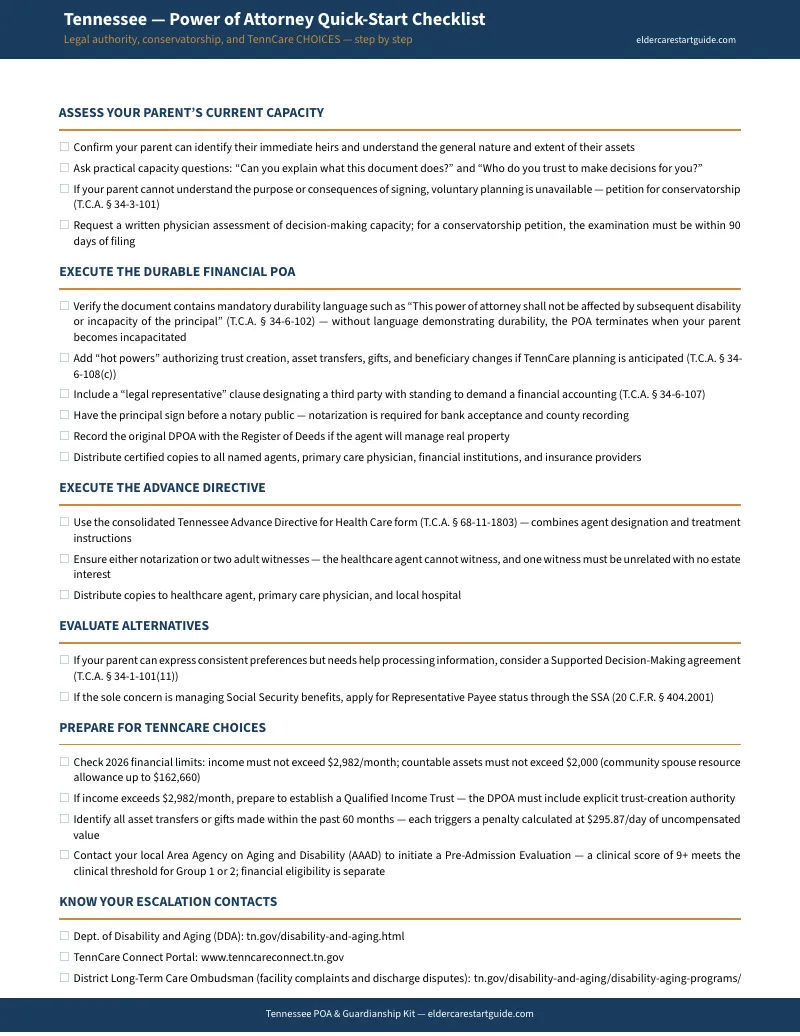
- Quick-Start Checklist — A printable 2-page action list (23 items) for crisis mode. What to do today, this week, and this month — extracted from the full guide for the caregiver who needs to know what to do before calling the hospital back.
Who This Kit Is For
- Adult children who just learned they need "power of attorney" for an aging parent in Tennessee and do not know where to start
- Families facing a hospital discharge where the parent cannot go home alone and nobody has legal authority to sign admission or consent forms
- Caregivers whose parent has early-stage dementia and can still sign — but the window is closing
- Families navigating TennCare CHOICES eligibility, the Pre-Admission Evaluation, or the Qualified Income Trust process without paying thousands in attorney fees
- Siblings who need a clear, documented fiduciary process to avoid disputes about who controls what
- Anyone dealing with a Tennessee bank or institution that will not honor an existing power of attorney document
Why Not Just Use Free Forms?
Tennessee publishes some statutory forms through government portals. National sites like eForms and LegalTemplates offer downloadable POA forms. You can download blank forms right now.
Here is what those forms do not tell you:
- That Tennessee POAs are only durable if they contain the explicit durability clause under § 34-6-102 — without it, your document terminates the moment your parent becomes incapacitated, exactly when you need it most
- What to do when a bank teller refuses to honor the form you just had notarized — and how to escalate using the statutory liability protections that make acceptance less risky for the bank than refusal
- How to determine whether your parent can still legally sign, or whether the window has already closed and you are looking at a probate court conservatorship
- How to set up the Qualified Income Trust that overcomes the $2,982 monthly income cap — without which TennCare will deny your parent's CHOICES application regardless of how perfectly the rest of the paperwork is completed
- Which Area Agency on Aging and Disability serves your county, how to initiate the Pre-Admission Evaluation screening, and what clinical score your parent needs to qualify for home care vs. nursing facility placement
The forms are step one. This kit covers the rest of the process.
Satisfaction Guarantee
If the kit does not give you a clearer path forward, email [email protected] and we will make it right.
— Less Than One Hour of a Tennessee Elder Law Attorney's Time
The average initial consultation with a Tennessee elder law attorney runs $300 to $500 per hour. A full conservatorship proceeding can cost $2,500 to $4,500 or more in court fees, bonding, Guardian ad Litem fees, and legal representation.
This kit will not replace an attorney for complex trust litigation or multi-property estate restructuring. But for the standard power of attorney execution, institutional acceptance, Qualified Income Trust setup, and TennCare CHOICES navigation that most Tennessee families need, it covers the process at a fraction of the cost.
Start with the free checklist to see if the approach fits your situation. The full kit goes deeper with complete guides, decision flowcharts, and step-by-step institutional playbooks.