
Your parent was just diagnosed with dementia. Tennessee's care system was not designed for you to figure out alone.
You are staring down a system that splits critical information across TennCare, the Health Facilities Commission, the Department of Disability and Aging, nine Area Agencies, and hundreds of pages of administrative code. You need answers right now — how to get legal authority before your parent loses capacity, whether TennCare will cover a memory care facility, what happens to the house after your parent passes — and every free resource you find sends you in circles between departments or straight to a phone call with a referral service that earns commission from the facilities it recommends.
The Tennessee Dementia Care Navigation System is a step-by-step guide that replaces the 400-page administrative scavenger hunt with one document built specifically for Tennessee families. It covers every decision point from diagnosis through placement, with the actual financial thresholds, legal procedures, and facility licensing rules you need — not generic national advice that ignores Tennessee's unique TennCare CHOICES structure, its lack of a medically needy spend-down for adults, or its probate-only Medicaid estate recovery policy.
What's Inside
- TennCare CHOICES Application Roadmap — The three enrollment groups work differently, and most online sources blur the distinctions. Group 1 covers nursing facility care. Group 2 funds home and community-based services up to a $294.87 daily cap, including the Consumer Direction option that lets you hire and pay a family member. Group 3 covers at-risk seniors who don't yet meet nursing-home criteria. The guide walks through each group's eligibility rules, services, and application steps so you file for the right one the first time.
- Qualified Income Trust Setup Kit — Tennessee has a hard monthly income cap of $2,982 with no adult spend-down option. If your parent's Social Security and pension exceed that by even a few dollars, they are automatically disqualified unless you establish a QIT (Miller Trust) before applying. The guide includes the setup sequence, EIN application instructions, a bank account script, and a monthly ledger template for the mandatory distribution waterfall — because one misstep in the payment order can invalidate the trust and trigger retroactive loss of benefits.
- Memory Care Facility Evaluation Scorecard — Tennessee does not issue a standalone memory care license. Secure dementia units operate inside Assisted-Care Living Facilities (ACLFs) or Residential Homes for the Aged (RHAs), each with different admission criteria and discharge triggers. The scorecard covers HFC licensing compliance, 24/7 awake-attendant verification, dementia training standards, hidden acuity-care charges, and the quarterly interdisciplinary team review process that determines whether your parent stays or gets transferred.
- Asset Protection Strategy Guide — Tennessee is unusually protective during an applicant's lifetime (no pre-death TEFRA liens on the home, equity exempt up to $752,000 with a subjective intent-to-return statement), but the home becomes vulnerable to Medicaid estate recovery after death. The guide covers tenancy by the entirety, irrevocable Medicaid Asset Protection Trusts, the 60-month lookback period, spousal impoverishment protections (CSRA up to $162,660), and why Tennessee does not recognize Lady Bird deeds — so families who attempt them unknowingly leave the property in probate.
- Legal Authority Toolkit — Covers the Durable Financial Power of Attorney, the Tennessee Advance Directive for Health Care (which integrates the healthcare POA and living will into one form), and the conservatorship petition process for families whose parent has already lost capacity. Includes county-by-county filing costs, the capacity threshold required to sign, and emergency judicial paths when decisions cannot wait.
- Silver Alert and Wandering Prevention Profile — A pre-built emergency response template with physical descriptions, medication lists, recent photographs, and the TBI Silver Alert activation requirements (T.C.A. § 38-6-121). Includes home-proofing strategies and GPS tracking options so you have a plan before the first wandering incident, not after.
- Care Transition Workflow — An eight-phase timeline that sequences every action from suspected cognitive decline through ongoing compliance: when to sign legal documents, when to start home care, when to begin the Medicaid financial countdown, how to navigate the Pre-Admission Evaluation, and what triggers a move from home care or assisted living to a nursing facility. Each phase has concrete deadlines and the specific Tennessee forms and contacts you need.
- Caregiver Support and Respite Directory — The Family-Directed Respite Voucher reimburses up to $600 per year but has a narrow April 1–June 30 application window that most families miss. The guide also covers VA Respite Care (up to 30 days per year for eligible veterans), the CMS GUIDE Model (up to $2,500 annually for respite through participating clinics like Erlanger in Chattanooga), and how to access the OPTIONS for Community Living evaluation through your local Area Agency.
Who This Is For
- Adult children coordinating care for a parent with dementia in Tennessee — whether you are managing a crisis discharge, planning a transition from home to facility care, or trying to protect family assets before applying for TennCare
- Families navigating the TennCare CHOICES application for the first time and unsure which enrollment group to apply for
- Caregivers whose parent's income exceeds the Medicaid cap and need to set up a Qualified Income Trust correctly
- Siblings who disagree about a parent's care needs and need an objective, state-specific framework to build consensus
- Anyone weighing whether to hire an elder law attorney or manage the process themselves
What Free Resources Get Wrong
National directories like A Place for Mom and Caring.com are free because the facilities they recommend pay them a commission — often equal to a full month's rent. Their advisors are financially incentivized to steer you toward expensive private-pay memory care and rarely mention TennCare CHOICES, community waivers, or respite grants. State government websites have the raw rules, but they are scattered across multiple departments, written in regulatory language, and do not provide templates, checklists, or step-by-step application guidance.
This guide accepts no referral fees or facility commissions. It covers both private-pay and state-funded care paths equally, with the actual forms, financial thresholds, and procedural sequences that Tennessee families need to make informed decisions.
Satisfaction Guarantee
If the guide does not help you navigate your parent's dementia care in Tennessee, email us for a full refund. No time limit, no hoops.
Get Started
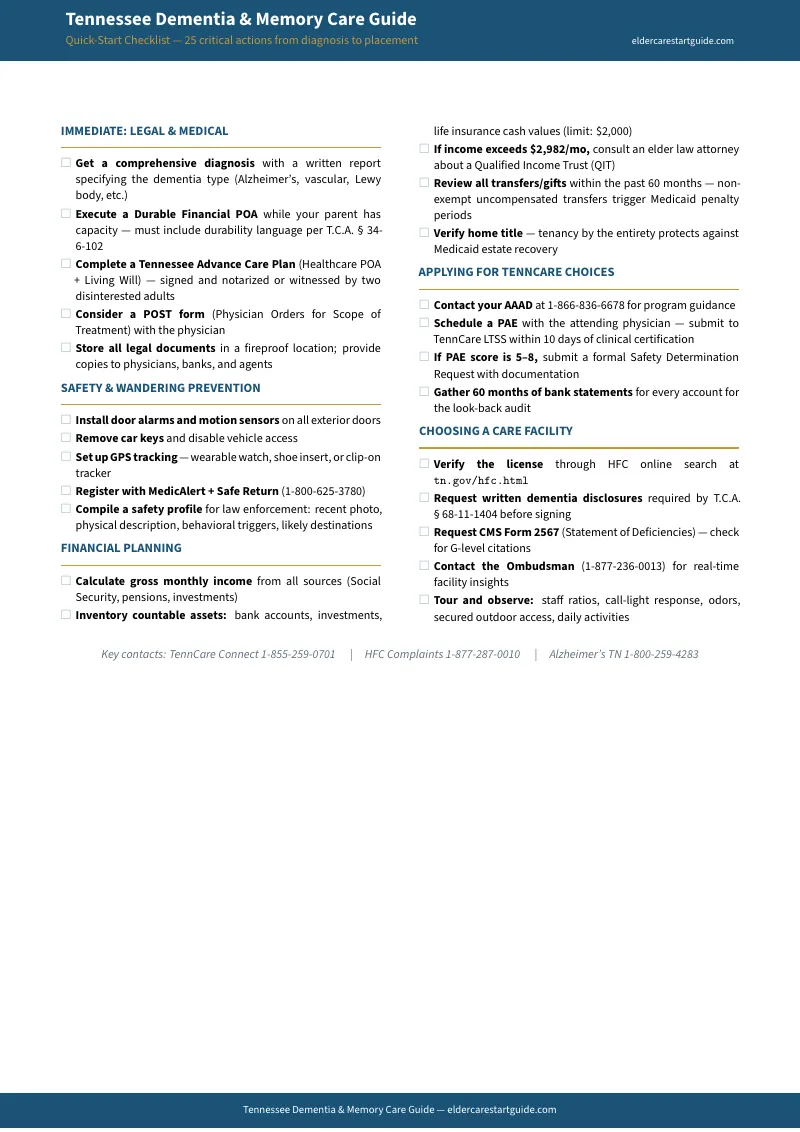
Download the free Tennessee Dementia Care Resource Checklist to see the 25 action items the guide covers. When you are ready for the full system — application roadmaps, QIT templates, facility scorecards, asset protection strategies, and the complete care-transition workflow — upgrade to the full guide for .