Your parent needs long-term care. South Dakota's rules are about to decide who pays.
Nursing home care in South Dakota averages over $9,400 a month. Your parent's Social Security and pension won't cover it. And the state's Medicaid program has an income cap, a $2,000 asset limit, and a five-year financial audit that can penalize gifts you forgot about a decade ago.
Dakota at Home can help with clinical assessments — but they can't advise on asset protection. Elder law attorneys can, but at $300 to $500 an hour, the meter runs while you're still learning the vocabulary. Free online resources explain that a Miller Trust exists — not how to actually set one up, calculate the monthly patient liability, or keep the trust compliant month after month.
The South Dakota Care Cost Defense System bridges that gap. It gives you the complete financial roadmap — from determining whether your parent qualifies, to protecting the family home and ranch from South Dakota's unusually aggressive estate recovery program, to submitting a Medicaid application that doesn't get kicked back for missing paperwork.
What's inside
The South Dakota Medicaid Long-Term Care & Asset Protection Guide covers every step in the order you'll face them. Each chapter includes worksheets and worked examples so you're calculating real numbers, not reading theory.
- Income cap and Miller Trust walkthrough — South Dakota is a strict income-cap state. If your parent earns over $2,982/month, they need a Qualified Income Trust to qualify. The guide explains how to open the trust bank account, calculate the monthly patient liability, and keep the disbursements compliant — because DSS rejects generic online trust templates.
- Asset inventory and spend-down planner — which assets count (retirement accounts are fully countable in South Dakota, even in payout status), which are exempt, and safe ways to convert excess assets (prepaid burial plans, home repairs, debt payoff) without triggering lookback penalties.
- Spousal protection calculator — if one spouse enters care, the at-home spouse can keep $32,532 to $162,660 in assets and receive income diversions of $2,705 to $4,066.50 per month. The worksheets calculate your family's exact allowances based on the snapshot-date balance.
- 60-month lookback audit — a transaction-by-transaction checklist for the five years of bank statements DSS will review. Flags the transfers that trigger penalties (cash gifts, below-market property sales, informal caregiver payments without a written agreement) and the ones that don't.
- Expanded estate recovery defense — South Dakota recovers Medicaid costs not just from probate estates but from joint accounts, life estates, TOD/POD accounts, and revocable living trusts under SDCL 28-6-23. The guide maps every asset type the state can reach and the conditions that defer or block a claim.
- HOPE waiver eligibility — South Dakota's single home-care waiver for adults who need nursing-facility-level care but want to stay home. Covers the clinical assessment, the 85% cost cap, service categories, and the key limitation that HOPE does not allow participant-directed care (you cannot hire family members as paid caregivers under this program).
- Application roadmap — document checklists, the eaportal.sd.gov online portal, Dakota at Home clinical assessments, and the 45-day processing timeline. Includes a worked example of the full Miller Trust monthly calculation.
- Rural placement strategies — with 18+ nursing home closures across South Dakota in the last decade, rural families face unique challenges. The guide addresses bed availability across regional hubs, transfer logistics, and how facility closures affect Medicaid-pending residents.
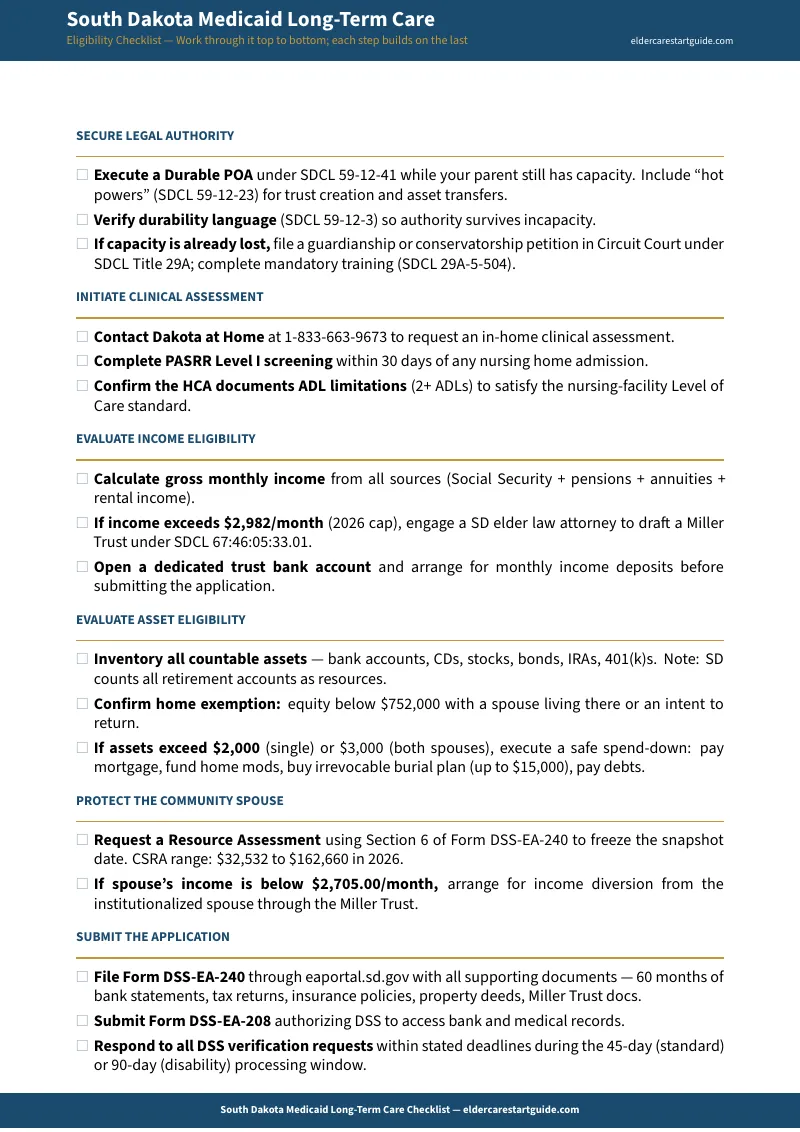
Plus six printable standalone tools — a Miller Trust monthly distribution worksheet, a spend-down planner, a spousal protection calculator, a 60-month lookback audit log, an estate recovery asset map, and an application document checklist — along with a step-by-step eligibility checklist that tracks every action from "gather 60 months of bank statements" to "confirm Medicaid approval letter."
Who this is for
- Adult children managing a parent's hospital discharge, nursing home placement, or transition from private pay to Medicaid in South Dakota
- Spouses trying to protect their own financial security while qualifying a partner for long-term care Medicaid
- Families with agricultural land — farms, ranches, or multi-generational homesteads that are vulnerable to South Dakota's expanded estate recovery
- Anyone whose parent earns slightly over the income cap or has modest savings above $2,000 and needs a clear path to eligibility
Why not just use free resources?
Free resources in South Dakota fall into two categories, and neither one gives you the full picture.
State agencies — Dakota at Home, the Long-Term Care Ombudsman, and local Area Agencies on Aging provide clinical assessments and care coordination. They are legally required to stay neutral, which means they cannot advise on asset protection, spend-down strategies, or trust structuring. They'll tell you the income limit exists; they won't tell you how to work within it.
Senior living directories — services like A Place for Mom earn commissions from private-pay facilities. They rarely mention Medicaid eligibility, and their "free advisor" calls are designed to steer families toward assisted living communities that pay referral fees — not toward the state benefits your parent may qualify for.
This guide fills the gap between government neutrality and commercial bias. It covers the strategy that state agencies can't touch and the eligibility process that placement directories ignore — for a fraction of one hour with an elder law attorney.
The guarantee
If the guide doesn't help you build a clearer plan for your parent's care costs, email [email protected] and we'll refund the full purchase. No time limit, no forms.
Start tonight
Download the free checklist to see the eligibility overview. When you're ready for the full system — worksheets, calculators, worked examples, and step-by-step application prep — get the complete guide for .