
The Bank Refused Your Signature. The Hospital Wants a Legal Name. Your Parent Can't Provide One.
Your parent had a fall, a stroke, or a slow cognitive decline — and suddenly every institution in South Dakota needs proof that you can legally act on their behalf. The bank delayed the transaction for an "internal legal review." The discharge planner at Sanford or Avera wants a designated decision-maker before releasing your parent to a rehab facility. Dakota at Home needs an authorized contact before they'll start the HOPE waiver intake.
You're stuck in the legal-authority gap: responsible for everything, authorized for nothing.
South Dakota gives you two pathways. If your parent still has capacity, you can establish authority this week, privately, through voluntary documents. If capacity is already gone, you face a court-supervised guardianship under SDCL Title 29A that typically costs $3,000–$7,000, takes months, and becomes public record. The problem is that nobody explains which pathway you're on, what to do first, or how to get South Dakota's banks, hospitals, and state agencies to accept your documents once you have them.
The South Dakota Legal Authority Roadmap
This kit replaces the confusion with a step-by-step system built for South Dakota's specific statutes, benefit programs, and rural institutional landscape — not a generic POA overview with "South Dakota" pasted in. It covers both pathways in the order families actually experience them: capacity triage, document execution, institutional acceptance, benefit applications, court process, and asset protection.
It's built for the adult child who became the family's legal coordinator overnight — whether you're in Sioux Falls or Rapid City, on a ranch in Haakon County, or managing everything from another state while your parent lives hours from the nearest elder law attorney.
What's Inside
Durable Financial Power of Attorney (SDCL Chapter 59-12)
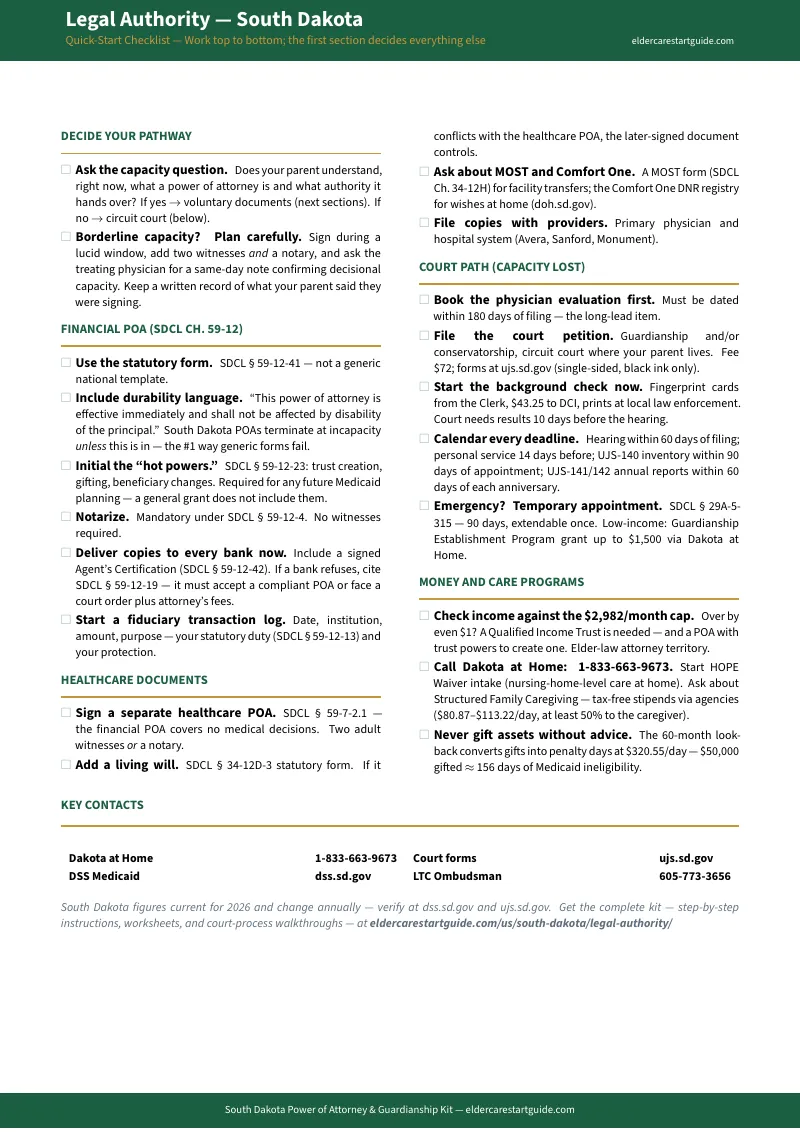
A complete walkthrough of the statutory financial POA (SDCL § 59-12-41), including the two South Dakota quirks that silently invalidate generic forms: durability is not the default under SDCL § 59-12-3 (without the exact durability sentence, the POA dies the moment your parent becomes incapacitated), and the "hot powers" under SDCL § 59-12-23 (trust creation, gifting, beneficiary changes) must be expressly initialed — a general grant of authority doesn't include them, and without them no Medicaid planning or Qualified Income Trust is possible. Covers notarization under SDCL § 59-12-4, the Agent's Certification form (SDCL § 59-12-42), and what to do when a bank pushes back — including the SDCL § 59-12-19 citation that obligates the bank to accept a compliant POA or face court order plus attorney's fees.
Healthcare POA, Living Will & Advance Directives
Medical authority requires a completely separate document. This section covers the healthcare POA under SDCL § 59-7-2.1 with its own execution rule (two adult witnesses or a notary — different from the financial POA), the statutory living will (SDCL § 34-12D-3), the later-document-controls rule when they conflict, MOST forms (SDCL Chapter 34-12H) and the Comfort One DNR registry for parents moving between home, hospital, and facility. Plus the fallback nobody knows about: South Dakota's statutory surrogate hierarchy (SDCL § 34-12C-3) when no document exists at all.
The Capacity Question — and the Paper Trail That Protects You
Can a parent with early dementia still sign? Often yes — capacity is measured at the moment of signing, and a lucid interval counts. But a borderline signing without documentation invites challenges of undue influence later. The kit includes a capacity assessment protocol and a Capacity Documentation Worksheet — how to time the signing, who to have in the room, and what to ask the treating physician to note, so the documents survive scrutiny.
Guardianship & Conservatorship — The Four-Phase Court Process
When capacity is already gone, this is the complete circuit-court roadmap under SDCL Title 29A: the petition and $72 filing fee, the physician/psychologist Evaluation Report (the long-lead item — book it first), service and notice rules, the fingerprint-based background check ($43.25 to DCI, results needed 10 days before the hearing), the mandatory fiduciary training, and the court-appointed attorney for your parent that you're required to fund. Then the ongoing duties most petitioners don't see coming: the fiduciary bond, the conservator's inventory (UJS-140), annual accounting (UJS-141), and guardian's annual report (UJS-142). Emergency temporary appointments under SDCL § 29A-5-315 (90 days, extendable once) get their own walkthrough — and low-income families get the Guardianship Establishment Program grant application (up to $1,500 toward costs).
Medicaid Long-Term Care, the HOPE Waiver & Getting Paid to Care
The 2026 numbers in one place: the $2,982/month income cap, the $2,000 countable asset limit, the 60-month look-back with its $320.55/day penalty divisor, the $752,000 home equity limit, and the Community Spouse Resource Allowance ($32,532–$162,660). South Dakota has no medically-needy spend-down for long-term care — one dollar over the income cap means a Qualified Income Trust, and this section shows you the setup blueprint and the monthly deposit log to run it. Then the HOPE waiver pipeline (Dakota at Home intake → LTSS Community Health Assessment → care plan) and Structured Family Caregiving: a family member sharing the home can receive a tax-free daily stipend (agency rates $80.87–$113.22/day, at least 50% passed through to the caregiver).
Estate Recovery & The Four "Hire a Lawyer" Triggers
South Dakota's Medicaid estate recovery program (SDCL § 28-6-23) can reclaim benefits from a deceased parent's estate. This section covers what's exposed, what's protected, and — just as important — the four specific situations where self-help ends and you genuinely need an elder law attorney, so you spend professional fees only where they matter.
Eight Fill-In Worksheets
Every system in the guide has a printable companion: the Fiduciary Transaction Log (your SDCL § 59-12-13 statutory duty, from day one), Capacity Documentation Worksheet, POA Acceptance Tracker (every institution, accepted or pushed back, with dates), Guardianship Deadline Calendar, Medicaid Spend-Down & Look-Back Ledger, QIT Monthly Deposit Log, HOPE Waiver Pipeline Checklist, and the Annual Reporting Worksheet that pre-collects every number UJS-140/141/142 will ask for.
Who This Is For
- Adult children in South Dakota who need legal authority to manage a parent's finances, medical care, or benefit applications — and don't know which documents they need or where to start
- Families facing a dementia diagnosis who need to establish authority while their parent still has capacity, before guardianship becomes the only option
- Out-of-state family members coordinating remotely for a parent in a rural county — where elder law attorneys are concentrated in Sioux Falls and Rapid City
- Families approaching Medicaid or the HOPE waiver who need the 2026 thresholds, QIT mechanics, and SFC stipend process before savings run out
- Siblings in conflict who need an objective, statute-based framework for deciding who holds authority — before a judge appoints a professional fiduciary instead
Why Free Forms Aren't Enough
The SD Unified Judicial System provides official forms as-is, and court staff are barred from helping you select, complete, or execute them. A blank form doesn't tell you that a healthcare POA needs two witnesses OR a notary (the financial POA needs a notary only), that court filings must be printed single-sided in black ink, or that the fingerprint check results must reach the court 10 days before your hearing. National platforms like Nolo and LegalZoom generate documents from templates that routinely miss South Dakota's non-durable default under SDCL § 59-12-3 — the single most common way a DIY POA fails at the worst possible moment.
Elder law attorneys in South Dakota charge $200–$500 per hour, and they're concentrated in Minnehaha and Pennington counties. For families in rural West River or East River counties, getting to an attorney's office is its own logistical problem.
This kit bridges the gap — handling the procedural and administrative work families can do themselves, and naming exactly the point where a situation crosses into attorney territory.
Satisfaction Guarantee
If this kit doesn't give you the clarity and confidence to establish legal authority for your parent, email us for a full refund. No forms, no hoops, no time limit.
— Less Than a Single Hour of Professional Help
A South Dakota elder law attorney charges $200–$500 per hour. A full guardianship runs $3,000–$7,000. A Medicaid planning engagement runs $2,000–$5,000. This kit handles the process navigation you can do yourself — and saves the professional fees for the decisions that actually require one.
Download the free South Dakota Power of Attorney Quick-Start Checklist to start, or get the complete kit: the full 12-chapter guide, the 20-item quick-start checklist, and eight fill-in worksheets — 10 PDFs total.