
Your Parent Has Dementia. South Dakota's Care System Has Rules Nobody Explained.
Your parent was just diagnosed with Alzheimer's or another form of dementia. The doctor handed you a pamphlet. The internet gave you a hundred contradictory articles. And somewhere between "memory care costs $5,700 a month" and "Medicaid has a $2,000 asset limit," you realized that nobody is telling you what to actually do — in what order, under South Dakota's specific rules.
You searched for "Silver Alert South Dakota" and found out the state does not have one. You called about the HOPE Waiver and got a 40-minute phone tree. You looked at assisted living memory care facilities and discovered that South Dakota's licensing rules under ARSD 44:70 mean your parent could be discharged the moment they need a mechanical lift or a two-person transfer — and nobody mentioned that during the tour.
Meanwhile, the family farm sits exposed. Medicaid's 60-month look-back is ticking. And every week you wait to execute a durable POA is a week closer to the day a court decides your parent lacks capacity and you need a full guardianship proceeding instead.
The South Dakota Dementia Care Navigation System
This is not a brochure of phone numbers you can find on dhs.sd.gov. It is the process around the system — the part that elder law attorneys explain for $300 to $500 an hour and that state agency websites never cover.
The guide walks you through every stage of the dementia caregiving journey in South Dakota: from the first 30 days after diagnosis through legal authority, HOPE Waiver enrollment, Medicaid financial eligibility, facility vetting, care transitions, and estate recovery protection. Every chapter follows the order these decisions actually arrive — because nobody facing a hospital discharge deadline has time to read chapters out of sequence.
What's Inside
- First 30 Days After Diagnosis — Action Plan — The legal documents to execute while your parent still has capacity (Durable Financial POA with the "hot powers" clause under SDCL 59-12-23, Health Care POA), the call to Dakota at Home (833-663-9673) for HOPE Waiver screening, and the wandering safety measures to install before the first elopement attempt — because sixty percent of dementia patients wander, and South Dakota's EMA system only works if you have already filed a profile with the sheriff's office.
- HOPE Waiver Enrollment — From Screening to Services — South Dakota's primary home and community-based care program for adults who meet nursing facility level of care. The guide covers the 2026 income cap ($2,982/month), the $2,000 asset limit, Community Spouse Resource Allowance (up to $162,660), the Qualified Income Trust requirement for over-income applicants, and exactly how the Long Term Services and Supports specialist coordinates your parent's assessment across a rural state where the nearest office may be two hours away.
- Medicaid Financial Eligibility — Asset Protection Strategies — The 60-month look-back audit, the daily penalty divisor ($320.55), and the specific strategies that are legal under South Dakota law: paying off debts, funding a prepaid irrevocable burial trust (up to $15,000), addressing deferred medical needs, and establishing a caregiver agreement at fair market value. Includes the Spousal Impoverishment protections — CSRA, MMMNA, home equity exemption — and why the federal gift-tax exclusion does not protect you from a Medicaid penalty.
- Memory Care Licensing Under ARSD 44:70 — South Dakota does not issue a standalone memory care license. Your parent's "memory care unit" is legally a secured unit inside a licensed assisted living center, and it comes with hard clinical limits: one-staff-member maximum for ADL assistance, no mechanical lifts, less than 8 hours of skilled nursing per day. The guide explains exactly when your parent will hit these retention thresholds and what happens next — because the facility's marketing brochure will not mention the discharge criteria until it is too late.
- Facility Vetting System — How to access the Department of Health's Form 2567 Statement of Deficiencies for any facility, what to look for in repeated violations (staffing, medication errors, resident rights), the mandatory 0.8 hours of direct care per resident per day, and the physical plant requirements (ground-floor units, fenced outdoor access). Includes the questions to ask during a tour that the facility would prefer you did not ask — staffing ratios on nights and weekends, resident-to-aide ratios in the secured unit, and their policy on restraint use.
- Care Transitions — When Needs Outgrow the Setting — The clinical triggers that force a move from home care to assisted living memory care to skilled nursing. How to manage the hospital-to-facility discharge window (often 24 to 72 hours), the bed-hold policy during hospitalizations, and the Medicaid continuity rules that prevent a gap in coverage during transitions.
- Guardianship When Capacity Is Already Lost — If your parent never executed a POA before losing capacity, the guide walks through the full Circuit Court petition process under SDCL 29A-5: the mandatory fingerprint-based background check, the court-appointed attorney for the respondent, the court visitor interview, and the ongoing reporting requirements (Form UJS-140 initial inventory, Form UJS-141 annual accounting, Form UJS-142 annual report). This chapter exists because most families do not learn about guardianship until they are already in crisis.
- Estate Recovery Protection — After your parent passes, South Dakota can pursue estate recovery against Medicaid payments. The guide covers the Petition for Limitation (which must be filed within six months of death), the home equity exemption for surviving spouses, and the specific asset structures that are vulnerable versus protected.
- Structured Family Caregiving — The HOPE Waiver does not allow direct participant-directed hiring of family members. But through the Structured Family Caregiving program, an authorized provider agency can employ, train, and pay you up to $3,000 per month to care for your parent at home — critical in rural South Dakota where professional home-care aides may simply not exist within driving distance.
Plus: 10 Printable Standalone Tools
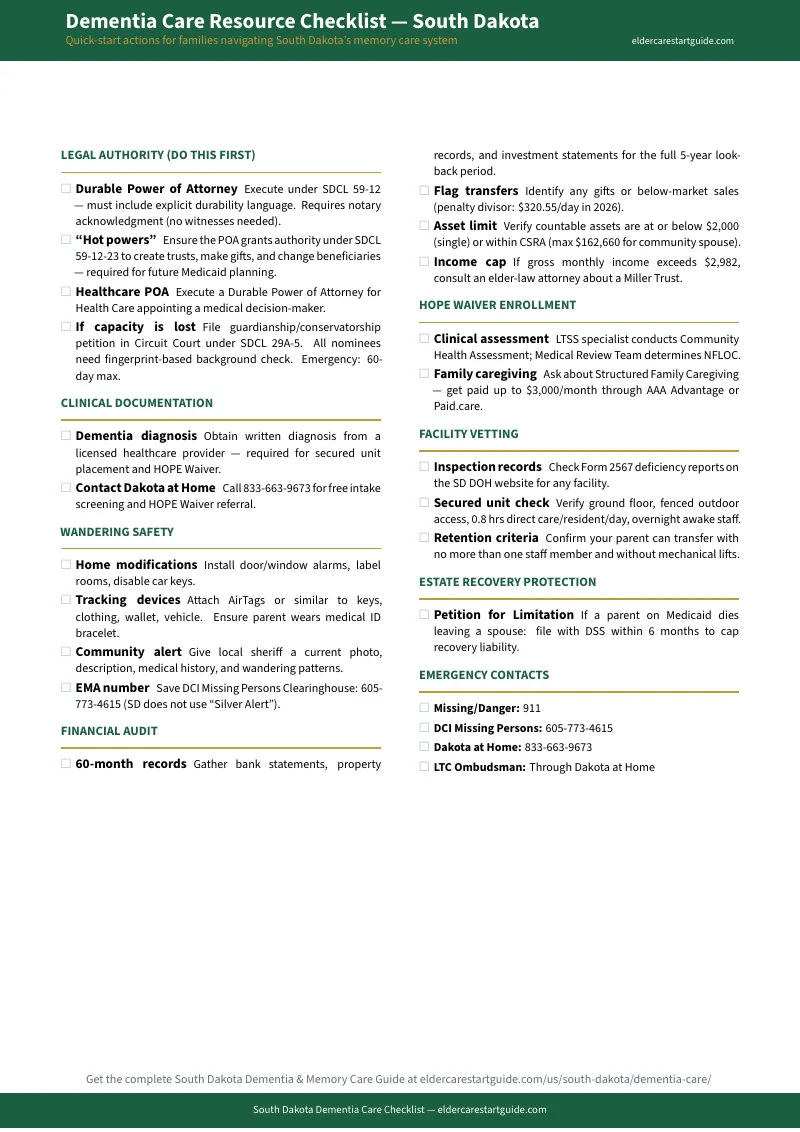
- Quick-Start Checklist — One-page 20-item action list with every threshold, phone number, and deadline at a glance
- First 30 Days Action Plan — 10-step plan for the first month: legal documents, wandering safety, and first calls
- HOPE Waiver Enrollment Guide — Eligibility limits, covered services, and the step-by-step enrollment process
- Medicaid Asset Protection Worksheet — Asset inventory, spousal protections, look-back audit, and penalty-free spend-down strategies
- ARSD 44:70 Memory Care Licensing Reference — Retention limits, secured unit rules, and the questions to ask on a tour
- Facility Vetting Checklist — Complete one per facility: physical environment, staffing, finances, discharge policies, and red flags
- Guardianship Petition Checklist — Circuit Court process under SDCL 29A-5: background checks, court visitor interviews, reporting forms
- Estate Recovery Protection Reference — Petition for Limitation deadline, exemptions, hardship waivers, and liability types
- Care Cost Comparison Sheet — Median costs by care setting, regional variations, and a worksheet for your family's comparison
- Resource Directory — Every phone number, website, and contact for South Dakota dementia care agencies, courts, and facilities
Who This Is For
- Adult children whose parent was just diagnosed with Alzheimer's or another form of dementia and need to know what to do first — in South Dakota, not generically
- Families managing care across distances in a rural state where the nearest memory care facility may be an hour or more from the family home
- Caregivers whose parent is approaching the ARSD 44:70 retention limits and will soon need to transition from assisted living to skilled nursing
- Families trying to protect the family home, farming assets, or a community spouse's savings from Medicaid's $2,000 asset limit and estate recovery
- Anyone who needs a Qualified Income Trust (Miller Trust) set up because their parent's income exceeds $2,982 and there is no spend-down option in South Dakota
- Caregivers who want to get paid through Structured Family Caregiving but cannot find clear instructions on how the program actually works
- Families facing a guardianship proceeding because a POA was never executed and their parent can no longer sign legal documents
Why Not Free Government Resources?
Dakota at Home provides intake screenings. The Department of Health publishes facility inspection records. The DSS website lists Medicaid eligibility limits.
Here is what none of them provide:
- A step-by-step sequence that tells you what to do first, second, and third — not a directory of agencies to call in no particular order
- The ARSD 44:70 retention limits explained in plain language, so you know exactly when your parent's assisted living facility will say "we can't keep them anymore"
- The asset protection strategies that are legal under South Dakota law, with the specific exemptions and timing rules that distinguish a Medicaid-approved spend-down from a penalized transfer
- A facility vetting system built on Form 2567 deficiency data — not commission-funded referral sites that steer families to their paying partners
- The Structured Family Caregiving enrollment process, which most families never hear about until they have already hired and paid a private aide out of pocket
State agencies administer programs. Elder law attorneys explain them at $300 to $500 per hour. This guide bridges the gap — translating hundreds of pages of South Dakota statutes, administrative rules, and agency procedures into a sequence you can work through in an evening.
Satisfaction Guarantee
If the guide doesn't give you a clearer path forward for your parent's care, email [email protected] and we'll make it right.
— Less Than One Hour of an Elder Law Attorney's Time
An initial consultation with a South Dakota elder law attorney runs $300 to $500. A full Medicaid planning engagement can exceed $5,000. A guardianship proceeding adds thousands more in court costs and legal fees.
This guide won't replace an attorney for complex trust litigation or multi-million dollar estate planning. But for the HOPE Waiver enrollment, asset mapping, facility vetting, and care transition planning that most South Dakota families need, it covers the process at a fraction of the cost — and if you do need an attorney, you'll walk in with organized records and the right questions instead of starting from scratch.
Start with the free checklist to see if the approach fits your situation. The full guide goes deeper — every threshold, every strategy, every form, every phone number.