
South Dakota Doesn't Regulate Private Home Care — and Its Estate Recovery Program Reaches Assets That Bypass Probate
Your parent needs more help than you can provide. You're researching options in South Dakota and the first thing you discover is a regulatory anomaly that most families learn about too late: the state has no licensing, regulation, or background-check requirements for private-pay non-medical home care agencies. Any individual can start an agency and place unvetted caregivers in your parent's home without state oversight. Medicare-certified home health agencies providing clinical services are regulated, but the private-pay personal care market — where most families start their search — is a complete regulatory vacuum.
Then the financial math hits. Private-pay home care in South Dakota runs roughly $101,244 per year at 44 hours per week — nearly double assisted living at about $4,350–$4,900/month. The state's HOPE waiver can fund home-based services through Medicaid, but qualifying requires meeting a Nursing Facility Level of Care clinical standard plus navigating a $2,000 asset limit, a $2,982 monthly income cap that may require a Miller Trust, and a 60-month financial lookback with the same penalty rules as institutional Medicaid. And if your parent eventually receives Medicaid long-term care benefits, South Dakota's expanded estate recovery program reaches assets that pass outside probate — joint bank accounts, survivorship deeds, life estates, living trusts — not just the probate estate. Hospital discharge planners are pushing for quick decisions. Commission-based referral services are calling. Every state website is written in administrative code for providers, not families.
The South Dakota Care Decision System
This guide maps the complete care decision pathway through South Dakota's elder care system — from the Community Health Assessment through care setting comparisons, the home care licensing gap, Structured Family Caregiving, Medicaid eligibility, the HOPE waiver, Miller Trust preparation, expanded estate recovery defense, facility vetting, and ombudsman advocacy. Every cost figure, asset threshold, waiver rule, and contact resource is specific to South Dakota's Department of Human Services, the Division of Long Term Services and Supports, Dakota at Home, and the Long-Term Care Ombudsman Program.
What separates this from government portals and placement referral sites: it connects the systems that South Dakota treats as separate bureaucratic processes. Your parent's Community Health Assessment, their HOPE waiver application, the licensing status (or absence of licensing) of the home care agency you're considering, the expanded estate recovery exposure of the family farm after death, and the legal authority documents that must be executed before capacity declines all interact — and families routinely discover mid-crisis that they missed a step that's now impossible to undo. The guide shows how these pieces fit together so you can sequence each decision correctly.
What's Inside — Printable PDFs
- guide.pdf — fourteen chapters covering every stage of the care decision: recognizing decline through ADL and IADL tracking, Dakota at Home intake and the Community Health Assessment, South Dakota's full care spectrum with cost comparisons (home care at ~$8,437/month or ~$101,244/year at 44 hours per week, assisted living at ~$4,350–$4,900/month, skilled nursing at ~$9,086–$10,189/month semi-private to private), the home care licensing gap and the vetting protocol for unregulated agencies, Structured Family Caregiving and the daily stipend program, assisted living centers regulated under ARSD 44:70, memory care, Community Living Homes, skilled nursing, legal authority (DPOA-HC, the SDCL 34-12C-3 surrogate hierarchy and its life-sustaining treatment gap, guardianship and conservatorship), Medicaid financial eligibility including the Miller Trust under ARSD 67:46:05:33.01, the 60-month lookback at $320.55/day and the HOPE waiver trap, expanded estate recovery under ARSD 67:48:02:01 with the 6-month petition, appeals and fair hearings, and a complete contacts directory
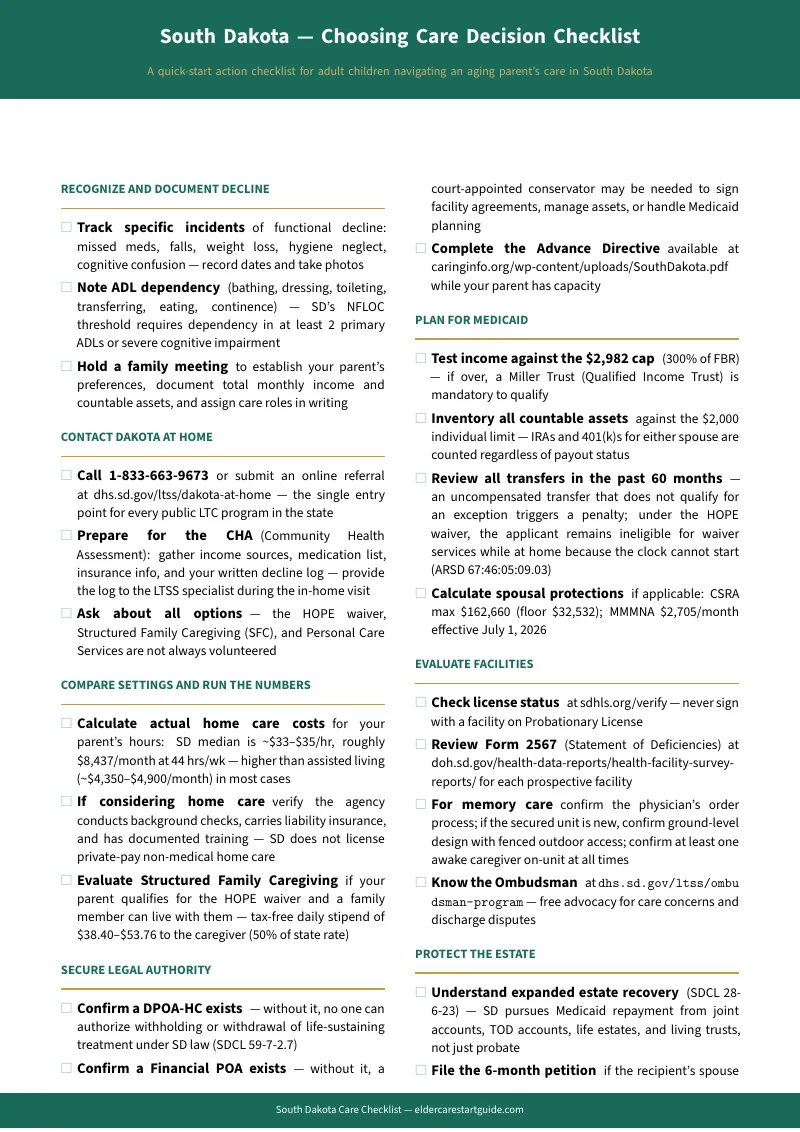
- checklist.pdf — a 22-item printable quick-start covering every key action from needs assessment through post-placement monitoring, mapped to the corresponding guide chapters
- decline-documentation-log.pdf — dated observation log of ADL/IADL decline to bring to the Community Health Assessment
- care-cost-comparison-worksheet.pdf — fillable cost comparison across home care, assisted living, memory care, Community Living Homes, and skilled nursing
- home-care-agency-vetting-checklist.pdf — screening questions for private-pay agencies in a state with no licensing or background-check requirement
- care-funding-decision-worksheet.pdf — compare HOPE waiver services, Structured Family Caregiving income, private-pay home care, and assisted living
- facility-evaluation-checklist.pdf — print-and-carry tour notes for assisted living, memory care, and skilled nursing
- legal-authority-inventory.pdf — inventory of DPOA-HC, financial POA, advance directives, and gaps before a crisis
- medicaid-eligibility-worksheet.pdf — walk the $2,982 income cap, $2,000 asset limit, and spousal protections with your parent's numbers
- miller-trust-preparation-checklist.pdf — documents an elder-law attorney needs to set up a Qualified Income Trust
- look-back-transaction-review.pdf — 60-month transfer audit using South Dakota's $320.55/day penalty divisor
- estate-recovery-action-checklist.pdf — 6-month surviving-spouse petition deadline and related documentation
- agency-communication-log.pdf — dated log of every call, email, and meeting with Dakota at Home, DSS, LTSS, facilities, and professionals
Who This Is For
- Adult children watching a parent's slow decline — missed medications, skipped meals, unexplained bruises — who need a structured way to evaluate whether it's time for outside help
- Families in a hospital discharge crisis, with Medicare's skilled nursing benefit running out and a discharge planner pushing for a quick decision about what comes next
- Anyone comparing home care vs. assisted living vs. nursing home care in South Dakota and trying to understand the cost math — especially why private-pay home care at ~$8,437/month for 44 hours per week can approach double the cost of assisted living at ~$4,350–$4,900/month
- Families hiring private-pay home care and alarmed that South Dakota has no state licensing or background-check requirements for non-medical agencies — you need a structured vetting process before placing anyone in your parent's home
- Families trying to determine if their parent qualifies for the HOPE waiver and what the Community Health Assessment actually measures — including how to prepare so the assessment accurately captures your parent's needs
- Out-of-state adult children in Minneapolis, Denver, or Omaha coordinating care for a parent in rural South Dakota who need a remote-management framework and a clear decision sequence
- Siblings who disagree about what level of care is appropriate and need a clinical framework based on documented ADL deficits rather than competing opinions
- Families trying to protect the family farm or home from expanded estate recovery — and need to understand the specific exemptions, the 6-month petition deadline, and the Long-Term Care Partnership Program before it's too late
Why Free Resources Leave You Stuck
Dakota at Home publishes service directories, options counseling referrals, and program overviews. The Department of Health posts assisted living and nursing home survey reports. But these resources are designed for providers and administrators — ARSD 44:70 and ARSD 67:48:02:01 are not family planning guides. You can find the HOPE waiver eligibility criteria on the Department of Human Services website, but you won't find a walkthrough that connects the clinical assessment to the financial application to the legal authority preparation in a sequence a family can follow. And critically, the state publishes nothing about how to vet the private-pay home care agencies it doesn't regulate.
Senior living referral services will match you with assisted living communities for free — because the facilities pay them the equivalent of one month's rent per placement as a commission. They recommend only facilities within their paid network, which means they routinely omit non-participating homes, non-profit options, and state-subsidized programs like the HOPE waiver and Personal Care Services. Their recommendations are shaped by their revenue model, not your parent's needs.
Elder law attorneys and Medicaid planners provide expert guidance — at $300 to $500 per hour. For families navigating Miller Trust setup, complex asset structures, or contested guardianship, professional counsel is essential. But you shouldn't be paying attorney rates to learn how South Dakota's home care licensing gap works or to understand the income-cap Medicaid model. Using this guide to organize your records and understand the system before your first consultation can save hours of billable time.
Satisfaction Guarantee
If the guide doesn't help you identify at least one care setting, waiver program, or vetting step you weren't already aware of, email [email protected] for a full refund, no time limit.
Start Navigating South Dakota Elder Care with Confidence
Download the free checklist to get the care decision overview — or get the full toolkit for and have 13 printable PDFs: the fourteen-chapter guide, the 22-item checklist, and 11 fillable worksheets covering decline documentation, cost comparison, home care agency vetting, funding decisions, facility evaluation, legal authority, Medicaid eligibility, Miller Trust preparation, the 60-month look-back, estate recovery, and agency communication.