Your Parent Needs Long-Term Care. South Carolina's Medicaid System Won't Walk You Through It.
The nursing home costs $8,000 to $10,000 a month. Medicare covered the first 20 days, co-pays kicked in, and after day 100 the coverage stops entirely. The discharge planner says you need to "apply for Medicaid" — but nobody explains how a system with a $2,982 income cap, a $2,000 asset limit, and a 60-month lookback audit of every bank transaction actually works.
South Carolina is a strict income-cap state. If your parent's gross income exceeds $2,982 by even one dollar, the application is denied. No spend-down exception, no medically needy pathway — unless you set up a Qualified Income Trust first, which nobody at the hospital mentioned. The state will audit five years of bank statements, property transfers, and gifts. A single gift to a grandchild three years ago could trigger a penalty period that leaves your family paying out of pocket for months.
And here's the part that catches South Carolina families off guard: the spousal asset limit is a flat $66,480. Other states allow up to $162,660. If your parents have more than $66,480 in combined savings, your healthy parent must spend down to that number before the application goes through — regardless of their age or retirement needs.
Elder law attorneys in South Carolina charge $300 to $500 an hour. A full Medicaid planning engagement runs $5,000 to $10,000. You shouldn't need to spend that just to understand the process.
— The SC Medicaid Protection Navigator
This is the SC Medicaid Protection Navigator — a step-by-step guide that takes the entire South Carolina Medicaid long-term care process and maps it into a sequential system you can follow from crisis to coverage. It covers every decision point between "the hospital says Mom can't go home" and "Medicaid is approved, the home is protected, and the bills are covered."
It's not a national overview with South Carolina mentioned in a sidebar. It's not a one-page eligibility checklist from a referral service that earns commissions from the facilities it recommends. This is the specific regulatory, financial, and legal process for South Carolina — the income caps, the flat $66,480 CSRA, the QIT setup instructions, the Community Choices Waiver mechanics, the lookback exceptions, the probate-only estate recovery rules — organized in the order you'll actually need them.
What's Inside — 11 PDFs
- Complete 13-Chapter Guide (guide.pdf) — the full South Carolina Medicaid long-term care process from crisis to coverage, including eligibility pathways, QIT setup, asset spend-down strategies, the five-year lookback, Community Choices Waiver, spousal protections under the flat $66,480 CSRA, estate recovery, appeals, and the application walkthrough.
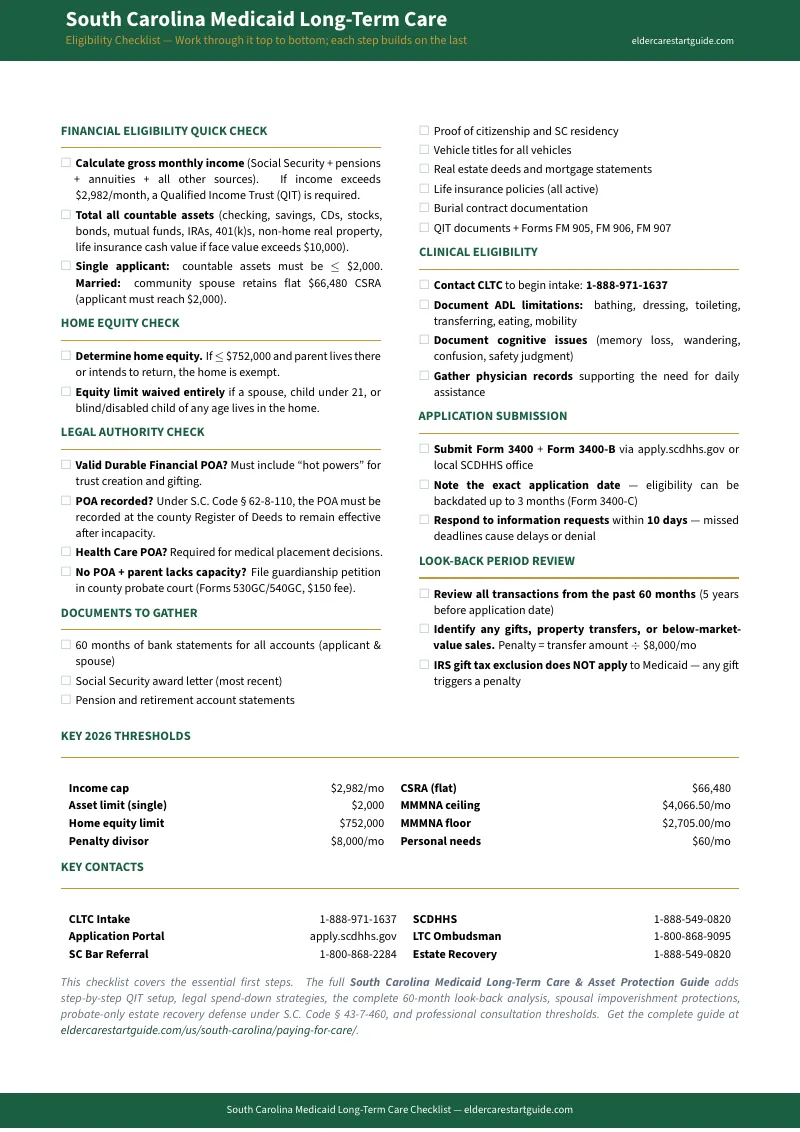
- Eligibility Checklist (checklist.pdf) — a quick-reference overview of South Carolina's income limits, asset limits, and the critical steps from confirming clinical eligibility through submitting the application. Includes the 20-item action checklist.
Plus 9 standalone printable worksheets:
- Income & Asset Eligibility Worksheet (eligibility-worksheet.pdf) — calculate your parent's income against the $2,982 cap, inventory countable vs. exempt assets, and determine the spend-down amount
- QIT Setup Checklist (qit-setup-checklist.pdf) — step-by-step Miller Trust setup with the mandatory monthly distribution sequence and SCDHHS form numbers
- Monthly QIT Distribution Worksheet (monthly-qit-distribution.pdf) — print one per month to log income deposits, distributions in the mandatory sequence, and month-end balance verification
- Asset Spend-Down Strategy Planner (spend-down-planner.pdf) — track penalty-free spend-down methods with a running total from starting assets to the $2,000 limit
- Five-Year Lookback Audit Log (lookback-audit.pdf) — 60-month transfer log with SC's $8,000 penalty divisor calculation and exempt transfer reference
- Estate Recovery Vulnerability Assessment (estate-recovery-worksheet.pdf) — asset-by-asset probate exposure review with SC's protection strategies and $25,000 minimum threshold
- Application Document Checklist (application-document-checklist.pdf) — every form and document needed for the Healthy Connections portal, organized by category
- Step-by-Step Action Timeline (action-timeline.pdf) — the 5-phase crisis-to-coverage roadmap with checkboxes for each action item
- Contacts & Forms Quick Reference (contacts-forms-reference.pdf) — key phone numbers, PACE locations, all form numbers, and 2026 eligibility thresholds on one page
Who This Is For
- Adult children trying to figure out how to pay for a parent's nursing home, assisted living, or home care in South Carolina — especially after a hospital discharge or sudden decline
- Families facing the 100-day Medicare cliff and needing to transition a parent to Medicaid coverage before savings run out
- Spouses trying to understand how to protect their own retirement assets and income under South Carolina's restrictive flat $66,480 spousal limit
- Caregivers exploring whether the Community Choices Waiver can fund home-based care — and how to navigate the 23,000-person interest list
- Families who've been told they need a Miller Trust but don't know what it is, how to set one up, or how to manage it after approval
- Heirs who've received (or want to prevent) an estate recovery notice from the South Carolina Medicaid Estate Recovery Program
Why Not Just Use Free Resources?
South Carolina publishes Medicaid eligibility rules across the Department of Health and Human Services (SCDHHS), the Community Long Term Care offices (CLTC), the Department on Aging, and the GetCareSC.com portal. The information exists — it's scattered across agencies that don't coordinate, written in regulatory language, and organized by bureaucratic function instead of by what you need to do next.
National referral services like A Place for Mom will find you a facility for free. But they earn commissions from the facilities they recommend, so they steer toward private-pay assisted living and memory care. They don't cover Medicaid waivers, Community Choices Waiver interest lists, QIT setup, or estate recovery protections because there's no referral fee attached. This guide covers every option — including the ones nobody gets paid to tell you about.
Elder law attorneys provide excellent planning — at $5,000 to $10,000 for a full engagement. This guide gives you the same step-by-step process, the same checklists, and the same asset protection strategies so you can manage it yourself. If you do need an attorney for a specific issue, you'll know exactly which issue to hire them for instead of paying for a full engagement.
Satisfaction Guarantee
If the guide doesn't help you navigate South Carolina's Medicaid system more confidently, email us within 30 days for a full refund. No forms, no questions.
Get Started Now
Download the free Eligibility Checklist to see whether your parent is likely to qualify. When you're ready for the full process — the QIT setup checklist, the spend-down planner, the lookback audit log, the application document checklist, and the estate recovery assessment — get the complete SC Medicaid Protection Navigator with all 11 PDFs.