
Your parent needs help. South Carolina law says you're a stranger.
The bank won't release funds from their account. The hospital discharge planner needs someone to sign the facility admission contract and you don't have standing. The Community Long Term Care office won't process a waiver application without a legally authorized agent. You've been managing your parent's daily care for months — but without the right documents, South Carolina treats you like any other member of the public.
Getting legal authority in South Carolina isn't one document. It's a system of interlocking instruments — a Durable Financial Power of Attorney under the S.C. Uniform Power of Attorney Act (§ 62-8-101 et seq.), a Healthcare Power of Attorney under § 62-5-504, and potentially a guardianship or conservatorship petition through Probate Court when capacity is already gone. Miss the recording requirement under § 62-8-109(c) and your POA is unenforceable after incapacity. Skip the explicit "hot powers" clause and your Medicaid planning authority vanishes. Execute the Healthcare POA with the wrong witnesses and the entire document is void.
The South Carolina Legal Authority System
This kit replaces the scattered, contradictory information with a single system built around South Carolina's actual statutes and administrative processes. It's the difference between guessing which forms apply and knowing exactly which documents to execute, in what order, with the precise language South Carolina's banks, hospitals, and state agencies require.
What's Inside
- Durable Financial POA Walkthrough — the exact durability language under § 62-8-104, the two-witness-plus-notary execution requirements of § 62-8-105, the mandatory post-incapacity county recording step under § 62-8-109(c) that most families discover too late, and the "hot powers" clause under § 62-8-201 that your agent needs to create Miller Trusts, gift assets, and restructure property for Medicaid eligibility
- Healthcare POA & Advance Directive Packet — the statutory Healthcare Power of Attorney form under § 62-5-504, the strict witness exclusion rules (no spouses, children, grandparents, siblings, treating physician employees, or named heirs), the Declaration of a Desire for a Natural Death under § 44-77-40, and the two-physician terminal certification trigger
- Capacity Assessment Protocol — how to evaluate cognitive capacity using the "contractual capacity" standard from In re Thames, 344 S.C. 564, what lucid intervals mean for document execution, when supported decision-making is sufficient, and the boundary where voluntary documents end and court petitions begin
- Probate Court Guardianship & Conservatorship Filing Roadmap — the Dual Petition (Forms 520GC/530GC), the $150 filing fee, the $25 SLED background check, the physician's Examiner Report (Form 539GC), service-of-process rules, the Guardian ad Litem review, the 1.5x liquid asset surety bond for conservators with estates exceeding $15,000, and the annual Conservator Report (Form 567GC)
- Emergency Guardianship Procedures — the § 62-5-310 temporary appointment process, the 90-day term limit, and the Adult Health Care Consent Act emergency consent provisions under § 44-66-30
- Bank Compliance Toolkit — the § 62-8-120 strict liability citation, the seven-business-day compliance window, the Agent Certification form under § 62-8-119, and the exact statutory demand language to present to branch compliance officers when a bank refuses your POA
- Medicaid & Community Choices Waiver Guide — South Carolina's 2026 Healthy Connections eligibility thresholds ($2,982/month income, $2,000 countable assets), the nursing-facility level of care (NFLOC) assessment through local CLTC offices, the Community Choices Waiver waiting list, Qualified Income Trust (Miller Trust) setup when income exceeds the cap, and the Community Spouse Resource Allowance
- Estate Recovery Protection — South Carolina's probate-only MERP rules under § 43-7-460, which assets transfer outside probate and are exempt from state recovery, and how joint tenancy with rights of survivorship protects the family home
- Planning Worksheets & Contacts — capacity assessment worksheet, POA execution tracker, bank compliance checklist, court filing tracker, Medicaid financial inventory, care facility comparison worksheet, agency communication log, and a 72-hour crisis workflow
Who This Kit Is For
- You're in crisis. Your parent was just hospitalized or diagnosed, and you need to establish legal authority within days. The kit gives you the exact filing sequence so nothing gets missed under pressure.
- You're planning ahead. Your parent is declining but still has capacity. You have a window to execute voluntary documents — and the kit shows you every clause that matters before that window closes.
- You're filing pro se. An elder law attorney quoted you $2,000–$5,000 for a guardianship petition. The kit walks you through every Probate Court form, every deadline, and every service requirement so you can file the petition yourself.
- You're navigating Medicaid. Your parent's savings are draining and you need to transition to publicly funded care. The kit explains exactly how to structure the POA, handle the spend-down, and protect the family home from estate recovery.
Why Not Just Use Free Forms?
South Carolina publishes a free statutory Healthcare POA form — and that form covers one piece of the puzzle. But the state does not publish a standard fill-in-the-blank form for financial powers of attorney. The generic templates on national legal document sites use boilerplate language that routinely omits the clauses South Carolina institutions actually scrutinize. A financial POA without explicit "hot powers" under § 62-8-201 cannot create a Miller Trust or restructure assets for Medicaid planning. A document that hasn't been recorded at the county Register of Deeds under § 62-8-109(c) is legally unenforceable after incapacity. Free forms give you a document. This kit gives you a system — the right documents, executed correctly, with every clause South Carolina's banks, hospitals, and state agencies actually require.
What You're Getting
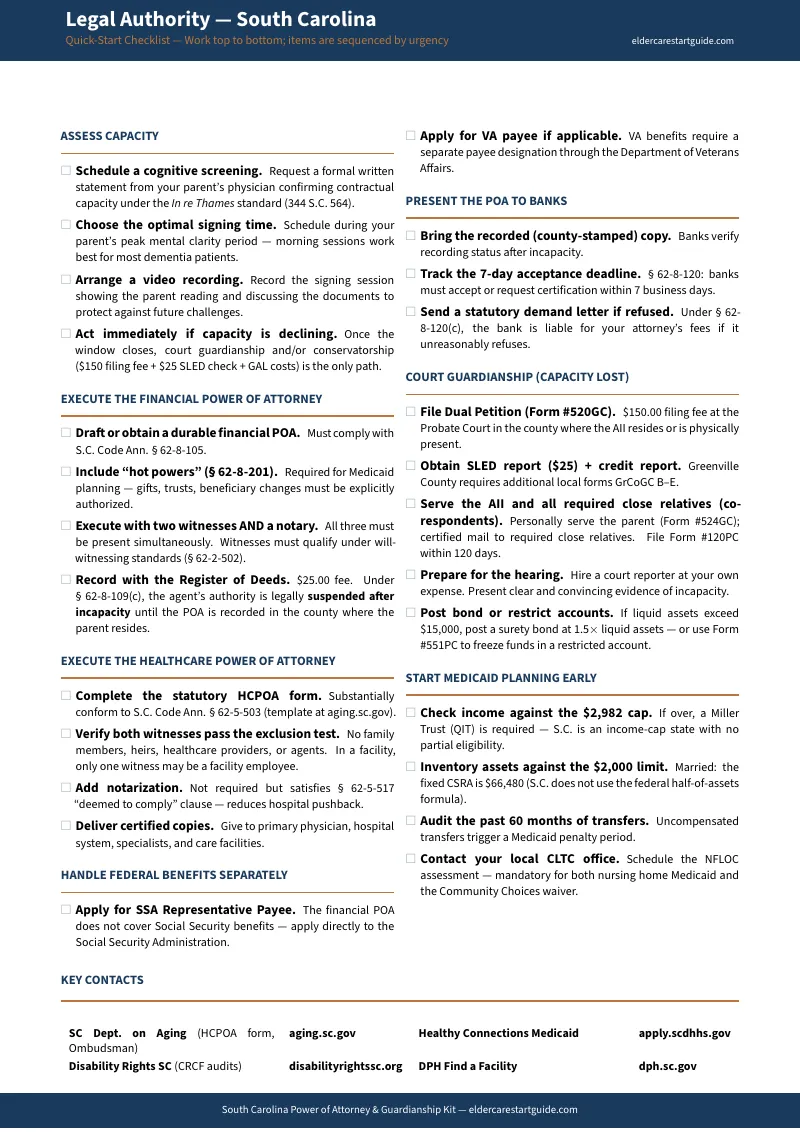
A 42-page guide covering every legal instrument, worked examples with real cost breakdowns and penalty calculations, a printable quick-start checklist, and 10 standalone planning worksheets — including a capacity assessment checklist, POA execution ceremony guide, bank presentation log, guardianship petition assembly guide, Medicaid eligibility worksheet, Miller Trust disbursement tracker, and agency communication log. The full kit is available for , and a free checklist is available if you want to see the approach before committing.
Satisfaction Guarantee
If the kit doesn't give you a clearer path to legal authority than what you've found on your own, email [email protected] and we'll refund your purchase in full — no time limit, no forms to fill out.