
Your Parent Is Being Discharged. Nobody Told You What Happens Next.
The case manager just said your parent is going home tomorrow. They're still unsteady on their feet, the medication list changed three times this week, and you just overheard something about "observation status" that nobody bothered to explain. You're supposed to figure out rehab coverage, home modifications, and insurance paperwork — all before noon.
Most families don't realize that a single administrative designation — whether the hospital classified your parent as "inpatient" or "observation" — can mean the difference between Medicare covering rehabilitation and your family paying roughly $9,034 per month out of pocket. And that's just the first decision in a chain of high-stakes choices where the wrong move, or no move, costs thousands.
The Discharge Navigation System
This is not a pamphlet telling you to "ask about home care." The Hospital-to-Home in South Carolina guide is a structured decision-by-decision system that follows the exact sequence of the transition — from the moment you learn about a discharge date through long-term care eligibility. Every chapter is built around the specific moment you'll face it, with South Carolina's actual rules, phone numbers, and financial thresholds baked in.
Where a hospital social worker hands you a printed list of facilities and wishes you luck, this guide gives you the operational knowledge to challenge premature discharges, verify billing status, protect your parent's assets, and set up the right care — without relying on a $400-an-hour elder law attorney to explain what the forms mean.
What's Inside
- Observation Status Diagnostic — a step-by-step protocol for verifying your parent's billing status within 24 hours, including the exact department to call and what to say. If they're under observation, you'll know how to request reclassification and use the 2025 Medicare Change of Status Notice appeal to restore inpatient status before it's too late.
- QIO Discharge Appeal Playbook — the complete process for filing a fast-track appeal with Acentra Health (1-888-317-0751) to legally freeze an unsafe discharge. Includes filing deadlines, what happens after you call, and what to do if you miss the window.
- SNF Coverage Countdown — a clear breakdown of Medicare's 100-day skilled nursing benefit structure, including the co-insurance costs that start on day 21, what "plateauing" actually means clinically, and how to fight a Notice of Medicare Non-Coverage when the facility says coverage is ending early.
- Asset Protection and Spend-Down Matrix — South Carolina's exact 2026 Medicaid financial thresholds: the $2,000 single asset limit, $2,982 monthly income cap, $66,480 flat spousal CSRA, and $752,000 home equity exemption. No guessing, no out-of-state numbers.
- Miller Trust Implementation Guide — a checklist for setting up a Qualified Income Trust when your parent's income exceeds the $2,982 cap, including what the trustee can disburse each month and how to calculate patient liability.
- Medicaid Pending Eviction Protection Kit — clear instructions for managing a nursing home admission while Medicaid is under review. Covers which signature lines to avoid in facility paperwork, how to calculate and pay monthly patient liability, and federal protections against eviction during the pending period.
- Community Choices Waiver Action Plan — the full application process for South Carolina's home and community-based services program, including how to prepare for the CLTC clinical assessment, what the waitlist means practically, and how to use the self-directed Attendant Care option to get paid as a family caregiver.
- Legal Authority Safeguard Checklist — a diagnostic tool for verifying whether your parent's existing Power of Attorney and Healthcare Power of Attorney documents meet South Carolina's strict witness and notarization requirements, before a capacity crisis forces a costly Probate Court guardianship proceeding.
- Facility Admission Paperwork Guide — a clause-by-clause walkthrough of what you're actually signing when a nursing home hands you the admission packet. Identifies "responsible party" and "financial guarantor" language that creates personal liability, and explains how to sign as the patient's representative without accepting the debt.
- DME Pre-Discharge Protocol — how to use the Medicare pre-discharge delivery rule to get durable medical equipment delivered, fitted, and trained on before your parent leaves the hospital — not three days later when they're already home.
Who This Guide Is For
- Adult children managing a parent's discharge from a South Carolina hospital — whether the discharge is happening tomorrow or next week
- Families whose parent is in SNF rehab and approaching the end of Medicare coverage
- Caregivers navigating the Healthy Connections Medicaid application while simultaneously planning a transition
- Anyone who has been told their parent "doesn't qualify" for home services and wants to understand the actual eligibility rules
Why Not Just Google It
You can absolutely piece this together yourself. The SCDHHS policy manual is online. The Acentra Health appeals process is documented if you know where to look. Medicare's coverage rules are public.
The problem isn't that the information doesn't exist — it's that it's scattered across six different government websites written in regulatory language, and the pieces don't tell you which steps to take in what order. A family searching "South Carolina Medicaid nursing home" at 10 PM from a hospital waiting room doesn't need another FAQ page. They need a map — one that connects the discharge decision to the coverage timeline to the financial eligibility pathway in the exact sequence those decisions arrive.
That's what this guide does. It takes the operational knowledge that elder law attorneys charge $350 to $500 per hour to explain and puts it in a structured format you can work through at your own pace — turning what could be a multi-hour legal consultation into preparation you complete before your first meeting.
The Free Checklist Gets You Started
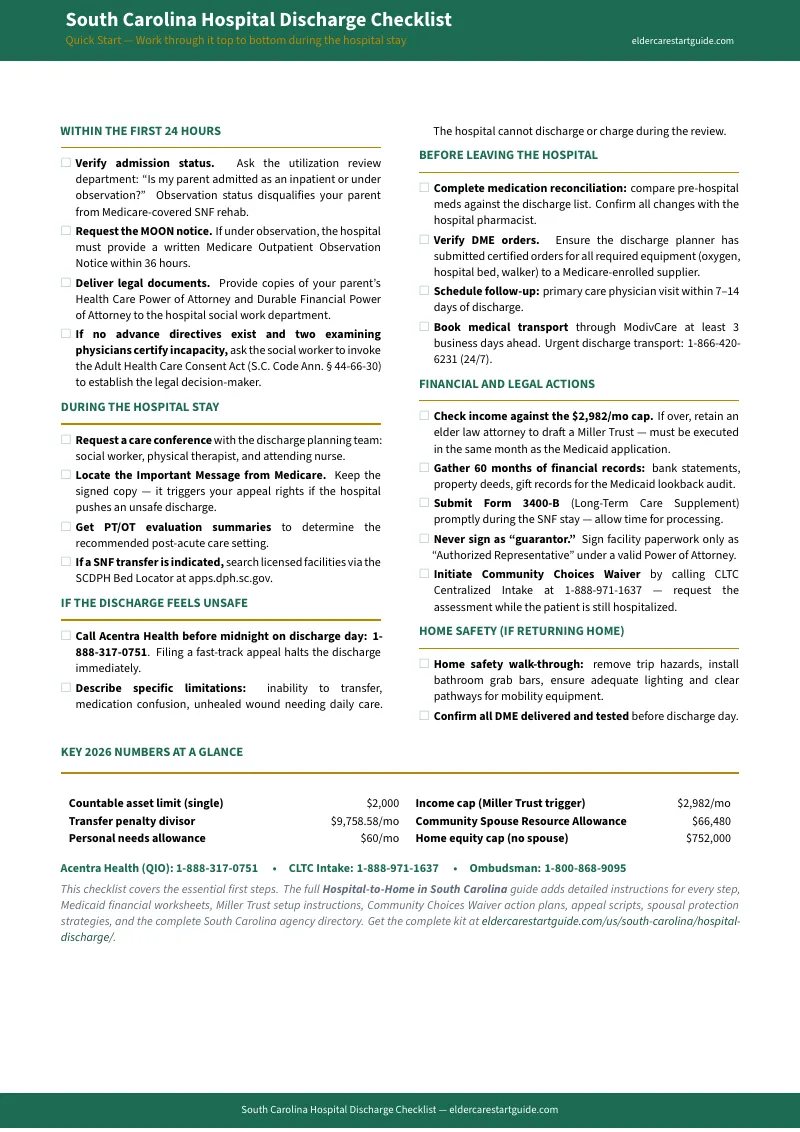
Not ready for the full guide? Download the free South Carolina — Hospital Discharge Checklist — a focused checklist covering the most critical steps in the first 72 hours after a discharge notice. It includes the QIO appeal phone number, observation status verification steps, and a discharge-day action sequence. If you need the complete system — the Miller Trust walkthrough, the Medicaid application pathway, the facility paperwork guide — the full toolkit is here when you're ready.
Satisfaction Guarantee
If the guide doesn't give you a clearer picture of your parent's transition options within the first hour of reading, email [email protected] and we'll make it right.