The form arrived. The clock is ticking. And nothing on it tells you what to do.
You opened the envelope from the Wilkes-Barre Direct Operations Center and found Form SSA-623 — the annual representative payee accounting report. It says you have 30 days. It lists a Total Accountable Amount you don't recognise. It asks you to sort a year's worth of spending into two categories: Food and Housing, and everything else. And it warns that failure to respond could mean losing your appointment as payee.
You have been managing your parent's Social Security benefits all year — paying rent, buying groceries, handling medical co-pays, keeping the lights on. You have the bank statements. You have most of the receipts. What you don't have is a system that turns twelve months of scattered paperwork into the numbers this form is asking for.
The Accounting Confidence System
The Representative Payee Annual Accounting guide is a step-by-step reporting companion built for individual family payees — especially adult children and other relatives who manage a parent's or loved one's benefits and need to file Form SSA-623 correctly. Exempt payees can also use its year-round recordkeeping and review guidance.
It doesn't just explain the form. It gives you a recordkeeping system you use all year long, so when the form arrives you are sorting organised records instead of searching through shoe boxes.
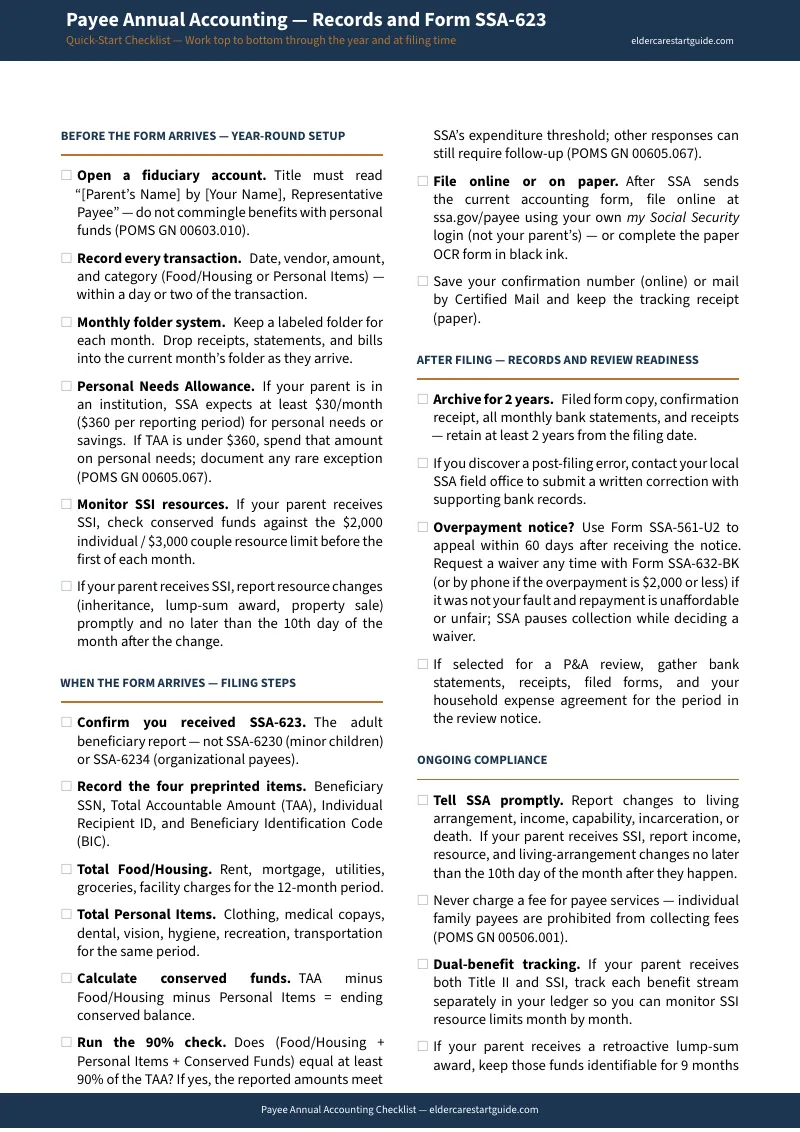
The free checklist gives you the filing steps and the recordkeeping rules across two pages. The full kit adds the 47-page guide plus ten fillable PDFs you print and write on.
What's Inside the Full Guide
- Who files, who's exempt, and which form to use — the 2018 Strengthening Protections Act created permanent exemptions for natural or adoptive parents of a minor child or disabled individual who primarily lives in the same household, legal guardians of a minor child who primarily lives in the same household, and beneficiaries' spouses, including spouses who live separately. The Exemption Decision Path (one printable page) tells you in under a minute whether you need to file, and if so, whether you need Form SSA-623 or a different version.
- Form SSA-623 line by line — every line explained in plain language, including where to find the Total Accountable Amount, how to allocate shared household costs between Food and Housing and Personal Items, and how the online my Social Security portal pre-fills some of the numbers for you. Draft your answers on the Form SSA-623 Line Worksheet before you copy them onto the official mailer.
- Three worked examples from bank statement to finished form — a beneficiary in a nursing facility, one sharing a household with the payee, and one who received a retroactive award. Each example shows the full math: starting balance, monthly income, categorised expenses, conserved funds, and the final reconciliation. The Annual Accounting Reconciliation Worksheet is the same math with blanks for your numbers and SSA's 90% review tolerance.
- Year-round recordkeeping system — a Monthly Spending Log that sorts expenses into the SSA's two categories as you go, so the annual form takes minutes instead of a weekend. Includes a folder structure for the two-year records retention period.
- Saved benefits and the SSI resource limit — how conserved funds work under Title II versus Title XVI, the nine-month retroactive benefit exclusion, and when accumulated savings trigger an internal SSA review. Track the first-of-month balance on the Conserved Funds SSI Tracker.
- Protection and Advocacy review preparation — what a P&A site visit involves under the 2018 law, the records a reviewer may ask to see, and a P&A Review Preparation Checklist you can run before anyone else does.
- Late and mismatched reports — what Social Security does when a report is overdue or the numbers don't add up, the reminder sequence, and a Late Report Recovery Checklist for each stage.
- SSA Communication Log — a structured template for recording every phone call, portal submission, and office visit, with space for confirmation numbers and agent names. If a form gets lost or a submission doesn't go through, the log helps you document the filing and your follow-up.
- Account Titling Verification Checklist and Shared Household Cost Worksheet — confirm the fiduciary account title matches POMS GN 00603.010, and allocate a proportional share of real household bills when your parent lives with you.
Who This Is For
- Adult children who are a parent's representative payee — you manage the money, you sign the form, and you need a system that keeps you organised all year
- Spouses and siblings helping the appointed payee — you do the paperwork while the named payee signs; the guide gives you the same step-by-step path
- Retirees serving as payee for a spouse or adult disabled child — fixed-income households where every dollar is accounted for and the SSI resource limit adds another layer
Why Not Just Use the Free SSA Instructions?
The SSA publishes a one-page monthly log and a general payee guide. They explain what you must do — file the form, keep records, spend benefits on the beneficiary's needs. What they don't give you is a system for doing it.
The official instructions don't show you how to split a utility bill between Food and Housing and Personal Items when your parent lives with you. They don't walk you through reconciling your bank balance against the pre-printed Total Accountable Amount when the numbers are off. They don't tell you what a Protection and Advocacy reviewer will actually look at when they visit, or what to do when you have lost some receipts from six months ago.
The free guides explain the rules. This guide gives you the execution — worked examples, categorisation lookups, and a recordkeeping system that makes the annual form straightforward instead of stressful.
Satisfaction Guarantee
If the guide doesn't help you complete your annual accounting with confidence, email [email protected] for a full refund. No time limit, no questions.
Frequently Asked Questions
Is this an official government form or document?
No. This is an independent guide published by Elder Care Start Guide. It is not produced by, endorsed by, or affiliated with the Social Security Administration. The guide explains the official process and directs you to SSA's own forms and resources throughout.
I'm already my parent's payee. Do I need the representative payee guide too?
Only if you have questions about the initial application or the first year of payee duties. This guide focuses specifically on the annual accounting report and ongoing recordkeeping. The companion representative payee guide covers Form SSA-11 and the appointment process.
What if my parent receives SSI instead of regular Social Security?
The guide covers both Title II (retirement and disability insurance) and Title XVI (Supplemental Security Income). The SSI sections explain the resource limit, the nine-month retroactive benefit exclusion, and how conserved funds are reported differently from Title II savings.
Can I file the report online?
Yes. The guide walks you through both the paper form and the my Social Security online portal, including the four items you need from the paper notice to log in and what to do if the portal doesn't work.
What if I already missed the deadline?
The guide includes a section on late reports — the reminder sequence, what happens at each stage, and how to respond. Filing late is better than not filing at all, and the guide shows you how to handle it.
Frequently Asked Questions
What if the rules change after I buy?
We update the guide when the rules change. Email us any time, even years later, and we'll send you the current edition free.