The letter says you owe thousands. The math says otherwise.
An overpayment notice from Social Security is not a bill you simply pay. It is a claim — and claims can be wrong. Earnings counted twice. A pension amount misread from a form that was right when you filed it. A report you submitted on time that never made it into the system.
The problem is that proving the error means navigating the same bureaucracy that made it. You need the agency's month-by-month calculation before you can challenge it. You need to know which form to file, what to write in the reason statement, and how to assemble the evidence so the reviewer can follow your argument without digging through a pile of loose papers.
That is what this guide does. It is a Calculation Dispute System — a structured process for getting the numbers, testing them against your own records, and filing the strongest reconsideration request you can build.
What you get
- Monthly Calculation Audit Worksheet — a print-ready month-by-month table to compare what the agency says it paid against your bank deposits, pay stubs and pension vouchers, so discrepancies jump off the page instead of hiding inside a lump-sum demand
- Five common error tests — step-by-step checks in the guide for duplicate wage postings, wrong-year earnings allocation, WEP/GPO reductions after December 2023, unprocessed timely reports and Annual Earnings Test misapplication
- Form SSA-561 walkthrough — field-by-field instructions including how to write the reason statement so it identifies the specific error, not just "I disagree"
- Evidence Cover Index — a numbered cover sheet that tells the reviewer exactly what each attached document proves, so nothing gets lost in the field office
- Three types of reconsideration explained — case review, plus the informal and formal conference options available for SSI cases, with a plain-English breakdown of when each applies and what to expect
- Deadline Calendar — fill-in dates for the 60-day reconsideration deadline, Title II's 30-day collection-pause window, SSI's 60-day recovery-pause window from the notice date, and a good-cause framework for anyone who missed the deadline because of illness, missing records or agency misinformation
- Dual filing roadmap — when it makes sense to file both a reconsideration (Form SSA-561) and a waiver (Form SSA-632-BK) at the same time, and how the two requests interact
- Post-Filing Benefit Monitor — a deposit-by-deposit log for whether withholding has actually been paused after you file, so you are not caught off guard by a check that comes up short
- Filing and Proof-of-Receipt Tracker and Agency Communication Log — printable records of every submission and every call, visit or letter
Who this guide is for
This guide is written for two people: the retiree who received the notice, and the adult child or family member who is going to help sort it out.
If you are the retiree, the guide walks you through the process in plain English — no legal jargon, no POMS citations without an explanation of what they mean. If you are the helper, it covers the authority you need to act on a parent's behalf (a general power of attorney does not work here) and what records to gather when you do not have the beneficiary's full financial history in front of you.
The guide focuses on disputing the amount. If you agree the amount is correct and were not at fault, a waiver may apply if recovery would defeat the purpose of the Act or be against equity and good conscience — that process uses a different form and is covered in our overpayment waiver guide.
Why not just use the free resources?
You absolutely can. The form itself is free on SSA.gov. Legal aid organizations publish excellent toolkits. The Program Operations Manual System contains SSA's operating instructions.
The gap is execution. The form does not tell you how to audit the calculation. Legal aid toolkits have income eligibility limits and geographic boundaries. The POMS is an operating manual written for agency technicians, not for someone trying to figure out why their check dropped by $400 this month.
This guide takes the same rules and turns them into a step-by-step workflow: request the calculation, test it against your records, write the reason statement, assemble the evidence, file the form, and track what happens after. Everything in one place, in the order you actually need it.
What this guide does not do
It does not give legal, tax or financial advice. It does not promise that the overpayment will be reduced or eliminated — that depends on the facts of your case and the agency's decision. It does not replace an attorney when one is needed. It is a process guide: it shows you the steps, the forms, the deadlines and the evidence so you can walk into the field office with an organized case instead of a stack of worries.
Free checklist included
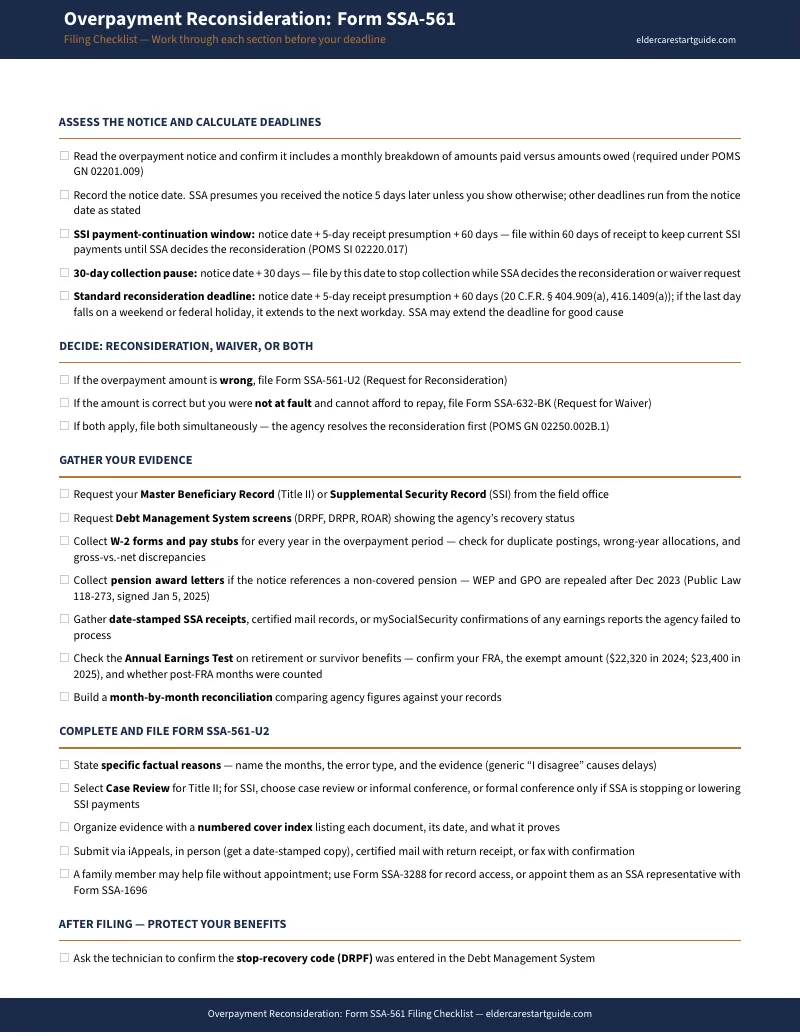
Not sure where to start? Download the free two-page filing checklist. It covers the deadline, the form choice (reconsideration vs. waiver), the essential evidence and the proof-of-delivery steps. No purchase required — and if the checklist is enough for your situation, you are done.
If your case is more complex — multiple years of disputed earnings, a pension issue, or a late filing — the full guide is where the detail lives.
The guide comes with a full refund, no time limit. If it does not help, email [email protected] and you get your money back.
Get the Calculation Dispute System — everything you need to challenge an overpayment amount, from requesting the numbers to filing Form SSA-561, in one organized guide for .
Frequently Asked Questions
What if the rules change after I buy?
We update the guide when the rules change. Email us any time, even years later, and we'll send you the current edition free.