Your waiver was denied. A Title II personal-conference denial can go to an ALJ hearing; SSI requires reconsideration first.
The personal conference is over. If SSA denied a Title II waiver after that conference, you can request a hearing before an administrative law judge. For SSI (Title XVI), request reconsideration of the waiver denial first; after that decision, you can request a hearing. If your reconsideration came back unfavorable, the hearing is the next appeal level.
For people still receiving Title II benefits, requesting a hearing alone does not stop monthly withholding. For Title II overpayment notices issued on or after April 25, 2025, SSA's default rate is 50% of the monthly benefit. For SSI (Title XVI), recovery continues during the hearing appeal and is limited to the lesser of 10% of total income or the full monthly SSI payment.
When a hearing is the next level of appeal, it is before an administrative law judge. This is not a rubber stamp of the earlier decision. The judge reviews everything from the beginning — new evidence, new arguments, a fresh look at whether you were at fault and whether repayment would leave you unable to pay for ordinary living expenses.
But the hearing process is unfamiliar territory. The forms, the deadlines, the exhibit file, the testimony — none of it is explained in plain language by the agency. And most disability attorneys decline overpayment cases because there is no backpay to fund their fee.
That is why we built the Overpayment Hearing Preparation System — a step-by-step guide that takes you from the denial notice through the hearing and the decision, with structured tools for every stage of the process.
What the guide covers
- Filing the hearing request — Form HA-501, the 60-day deadline and SSA's 5-day presumed-receipt rule, what to write in the statement of disagreement, and how to file online for non-medical cases
- Reviewing your hearing file — how to request a copy of your exhibit file from the Office of Hearings Operations, what documents SSA has collected, and how to spot missing evidence or errors in the record
- Building your evidence package — organizing bank statements, monthly expense records, medical bills, pay stubs, and SSA correspondence into a chronological submission the judge can follow
- The hardship worksheet — an itemized framework for documenting income against necessary living expenses under SSA's financial standards, so nothing legitimate is left off the form
- Preparing for testimony — what the judge will ask, how to answer direct questions clearly, what witnesses can contribute, and the decorum that applies to video, phone and in-person hearings
- Remote hearing logistics — setup for Microsoft Teams video hearings and phone hearings, submitting digital exhibits before the deadline, managing witness participation, and handling technical problems on the record
- Reading the decision — what the written decision means, how benefit withholding is calculated afterward, and the Appeals Council review process with Form HA-520 if the decision is unfavorable
- Repayment alternatives — Form SSA-634 for requesting a lower withholding rate, payment plan negotiations, and the administrative tolerance threshold for small debts
Who this is for
- A retiree whose overpayment waiver was denied after a personal conference — the guide starts at the hearing request and walks through every step
- An adult child organizing evidence and logistics for a parent's hearing — the evidence assembly tools and hearing-day checklists work whether you are the appellant or the helper
- Anyone who lost a reconsideration on the fact or amount of an overpayment and is considering a hearing before a judge
- A pro se appellant preparing without a lawyer — the guide provides the structure that an attorney would normally bring to the case
Why not free resources?
The SSA provides the forms but not the strategy. Form HA-501 has a box for your reasons for disagreement — it does not explain how to frame your argument. POMS and HALLEX describe the agency's internal procedures in regulatory language, not in instructions a retiree can follow at the kitchen table.
Legal aid organizations produce excellent toolkits for the initial waiver and reconsideration stages. But they rarely cover the formal hearing: how to request and review the exhibit file, how to organize evidence into a package a judge can follow, or what to expect when the ALJ opens the proceeding on video.
This guide fills the gap between "you have the right to a hearing" and actually being prepared for one. Every chapter translates the regulatory process into concrete steps. The full kit includes 8 PDFs: the 51-page guide, a preparation checklist, a filing deadline calculator, a hearing file review worksheet, an evidence submission tracker, a monthly budget worksheet, a pre-hearing statement template and a communication log — all built for someone doing this without a lawyer.
The free checklist gets you started
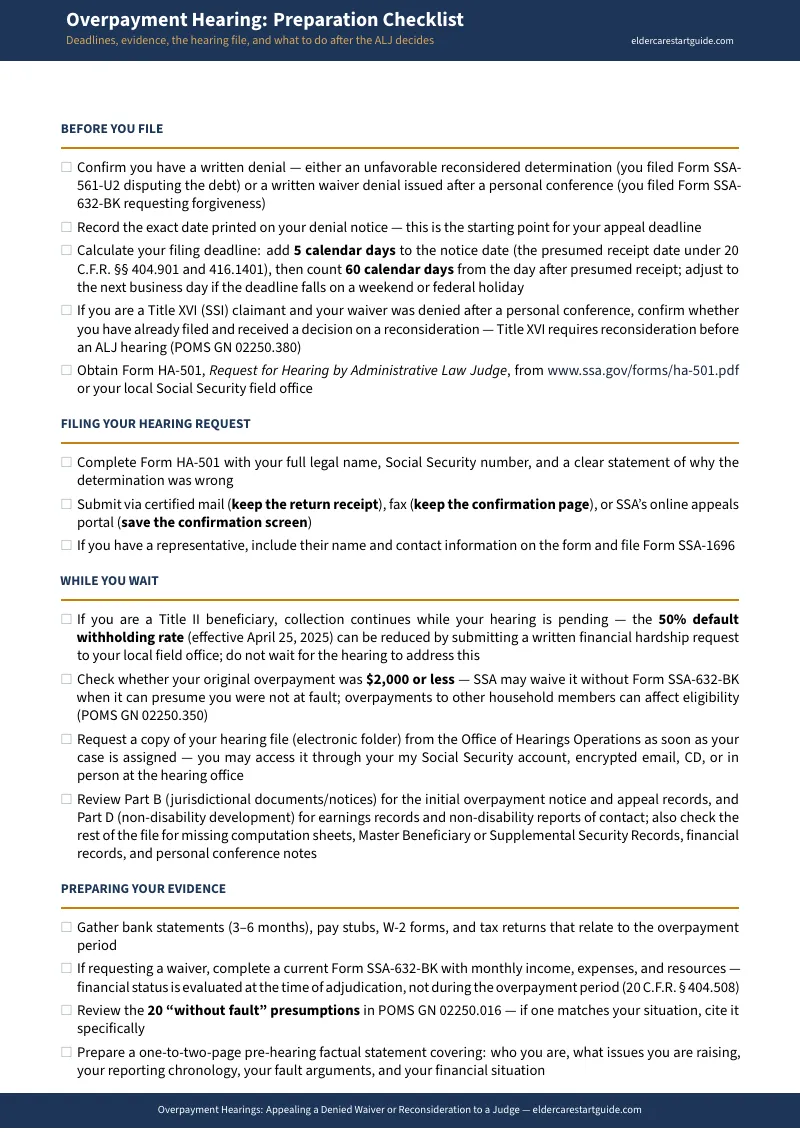
The free two-page checklist covers the filing deadline, the hearing file request, an evidence list and day-of steps for each hearing format. It is a standalone preparation sheet — useful even if you never buy the full guide.
The full guide goes deeper: 13 chapters covering the hearing request, evidence assembly, testimony preparation, remote hearing logistics, the decision, and the appeals beyond. If your situation is straightforward, the checklist may be enough. If you are building a case with financial hardship evidence, witness testimony and exhibit organization, the full guide provides the structure.
Satisfaction guarantee
Full refund, no time limit. If the guide does not help you prepare, email [email protected] and we will refund your purchase. No form, no explanation required.
Frequently Asked Questions
Is this an official government publication?
No. This is an independent educational guide. It is not affiliated with, endorsed by, or authorized by the Social Security Administration. Official forms are available free at ssa.gov.
Does this guide give legal advice?
No. The guide explains the administrative hearing process and provides preparation tools. It does not tell you whether to file a hearing, predict the outcome, or replace an attorney. If you can find a lawyer who handles overpayment cases, that is always a good option.
What if I already filed my hearing request?
The guide is useful at any point before or during the hearing process. If you have already filed Form HA-501, start with the chapters on reviewing the exhibit file and preparing your evidence.
Can my adult child use this guide to help me?
Yes. The evidence assembly tools, hearing-day checklists and witness preparation sections are written for both the appellant and the family helper. The guide also explains the limits: a family member who is not appointed as your representative may testify as a witness, but cannot act on your behalf at the hearing or access confidential SSA records without the required appointment or authorization.
What if my situation is an SSI overpayment, not a retirement overpayment?
The hearing process before an administrative law judge is the same for Title II (retirement/disability) and Title XVI (SSI). The guide covers both, noting where the rules differ — such as the withholding rate and the path from an initial waiver denial to the hearing request.
What is the difference between this guide and the waiver guide?
The overpayment waiver guide covers requesting a waiver with Form SSA-632 and preparing for the personal conference at the field office level. This guide picks up where that process ends — after the waiver is denied or the reconsideration is unfavorable, when the next step is a formal hearing before a judge.
Frequently Asked Questions
What if the rules change after I buy?
We update the guide when the rules change. Email us any time, even years later, and we'll send you the current edition free.