
The Bank Locked You Out. The Hospital Wants a Signature. Your Parent Can't Sign.
Your parent had a fall, a stroke, or a cognitive decline — and suddenly every institution in Rhode Island needs proof that you can legally act on their behalf. The bank froze the accounts. The hospital discharge planner wants a designated surrogate before releasing your parent. The DHS eligibility worker reviewing a Medicaid LTSS application requires a signed authorization before they'll even open the file.
You're stuck in the legal-authority gap: responsible for everything, authorized for nothing.
Rhode Island gives you two pathways. If your parent still has cognitive capacity, you can establish authority quickly and privately through voluntary documents. If capacity is already gone, you face a court-supervised guardianship through your local municipal probate court — a process that costs $2,000–$10,000+, takes 30–90+ days, and becomes a matter of public record. The problem is that nobody explains which pathway you're on, which of Rhode Island's 39 municipal probate courts handles your case, or how to get banks and hospitals to actually accept your documents once you have them.
The Rhode Island Legal Authority Roadmap
This kit replaces the confusion with a step-by-step system built for Rhode Island's specific legal codes, Medicaid rules, and institutional landscape — not a generic POA overview with "Rhode Island" pasted in. It covers both pathways in the order families actually experience them: capacity assessment, document execution, institutional acceptance, benefit applications, and asset protection.
It's built for the adult child who became the family's legal coordinator overnight — whether you're in Providence, on Aquidneck Island, or managing everything from another state while your parent lives in one of Rhode Island's 39 municipalities.
What's Inside
Rhode Island Durable Financial Power of Attorney
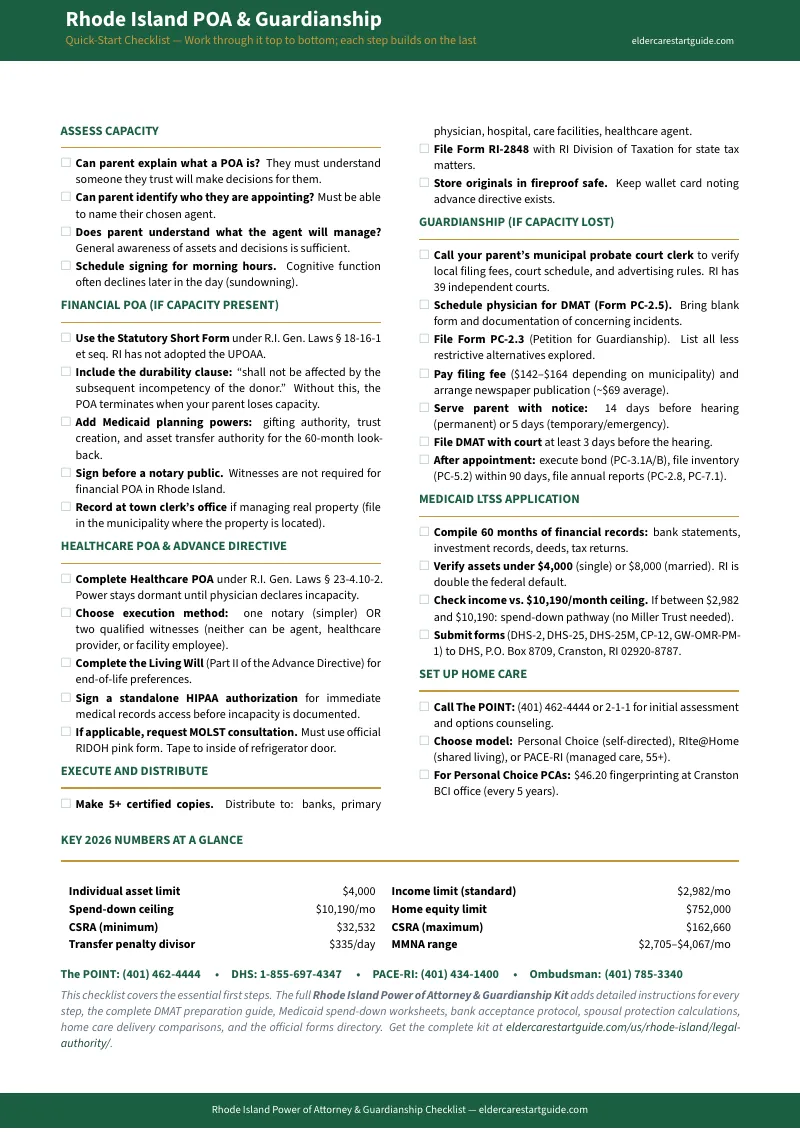
A complete walkthrough of the Short Form Power of Attorney Act (R.I. Gen. Laws § 18-16-1 et seq.), including which authority categories to grant, the mandatory notarization requirements, how to include the critical durability clause (without it, the POA dies the moment your parent is declared incompetent — and Rhode Island does not make durability automatic), and the exact process to get banks and financial institutions to accept the document. Includes a Bank Acceptance Protocol for when compliance officers refuse to honor your authority.
Healthcare Power of Attorney and Advance Directive
Healthcare decisions require a completely separate document from financial authority. This section covers how to execute a Healthcare POA under R.I. Gen. Laws § 23-4.10-2, the strict witness exclusion rules (healthcare providers, their employees, and community care facility operators are all barred), how House Bill 7158 expanded signing options to allow either two qualified witnesses or a single notary with a conflict-of-interest disclaimer, and how to integrate HIPAA release clauses so hospitals actually share information with you. Covers coordination with the Living Will and MOLST orders.
The Representative Payee Trap
Social Security ignores every Power of Attorney — it doesn't matter how well it's drafted under state law. To manage your parent's Social Security income, you must apply as a Representative Payee at a local Rhode Island SSA office through a separate federal process with its own rules, direct deposit mandates, and recordkeeping requirements. Most families discover this after weeks of trying to use their POA at the bank. This section covers the full application process and the recent federal rule changes that exempt certain family members from annual reporting.
Rhode Island's Municipal Probate Court System
When capacity is already gone, voluntary documents are off the table. Rhode Island's guardianship process is uniquely complex: petitions go to the municipal probate court of the city or town where your parent lives — not the state Superior Court. Each of Rhode Island's 39 municipalities operates its own probate court with different filing fees ($34–$164), hearing schedules, and local procedures. This section maps out the full filing process, required forms (PC-2.3 petition, PC-2.4 notice, PC-2.5 DMAT assessment), mandatory newspaper advertising, the court-appointed Guardian ad Litem, and what to expect at the hearing.
The Decision-Making Assessment Tool (DMAT)
Rhode Island requires a unique medical assessment form — Form PC-2.5, the Decision-Making Assessment Tool — that no other state uses. It evaluates your parent across biological, psychological, and social domains to determine the scope of guardianship needed. This section explains who can complete it (physicians, psychologists, psychiatric social workers), what each section measures, and how to prepare your parent's doctor so the assessment accurately reflects their needs without over-restricting their remaining autonomy.
Medicaid LTSS and the Global Waiver
Rhode Island's Medicaid long-term care program operates under the Global Consumer Choice Compact Waiver — a statewide managed care system that funds nursing facility care and home-and-community-based services. This section covers the 2026 eligibility limits ($4,000 countable assets for single applicants — double the federal floor), the $2,982 monthly income cap, the Medically Needy spend-down pathway, spousal impoverishment protections ($154,140 CSRA), the 60-month look-back period, and estate recovery rules. Includes how to draft your POA with explicit "Medicaid Planning Powers" so the DHS eligibility worker accepts it.
Home Care Options Under the Global Waiver
Rhode Island offers three home care pathways for families who want to avoid or delay institutional placement: the Personal Choice Program (self-directed care with a fiscal intermediary), RIte@Home shared living, and PACE-RI (comprehensive medical plus care management for dual-eligible seniors). This section compares all three programs — eligibility, costs, level of family involvement, enrollment process — and maps each to The POINT ADRC coordination for intake.
Rhode Island Resource Directory
Every contact mapped: The POINT ADRC, MyOptionsRI, RIPIN community health workers, DHS LTSS offices, EOHHS, PACE-RI enrollment, Long-Term Care Ombudsman, RIDOH facility licensing, Secretary of State probate forms, local SSA offices, and when to hire an elder law attorney versus handling it yourself — organized by the type of help you need, not by bureaucratic hierarchy.
Who This Is For
- Adult children in Rhode Island who need legal authority to manage a parent's finances, medical care, or benefit applications — and don't know which documents they need or where to start
- Families facing a dementia diagnosis who need to establish authority while their parent still has capacity, before the guardianship window becomes the only option
- Out-of-state family members coordinating remotely for a parent in Rhode Island who cannot navigate the municipal probate system from a distance
- Families approaching Medicaid who need to understand the Global Waiver, spend-down rules, and estate recovery before savings run out
- Siblings in conflict who need an objective, state-requirement-based framework for agreeing on who holds authority and how decisions get documented
Why Free Forms Aren't Enough
The Rhode Island Secretary of State, the Disability Law Center, and RIDOH publish legitimate statutory forms — but they're scattered across multiple agencies with no coordination. A blank Form PC-2.3 does not explain how to combine the financial POA with the healthcare POA, which authority categories to check and which to skip, how to get the DMAT assessment completed before filing, or how to handle bank acceptance when a compliance officer rejects your documents.
National platforms like Rocket Lawyer and Nolo generate documents from templates that often miss Rhode Island-specific details — like the 39 separate municipal probate courts, the DMAT requirement that no other state uses, or the fact that Rhode Island does not make durability automatic in financial POAs.
Rhode Island elder law attorneys charge $200–$500 per hour, and their availability is concentrated along the I-95 corridor. For families managing a crisis, the consultation wait alone can cost weeks you don't have.
This kit bridges that gap — handling the procedural and administrative work families can do themselves, and telling you exactly when a situation has crossed the line where you genuinely need an attorney.
Satisfaction Guarantee
If this kit doesn't give you the clarity and confidence to establish legal authority for your parent, email us for a full refund. No forms, no hoops, no time limit.
— Less Than a Single Hour of Professional Help
A Rhode Island elder law attorney charges $200–$500 per hour. A Medicaid planning specialist runs $2,000–$5,000 for a full engagement. A contested guardianship can exceed $10,000 in court costs and attorney fees alone. This kit handles the process navigation you can do yourself — and saves the professional fees for the decisions that actually require one.
Download the free Rhode Island Power of Attorney Quick-Start Checklist to start, or get the complete kit with the full 11-chapter guide, actionable checklist, 10 standalone printable worksheets, and Rhode Island resource directory — 13 PDFs total.