
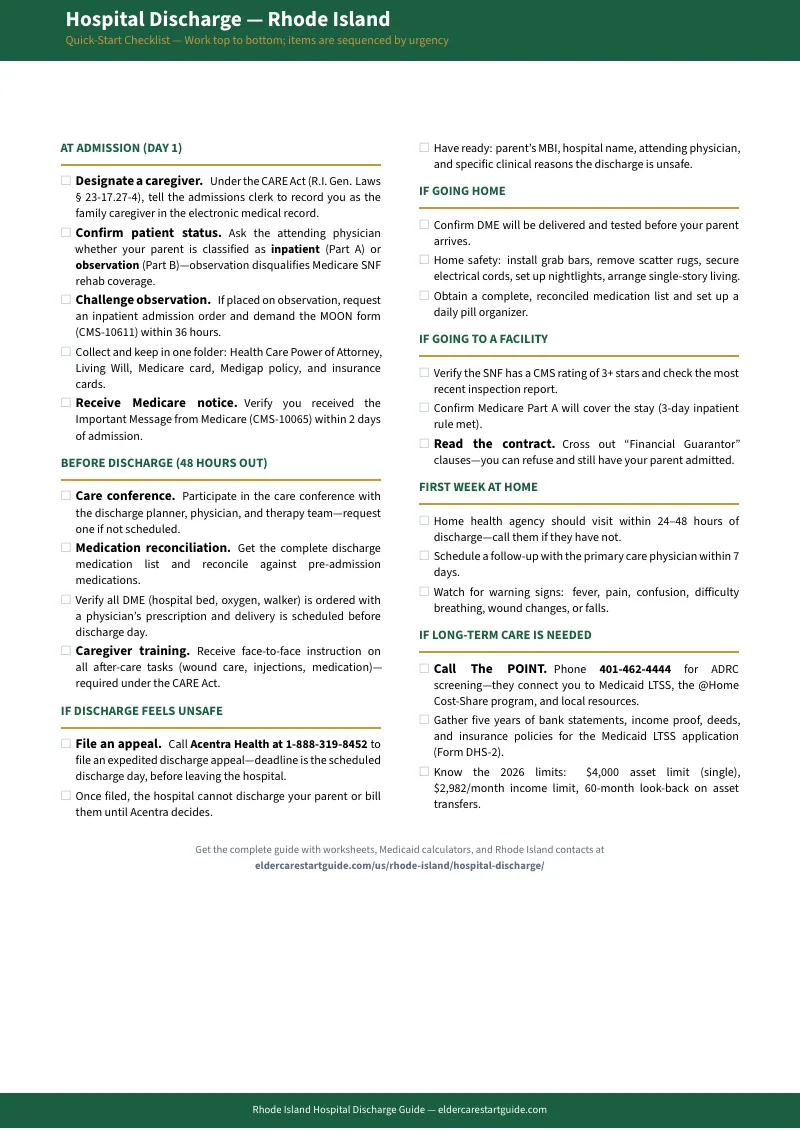
Your Parent Is Being Discharged Tomorrow. The Plan Feels Wrong.
The discharge planner says your parent is "medically stable." But you can see they're not ready — they can't stand without help, the medication list has changed three times this week, and nobody has explained who's going to manage wound care at home.
You have less than 48 hours. The hospital wants the bed. And everything you find online is either a 200-page Rhode Island Medicaid LTSS policy manual or a lead-gen site trying to sell you a nursing home placement.
The Rhode Island Discharge Navigator
This isn't a generic pamphlet about "planning ahead." It's a structured system for the 48-to-72-hour window when you're in the middle of a discharge crisis — built specifically for Rhode Island law, the Section 1115 Global Waiver, and the Rhode Island agencies you'll actually be calling.
The guide gives you the legal framework, decision sequences, and exact scripts to advocate for your parent's safety during every transition: hospital to home, hospital to rehab, rehab to skilled nursing, and the home-care pathway through The POINT and the @Home Cost-Share program that lets them stay home with subsidized custodial support.
What's Inside
- The 48-Hour Discharge Protocol — A step-by-step sequence for the first two days after you hear "we're discharging your parent." Covers who to call, what to document, and which forms to request before you leave the hospital — including your rights under the Caregiver Consultation and Discharge Planning Act (R.I. Gen. Laws § 23-17.27-4).
- QIO Appeal Scripts — Pre-written language for filing a fast-track appeal with Acentra Health (Region 1 BFCC-QIO) at 1-888-319-8452. Hospitals cannot charge your parent extra or force them out while the appeal is active — but most families don't know this right exists.
- Observation Status Decision Tree — If your parent was classified "outpatient under observation," Medicare won't cover SNF rehab. This section explains how to identify the reclassification, request a physician override, and file a CMS-10868 appeal through the QIO.
- Rhode Island Caregiver Act Compliance Guide — The hospital must designate you as the primary caregiver, perform a formal capability assessment, and provide face-to-face training on every aftercare task before discharge. This section explains how to assert those rights and what to do if the hospital skips steps.
- SNF Vetting Scorecard — A structured comparison framework with the specific questions to ask Rhode Island facilities about staffing ratios, therapy schedules, discharge timelines, and Medicare coverage policies. Includes red flags that signal a facility will rush your parent out at day 20.
- Home-Care Pathway Through The POINT — The complete enrollment pathway for Rhode Island's home-care programs: calling The POINT (2-1-1) for ADRC referral, the @Home Cost-Share program eligibility and application, and how to access subsidized non-medical custodial aid through the Office of Healthy Aging.
- Medicaid LTSS Financial Planning — Rhode Island's Section 1115 Global Waiver consolidates all long-term care programs under one system. This section covers the $4,000 asset limit, $2,982/month income threshold, the medically needy spend-down pathway, spousal protections, and the 60-month look-back rules.
- Guardianship, POA & Healthcare Proxy — Which documents you need to make decisions during a hospital stay, how to execute a healthcare proxy at the bedside in under five minutes, and what options exist when a parent can no longer sign — including emergency guardianship through the Rhode Island Family Court.
- Medication Reconciliation Worksheet — A structured form for tracking every medication change during hospitalization, ensuring nothing is missed or duplicated at discharge.
- Call Scripts and Letter Templates — Pre-written language for conversations with discharge planners, attending physicians, Acentra Health, The POINT intake staff, Office of Healthy Aging caseworkers, SNF admissions staff, and the Long-Term Care Ombudsman.
Who This Is For
- Adult children in Rhode Island managing a parent's hospital discharge — especially if the timeline feels rushed or the plan feels incomplete
- Families who need to halt an unsafe discharge and don't know they have the right to appeal
- Caregivers comparing rehab, skilled nursing, and home care — and unsure which Medicare or Medicaid LTSS programs apply
- Anyone starting the @Home Cost-Share or Medicaid LTSS application who wants to avoid mistakes that trigger denial or delay
- Long-distance caregivers coordinating from Boston, New York, or elsewhere who need a standardized compliance framework to remotely evaluate care quality
Why Not Just Use Free Resources?
The Office of Healthy Aging website has the policy manuals. Medicare.gov has the forms. The POINT will connect you with an intake specialist. But during a medical crisis, you don't need raw policy — you need a decision framework that tells you what to do first, what to say when you call, and which mistakes will cost your family thousands.
Free resources don't tell you that hospitals are incentivized to discharge quickly, that observation status quietly eliminates your rehab coverage, or that one improper asset transfer can create a five-year Medicaid penalty period. They give you information without sequence or priority. And they won't explain why Rhode Island's $4,000 asset limit is double the federal default — or how the medically needy spend-down pathway works for families above the income threshold.
This guide organizes Rhode Island-specific rules into actionable steps you can follow under pressure — from the first notification of discharge through the Medicaid LTSS application and beyond.
The Alternative Is Expensive
An elder law attorney in Rhode Island charges $300–$500 per hour, with full Medicaid planning engagements running $5,000–$15,000. A private geriatric care manager charges $100–$250 for an initial assessment plus $50–$150 per hour ongoing. This guide doesn't replace legal counsel for complex asset protection — but it prevents the common mistakes that make legal counsel necessary, and gives you the structure to handle the first 72 hours yourself.
Satisfaction Guarantee
If the guide doesn't give you a clearer path forward within the first 24 hours of your parent's discharge, email us for a full refund. No hoops, no forms.
— Less Than One Hour of Professional Advocacy
For a fraction of what a single consultation costs, you get the complete system: legal rights, appeal scripts, caregiver act compliance, facility comparison tools, Medicaid LTSS eligibility rules, and every template you need to navigate your parent's transition safely.
Download the free one-page checklist to see the framework, or get the full guide with all 12 chapters plus standalone printable tools — the 48-hour discharge protocol, QIO appeal scripts, observation status decision tree, caregiver act compliance guide, SNF vetting scorecard, home-care pathway through The POINT, medication reconciliation worksheet, call scripts and letter templates, and emergency contacts fridge sheet.