
Your Parent's Nursing Home Costs $11,000 a Month. The State Says They Need a "High Level of Care" to Stay Home. Nobody Explained That Rhode Island Runs Everything Through One Waiver — and the Application You File Determines Whether They Get Help at Home or a Bed in a Facility.
The discharge planner at the rehab facility just told you Medicare's skilled nursing coverage drops to a heavy co-pay after day 20 and ends completely at day 100. Your parent can't safely go home without help. The nursing home is quoting $11,000 per month — private pay — and in the Providence metro it's closer to $12,000. Someone mentioned "Medicaid LTSS" and you started searching.
Here's what you found: Rhode Island's countable asset limit is $4,000 for a single applicant. Your parent has a house, a checking account, a small retirement fund, and decades of careful saving. At $4,000, almost everything you thought was protected has to go.
What the discharge team didn't mention: Rhode Island operates its entire Medicaid long-term care system under a single Section 1115 Global Waiver. Unlike most states with separate waivers for different conditions, Rhode Island uses one application, one clinical assessment, and one eligibility determination for everything — home care, community services, and nursing home placement. The clinical assessment classifies your parent as either "High Level of Care" (eligible for home and community services) or "Highest Level of Care" (eligible for both home services and nursing home). If you don't understand this distinction before the assessment, you lose control of the outcome.
The Rhode Island Home Care Navigation System
This isn't a list of phone numbers you could pull from the EOHHS website or The POINT directory. The Rhode Island Home Care Navigation System maps the exact sequence of decisions, assessments, applications, and deadlines your family needs — starting from wherever you are right now — so you don't end up in a nursing home because you filed things in the wrong order.
The critical mistake most Rhode Island families make: they start the Medicaid LTSS application without first checking whether the OHA @Home Cost Share Program is a better fit. The @Home Cost Share has no asset test and serves families with income up to 250% of the Federal Poverty Level — but it has a sliding-scale co-pay that can be substantial. The Global Waiver covers care with no co-pay once you're eligible, but the $4,000 asset limit means a real spend-down. Screening for both programs before committing to either path is the single most consequential step in the entire process.
The second mistake: not understanding the Personal Choice option. Rhode Island will pay your family member — including a spouse or adult child — to provide care through a self-directed program with a fiscal intermediary. Families who don't know this exists hire private-pay aides at $30–$40 per hour while a state-funded alternative sits unused.
This guide puts you in the right order: screen for the @Home Cost Share and Global Waiver simultaneously, secure legal authority before the clinical assessment, understand the financial eligibility rules, choose between agency-directed and self-directed care, then file your application with every document organized.
What You Get — 4 PDFs
- 15-Chapter Guide — The complete Rhode Island Home Care Navigation System: how the Global Waiver works, first steps when you notice decline, every care option (non-medical home care, home health, adult day, PACE-RI), Medicaid LTSS financial eligibility with 2026 dollar figures, the OHA @Home Cost Share program, step-by-step application process, choosing between agency-directed and Personal Choice self-directed care, legal planning and guardianship, home modifications and safety, caregiver support and respite, Medicare's role in the hospital-to-home transition, provider quality checks, appealing denials, financial planning strategies, and a complete forms and resources directory.
- Care Program Decision Matrix (printable standalone) — Side-by-side comparison of the Global Waiver HCBS, OHA @Home Cost Share, PACE-RI, and private-pay home care. Income limits, asset rules, co-pay structures, and what each program actually covers. Print it and bring it to your POINT screening.
- Medicaid LTSS Application Checklist (printable standalone) — Every document DHS requires for the financial eligibility determination: 60 months of bank statements, property records, income verification, medical documentation, and legal authority paperwork. Organized by category with a tracking sheet so nothing gets lost in the DHS backlog.
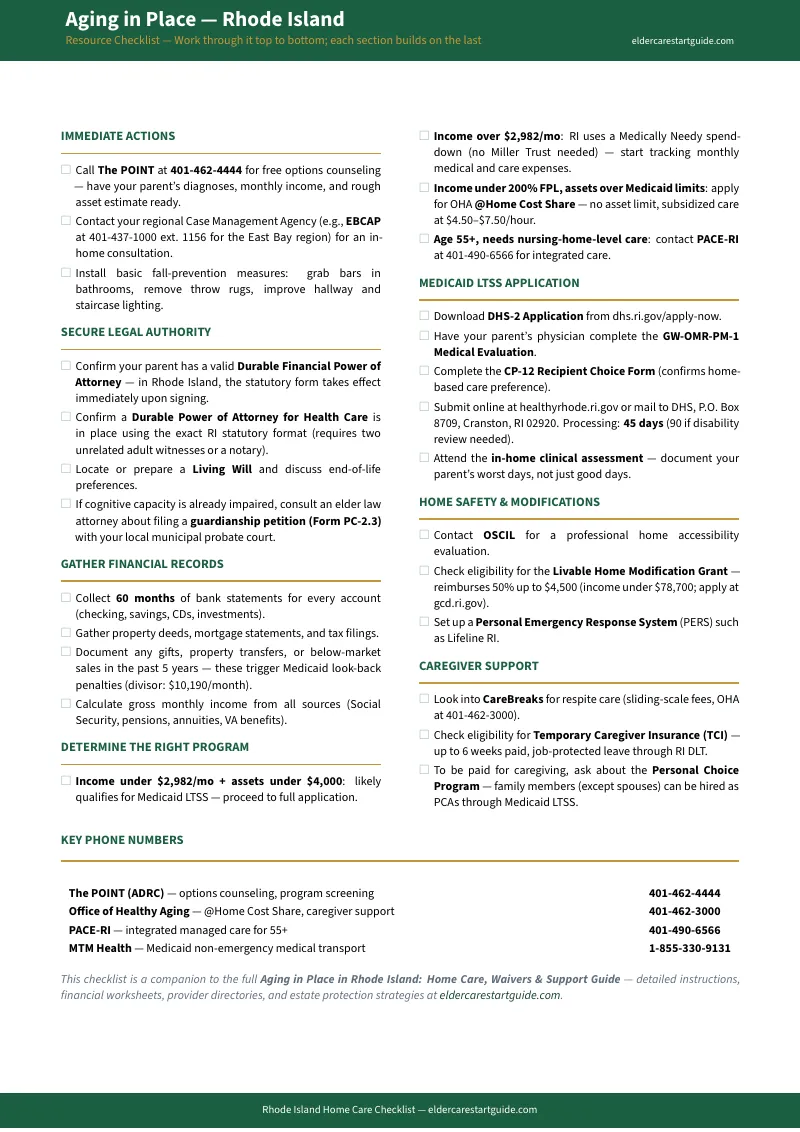
- Quick-Start Checklist (Free Download) — 20 actionable items organized by priority: calling The POINT, securing legal authority, gathering financial records, screening for the @Home Cost Share, and starting the Medicaid LTSS application. Know exactly what to do tonight, this week, and this month.
Who This Guide Is For
- Adult children in Rhode Island figuring out how to keep a parent safely at home — without draining every account to meet the $4,000 asset limit before knowing all the options
- Families facing a hospital or rehab discharge with no Medicaid application started and a facility demanding $11,000+ per month in private-pay rates
- Caregivers providing daily hands-on help who don't know that Rhode Island's Personal Choice program will pay them through a state-funded fiscal intermediary
- Families whose income is too high for Medicaid but who can't afford $30–$40 per hour for private-pay home care — the OHA @Home Cost Share may bridge the gap
- Married couples where one spouse needs care and the other needs to understand exactly how much of their joint savings Rhode Island law protects (spousal resource allowance up to $162,660)
- Out-of-state siblings coordinating a Rhode Island parent's care remotely and needing every phone number, filing deadline, and regional case management agency in one document
Why Free Information Isn't Getting You Anywhere
The EOHHS and DHS websites publish the official Medicaid LTSS rules. The numbers are accurate. But they don't tell you the order. They don't explain that screening for the @Home Cost Share before committing to the Medicaid spend-down could save your parent tens of thousands in assets. They don't walk you through the difference between a "High" and "Highest" level of care classification and why it matters for what services your parent can actually receive.
The POINT is an excellent starting resource — but it's a directory, not a roadmap. Options counselors provide referrals; they cannot legally advise on asset positioning, spousal protection strategies, or which program to apply for first. And the DHS phone queues can mean hours of hold time before you reach someone who can answer a specific financial eligibility question.
Rhode Island elder law firms — Heffner & Associates, Rampino Law, Sullivan Estate Law — publish helpful blog posts about Medicaid planning. Every one ends with a call to schedule a consultation at $300–$500 per hour. Their content is designed to sell legal services, not to give you a complete, actionable sequence of steps you can execute yourself.
A Place for Mom and Caring.com dominate the search results, but their revenue comes from referral fees paid by assisted living and nursing home chains. They are structurally incentivized to move your parent into a facility, not to help you access state-funded home care that generates no referral commission.
This guide fills the gap between the government portal that gives you facts without sequence, the law firm that gives you strategy but only through a multi-thousand-dollar planning package, and the referral site that steers you toward placements you may not need.
Satisfaction Guarantee
If this guide doesn't give you a clear, actionable path to keeping your parent safely at home in Rhode Island, email [email protected]. We read every message.
— Less Than One Hour of an Elder Law Attorney's Time
Rhode Island elder law attorneys charge $300 to $500 per hour. A comprehensive Medicaid planning retainer starts at several thousand dollars. A single procedural mistake — applying for Medicaid LTSS without first screening for the @Home Cost Share, missing the 60-month lookback window, or failing to secure legal authority before the clinical assessment — can cost your family months of delay and thousands in unnecessary private-pay charges.
This guide won't replace an attorney when you need one (and it tells you exactly when that is). But it will save you hours of research, prevent the most expensive mistakes, and ensure you walk into any conversation — with The POINT, the DHS caseworker, your regional case management agency, or an elder law firm — knowing exactly what Rhode Island law requires.
Download the free Quick-Start Checklist to see the 20 most urgent action items. When you're ready for the complete system, the full guide is waiting.