
Your Parent's Nursing Home Costs $12,106 a Month. Rhode Island Medicaid Only Covers It at the "Highest" Clinical Level. Nobody Explained That a "High" Assessment Locks Your Parent Out of Every Nursing Home in the State.
Your parent was admitted after a fall. The discharge planner is calling every day, pushing a 24-to-48-hour window to choose a post-acute facility. You started researching nursing homes and discovered that a semi-private room in Rhode Island averages $145,000 a year. Assisted living runs about $93,000. You searched for Medicaid coverage and hit a wall of state agency portals, elder law firm blogs, and referral sites that each give you a different piece of the picture without explaining the order.
Here's the problem nobody mentions during the discharge scramble: Rhode Island splits Medicaid long-term care into two clinical tiers — "High" and "Highest" — and the tier your parent lands on determines everything. A "High" assessment qualifies them for home care and assisted living through the Community Supportive Living Program, but it completely bars them from Medicaid-funded nursing home placement. Only a "Highest" determination unlocks nursing home coverage. If your parent is assessed at "High" and their needs escalate, you'll need to request a reassessment and navigate the appeal process — while potentially paying private rates that drain savings at $12,000 a month.
Meanwhile, Rhode Island is a "medically needy spend-down" state, not an income-cap state. If your parent's monthly income exceeds $2,982, they aren't disqualified — they qualify by spending their excess income on medical and care costs each month. No Miller Trust is needed. But the spend-down calculation is complex, the Department of Human Services can take months to process applications, and a single asset transfer within the 60-month look-back period can trigger a divestment penalty calculated by dividing the transferred amount by approximately $10,190 per month — turning a well-intentioned gift into months of ineligibility.
The Rhode Island Care Navigation System
This isn't a summary of Medicaid rules you could piece together from dhs.ri.gov, the Office of Healthy Aging website, and a handful of Fabisch Law blog posts. The Rhode Island Care Navigation System maps the exact sequence of assessments, screenings, applications, and legal documents your family needs — starting from wherever you are right now — so you don't commit to a facility, drain savings, or skip a critical program because you did things in the wrong order.
The most common mistake Rhode Island families make: they accept a nursing home placement before screening for home care through the Personal Choice Program, PACE-RI, or the @Home Cost Share Program. They assume a "High" clinical assessment means their parent needs a nursing home and don't realize it means the opposite — that Medicaid will only cover community-based care at that level. They assume "next of kin" gives them legal authority and discover at the facility intake office that without a Durable Power of Attorney, they can't sign admission papers, access medical records, or manage their parent's finances. And by the time they learn a POA must be signed while the parent still has mental capacity, it may be too late for anything short of a probate court guardianship — a process that costs $2,500 to $5,000 and requires ongoing court supervision.
The guide puts you in the right order: assess functional decline, establish legal authority while you still can, map every care option from nonmedical home care through skilled nursing, understand the High vs. Highest clinical assessment system, screen for state programs before committing to private-pay placement, navigate the Medicaid spend-down without triggering look-back penalties, protect the community spouse's financial security, and know exactly when free resources end and professional help begins.
What You Get
- 11-Chapter Rhode Island Care Decision Guide — The complete Rhode Island Care Navigation System: how the state's long-term care system works (The POINT, MyOptions counseling), recognizing decline, establishing legal authority (DPOA, Living Will, MOLST, guardianship), every care setting with cost comparisons, the High vs. Highest clinical level-of-care system, Medicaid financial eligibility under the 1115 Global Waiver (asset limits, spend-down, spousal protections, 60-month look-back, caregiver child exception), self-directed care programs (Personal Choice, PACE-RI, @Home Cost Share), facility vetting and the Electronic Monitoring Law, resident protections and the Long-Term Care Ombudsman, Temporary Caregiver Insurance, and a complete forms-and-contacts directory. Every dollar figure reflects 2026 Rhode Island regulations.
- Care Options Comparison Table — Every Rhode Island care level on one landscape sheet: who it serves, oversight agency, 2026 costs, payment sources, and which clinical tier unlocks Medicaid coverage. Print and bring to family meetings or discharge conversations.
- Facility Tour Checklist — Licensing checks through RIDOH, staffing questions, environment walk-through items, care communication questions, and contract red flags to review during every in-person facility visit.
- Financial Snapshot Worksheet — Map income, countable assets, exempt assets, and spousal protections against the 2026 Medicaid limits. Includes the care runway calculator so you know how many months of private-pay care your parent's savings will cover before Medicaid becomes necessary.
- Legal Authority Checklist — Track which legal documents are in place (DPOA, Living Will, MOLST, trust), with Rhode Island-specific execution requirements, probate court contact information for the relevant municipality, and a distribution checklist for certified copies.
- Forms and Contacts Directory — Every Rhode Island eldercare form, agency contact, verification portal, and financial threshold on one printable reference sheet — from The POINT and the Division of Elderly Affairs to the Long-Term Care Ombudsman and RIDOH licensing verification.
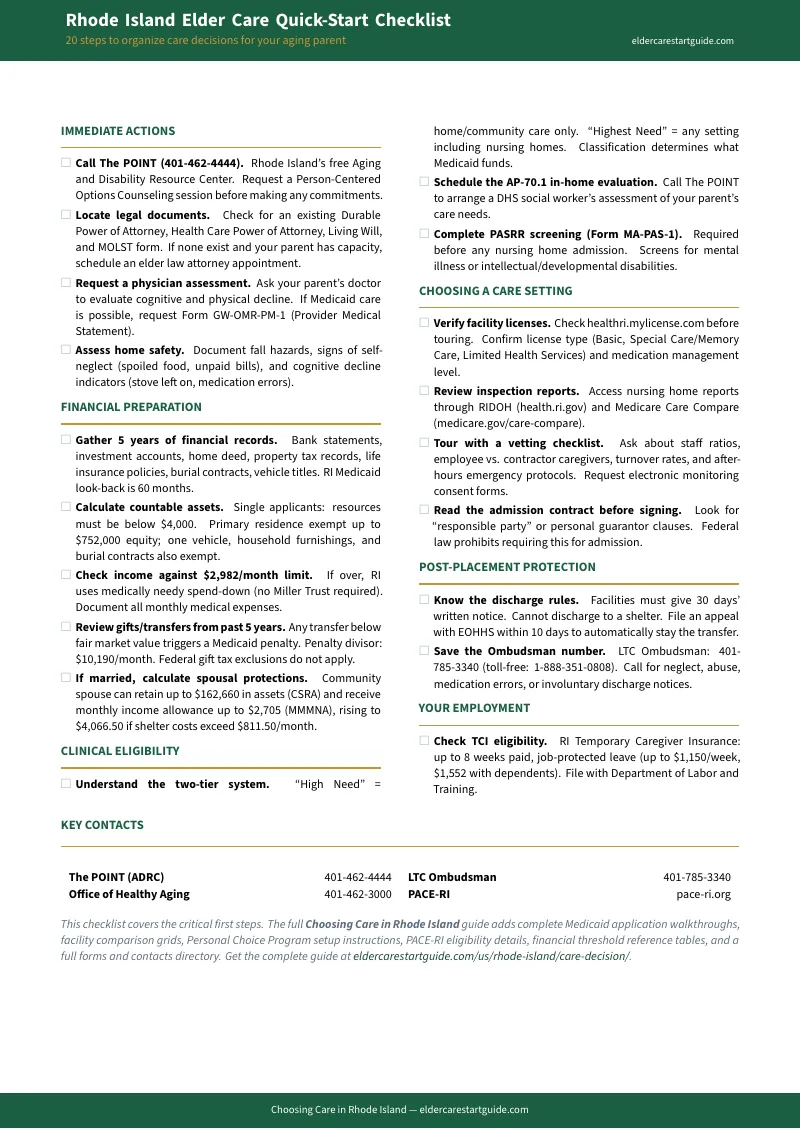
- Quick-Start Checklist (Free Download) — 19 actionable items organized across assessment, legal authority, care options, facility vetting, financial screening, and ongoing quality monitoring. Know exactly what to do tonight, this week, and this month.
Who This Guide Is For
- Adult children in Rhode Island whose parent has had a fall, a hospitalization, or a noticeable cognitive decline — and who need to choose the right level of care before the next crisis forces a decision under pressure
- Families trying to understand the "High" vs. "Highest" clinical assessment system and why that single determination controls whether Medicaid covers a nursing home or restricts your parent to community-based services
- Caregivers comparing the cost of home care, assisted living, and nursing homes in one of the most expensive elder care markets in the country — and who need to know which state programs (Personal Choice, PACE-RI, @Home Cost Share, CSLP) can bridge the gap
- Anyone navigating the Medicaid medically needy spend-down process who needs to understand how excess income is calculated, what the 60-month look-back covers, and how spousal impoverishment protections work in Rhode Island
- Out-of-state siblings coordinating a Rhode Island parent's care remotely and needing every state agency, licensing database, ombudsman contact, and financial threshold in one place
Why Free Information Isn't Getting You Anywhere
The Rhode Island Department of Human Services publishes the official Medicaid eligibility guidelines. The numbers are accurate. But they don't tell you the sequence. They don't explain that screening for the Personal Choice Program or PACE-RI before committing to a nursing home placement can save the difference between state-funded home care and $12,106 a month in private-pay skilled nursing. They don't walk you through the clinical level-of-care assessment that determines which care settings Medicaid will actually cover.
Oasis Senior Advisors and Assisted Living Locators offer free placement services, but their business model is referral commissions from private-pay facilities. They are structurally incentivized to recommend assisted living communities that pay them a commission, not to help you navigate Medicaid programs, nursing home options, or the Personal Choice self-directed care program. They will never mention that state-funded home care might eliminate the need for placement entirely.
Rhode Island elder law attorneys — Fabisch Law, Brule Nault & Hainley, Heffner & Associates — publish helpful blog posts that end with a call to schedule a $300 to $500/hour consultation. A comprehensive Medicaid planning package runs $3,000 to $10,000. Their content is designed to demonstrate expertise and sell legal services, not to give you a complete, executable sequence you can work through before deciding whether you need an attorney at all.
This guide fills the gap between the government portal that gives you rules without sequence, the referral service that steers you toward placements you may not need, and the law firm that gives you sequence only through a multi-thousand-dollar retainer.
Satisfaction Guarantee
If this guide doesn't give you a clear, actionable path to choosing and paying for your parent's care in Rhode Island, email [email protected]. We read every message.
— Less Than One Hour of an Elder Law Attorney's Time
Rhode Island elder law attorneys charge $300 to $500 per hour. A Medicaid planning package runs $3,000 to $10,000. A single procedural mistake — a look-back penalty triggered by a gift during the 60-month window, a nursing home application filed without the right clinical assessment, a facility placement accepted without checking the RIDOH licensing database — can cost months of eligibility and tens of thousands of dollars in private-pay care.
This guide won't replace an attorney when you need one (and it tells you exactly when that is). But it will save you hours of research, prevent the most expensive mistakes, and ensure you walk into any conversation — with the DHS Medicaid office, the facility admissions coordinator, The POINT, or an elder law firm — knowing exactly what Rhode Island law requires.
Download the free Quick-Start Checklist to see the 20 most urgent action items. When you're ready for the complete system, the full guide is waiting.