
Your Parent Needs a Nursing Home. Pennsylvania's Asset Rules Just Changed Everything.
Your parent fell. Or the doctor said "progressive." Or the discharge planner called and said Medicare's 100 days of skilled nursing coverage are ending next week — and someone needs to start paying $12,000 to $15,000 a month out of pocket.
You searched "Pennsylvania Medicaid nursing home" and found a wall of numbers: $2,982 income limit, $8,000 asset limit, $2,400 asset limit. Wait — two different asset limits? You called the County Assistance Office. They told you to file online through COMPASS. You started the form and hit a question about "transfers within the 60-month lookback period." You closed the laptop.
Meanwhile, a nursing home business office manager is asking your parent to sign a private-pay agreement. You've heard Pennsylvania is one of the states where they can sue you for the bill — not your parent, you — under the filial support law. You don't know if that's real. It is.
The Pennsylvania Care Cost Navigation System
This is not a reprint of eligibility limits from the DHS website. It is the process around the limits — the part that $6,000–$15,000 elder law attorneys explain across billable hours and that free government portals never cover.
Pennsylvania runs three entirely separate long-term care programs, each with its own financial tests, clinical assessments, and care delivery models. The guide maps all three — Community HealthChoices, LIFE, and OPTIONS — in the sequence a family actually encounters them: from the first hospital discharge conversation through Medicaid approval to estate recovery after a parent passes.
What's Inside
- The Two-Tier Asset Cliff — and How to Land on the Right Side — Pennsylvania's Medicaid asset limit is not one number. It is two: $8,000 for applicants with gross income at or below $2,982/month, and $2,400 for anyone above that line by even one cent. A $5 income difference costs a family $5,600 in protected savings. The guide walks through gross income reconstruction (adding back tax withholding, Medicare premiums, and pension deductions that banks strip before deposit), so you know exactly which tier your parent falls in before the CAO calculates it for you.
- The Medically Needy Spend-Down — Pennsylvania's Alternative to the Miller Trust — Most states require a Qualified Income Trust for over-income applicants. Pennsylvania does not. Instead, it uses a six-month budget cycle where the parent must accumulate documented medical expenses exceeding a spend-down threshold before Medicaid activates. The guide breaks down the six-month calculation, explains how nursing home private-pay invoices count toward the spend-down, and provides a tracking worksheet that prevents the process from resetting because of incomplete documentation.
- Income Spend Down Trusts for Home Care — If your parent's income exceeds $2,982/month but stays at or below $3,282 for Community HealthChoices (or $3,482 for LIFE), an ISD Trust through Achieva Family Trust, Legacy Enhancement Trust, or SCS Trust Services can restore waiver eligibility. The guide explains the enrollment process, the monthly deposit and disbursement mechanics, and the age-65 spend-down rule that catches most families off guard.
- Spousal Protection Formulas — When one spouse enters a facility, the community spouse keeps between $32,532 and $162,660 in assets under the Community Spouse Resource Allowance. The guide walks through the snapshot date calculation, the Minimum Monthly Maintenance Needs Allowance ($2,705 floor, up to $4,066.50 with high housing costs), income transfer rules, and when to request a fair hearing for a higher allocation — because most families never learn they can ask.
- The 60-Month Lookback Audit — The CAO reviews five years of financial transactions. Every gift, every below-market sale, every transfer to a family member triggers a penalty calculated at $421.20 per day. The guide explains the DRA timing trap (the penalty clock does not start until the parent is in a facility, out of money, and otherwise eligible), the IRS gift-tax exclusion that Medicaid ignores entirely, and the specific exceptions that can eliminate a penalty — including the caregiver child exception and spousal transfers.
- Penalty-Free Spend-Down Strategies — The complete list of Pennsylvania-approved ways to legally reduce countable assets without triggering a single day of penalty: paying off existing debt, home repairs and accessibility modifications on the primary residence, purchasing medical equipment, funding irrevocable prepaid burial contracts, and paying a family caregiver under a written agreement at fair market rates. Every strategy works even if your parent is entering a facility tomorrow.
- Home Protection and Deed Strategies — Pennsylvania does not recognize Lady Bird deeds. The guide compares the three options that do work: irrevocable Medicaid Asset Protection Trusts (which trigger the 2% realty transfer tax and a five-year lookback), life estate deeds (tax-exempt parent-to-child transfers, but irrevocable), and joint tenancy with right of survivorship. Each strategy is evaluated against estate recovery, lookback penalties, creditor exposure, and realty transfer tax.
- Estate Recovery Defense — Pennsylvania recovers only against assets that pass through a formal probate estate under 62 P.S. § 1412. That means joint tenancies, payable-on-death accounts, and irrevocable trust assets are immune. The guide provides an asset-by-asset audit worksheet to identify probate exposure, plus the permanent blocks: surviving spouse, child under 21, disabled child, and the $2,400 safe harbor.
- Filial Support Risk Management — Under 23 Pa. C.S. § 4603, nursing homes can sue adult children for unpaid care costs regardless of whether they signed a guarantor agreement. The Pittas ruling (2012) proved it — nearly $93,000 from a single adult child. The guide covers the POA signing protocol that blocks personal liability, the documentation strategy that prevents application delays, and the sibling contribution framework from Eori v. Eori.
- Community HealthChoices and OPTIONS Navigation — CHC coordinates home-based care through three MCOs across five geographic zones. OPTIONS serves seniors aged 60+ with no asset limit and a sliding co-pay from 0% to 100% based on income relative to the FPL. The guide includes the complete OPTIONS co-payment scale, CHC enrollment through the PA Independent Enrollment Broker, and the Nursing Facility Level of Care assessment that both programs require.
Plus: Worksheets, Calculators, and Checklists
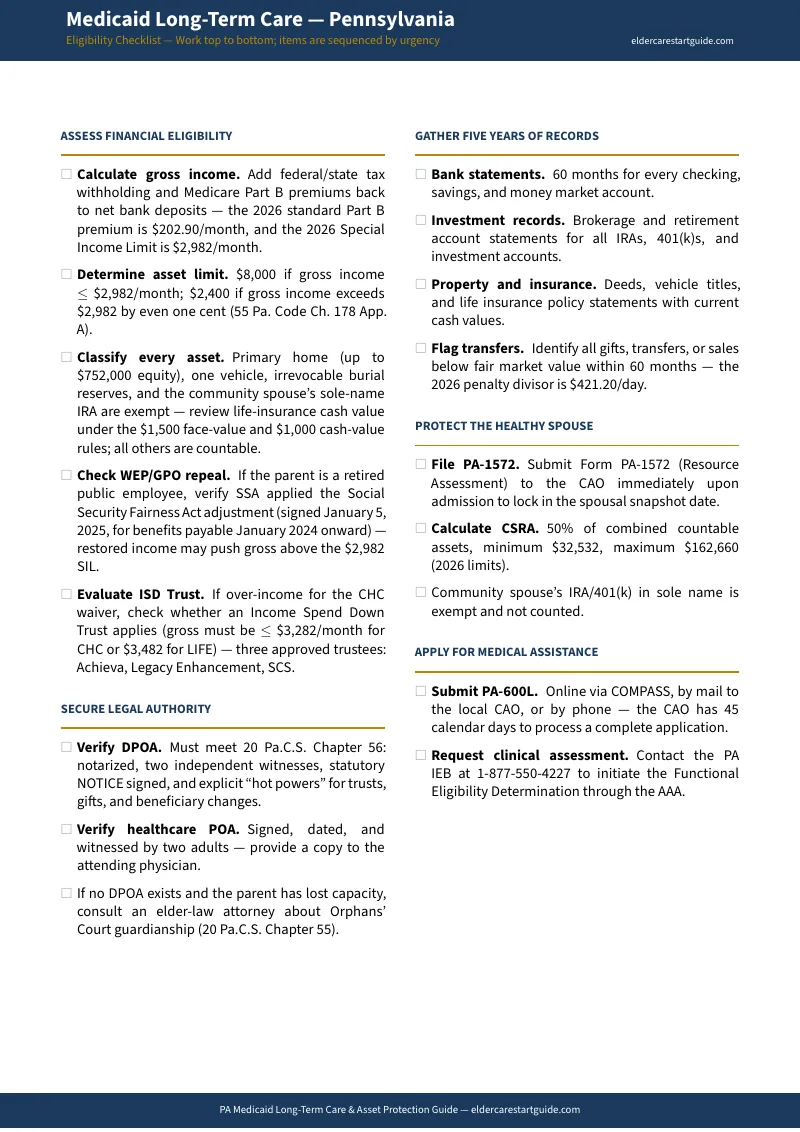
- Medicaid Eligibility Self-Assessment Worksheet — Gross income reconstruction, countable vs. exempt assets, and Tier One ($8,000) vs. Tier Two ($2,400) pathway result.
- Spousal Protection Calculator — CSRA and MMNA worksheets with the snapshot date, $32,532–$162,660 bounds, and excess shelter allowance.
- Five-Year Lookback Audit Checklist — Transfer log with penalty days at $421.20/day, exception checkboxes, and cure-option notes.
- 60-Month Financial Records Tracker — Account-by-account log matching the statements Form PA-600L requires.
- Agency Communication Log — Date, person, reference number, and follow-up for every CAO, PA IEB, AAA, MCO, and facility call.
- Care Crisis Week-by-Week Action Plan — Hospital admission through MCO enrollment, with form numbers and phone numbers on the page.
- Spend-Down Planner — Penalty-free strategies with checkboxes and a running total down to the $8,000 or $2,400 limit.
- Medically Needy Spend-Down Tracker — Six-month MNO-MA obligation plus an invoice log so the budget period does not reset.
- Estate Recovery Worksheet — Asset-by-asset probate exposure audit with permanent block verification and the $2,400 safe harbor calculation.
- Application Document Checklist — Every document the CAO needs for Form PA-600L, organized by category: legal, financial, income, property, transfers, and spousal assessment.
Who This Is For
- Adult children whose parent is being discharged from the hospital and someone needs to figure out who is paying $12,000+ a month starting next week
- Families navigating the two-tier asset cliff — trying to understand whether their parent keeps $8,000 or $2,400 and what to do about it
- Spouses trying to avoid impoverishment when one partner enters a nursing home and the CSRA and MMNA calculations determine their financial future
- Families who made gifts, paid grandchildren's tuition, or sold property below market value in the past five years and need to understand the lookback penalty before the CAO calculates it for them
- Out-of-state children coordinating long-distance care for a parent in Philadelphia, Pittsburgh, or anywhere in the Commonwealth
- Adult children worried about personal liability under Pennsylvania's filial support statute and looking for the signing and documentation protocols that reduce that exposure
- Anyone told "it's too late to protect anything" who wants to know what Pennsylvania's probate-only estate recovery rule actually allows
Why Not Free Government Resources?
COMPASS publishes forms. The DHS manuals run hundreds of pages of administrative code designed for state caseworkers. Your local Area Agency on Aging provides options counseling — but is legally prohibited from advising on asset protection, drafting caregiver contracts, or structuring deed transfers.
Here is what none of them provide:
- The two-tier asset calculation with gross income reconstruction — not just the limits, but the arithmetic that determines which limit applies to your parent
- The medically needy spend-down workflow with invoice tracking, budget period management, and the documentation that prevents a six-month restart
- The complete home protection analysis comparing irrevocable trusts, life estate deeds, and joint tenancy under Pennsylvania's specific realty transfer tax, lookback, and estate recovery rules
- The filial support risk management protocol — POA signing language, application timeline management, and the sibling contribution framework — that no free resource covers
- The ISD Trust enrollment pathway for CHC waiver home care, with the monthly deposit mechanics and the age-65 rule
Government sites administer rules. Elder law firms explain them for $6,000 to $15,000. This guide bridges the gap — translating hundreds of pages of Pennsylvania administrative code into a sequence you can execute in an evening.
Satisfaction Guarantee
If the guide doesn't give you a clearer path forward, email [email protected] for a full refund, no time limit.
— Less Than One Hour of an Elder Law Attorney's Time
An initial consultation with a Pennsylvania elder law attorney runs $200 to $500 per hour. A comprehensive crisis planning engagement costs $6,000 to $15,000. A contested Orphans' Court guardianship petition adds thousands more in legal fees and filing costs.
This guide won't replace an attorney for complex irrevocable trust drafting or contested guardianship proceedings. But for the asset tier calculation, spend-down management, home protection analysis, spousal formula worksheets, lookback audit, and COMPASS application walkthrough that most Pennsylvania families need, it covers 90% of the work at a fraction of the cost — and if you do need an attorney, you'll walk in with a fully organized file instead of a box of unsorted bank statements.
Start with the free checklist to see if the approach fits your situation. The full guide goes deeper — every threshold, every strategy, every form, every contact number.