
Your Parent Needs Help at Home. Pennsylvania Has Programs That Pay for It — But the System Won't Tell You How to Get In.
The doctor says your parent needs personal care at home. Maybe it's help with bathing, getting dressed, or someone to make sure they take their medications. You start researching and discover that Pennsylvania has three separate programs — Community HealthChoices, OPTIONS, and LIFE — each with different eligibility rules, different agencies, and different application paths.
Medicaid's two-tier asset limit means a small change in your parent's monthly income can swing their asset allowance by $5,600, turning an approval into a denial. The County Assistance Office has a 60-to-90-day timeline you can't speed up. The Independent Enrollment Broker manages plan enrollment, but their website reads like it was written for regulators, not families. And if you want to get paid to care for your own parent, Pennsylvania's Chapter 52 rules prohibit spouses and guardians from being compensated — but allow adult children, with an onboarding process through Tempus Unlimited that nobody explains in plain language.
Elder law attorneys charge $300 to $500 an hour to sort through the same paperwork you can prepare yourself — if you know what to prepare.
— The Pennsylvania Home Care Navigator
This is the Pennsylvania Home Care Navigator — a step-by-step guide that maps Pennsylvania's fragmented aging-in-place system into a single sequential process. It covers every decision from "my parent needs help at home" through Medicaid enrollment, paid family caregiving, program selection, and home safety — organized in the order you'll actually need it.
It's not a directory of agencies. It's not a national article about "how to find home care" with a referral number at the bottom. It's the specific regulatory process for Pennsylvania — the income thresholds, the asset tiers, the enrollment timelines, the people to call — written for the adult child who needs to act now.
What's Inside — 12 Printable PDFs
- Complete 16-Chapter Guide — the full Pennsylvania Home Care Navigator covering CHC, OPTIONS, LIFE, Medicaid eligibility, spend-down strategies, paid family caregiving, home care vs. home health, care settings, legal authority, crisis triage, home safety, appeals, contacts, and care coordination.
- Three-Program Decision Flowchart — standalone printable that maps your parent's income, assets, and clinical needs to the right program: Community HealthChoices (Medicaid waiver, no waitlist), OPTIONS (state-funded, for those who don't qualify for Medicaid), or LIFE (all-inclusive care centers for nursing-facility-eligible adults). Stops you from applying to the wrong program and losing weeks.
- Medicaid Financial Eligibility Workbook — fillable worksheet for Pennsylvania's two-tier asset test. Single applicants with gross monthly income at or below $2,982 get an $8,000 asset limit; above that threshold, it drops to $2,400. Identifies which assets count, which are exempt (the home up to $752,000 equity, one vehicle, irrevocable burial accounts), and legal spend-down strategies.
- CHC Application Checklist — standalone printable with the complete application process from initial contact with the County Assistance Office through financial verification, the in-home clinical assessment, MCO plan selection, and the Person-Centered Service Plan meeting. Includes a document checklist and key forms reference.
- Paid Family Caregiver Enrollment Guide — standalone printable covering exactly who Pennsylvania allows to be a paid caregiver (adult children yes, spouses no), how to enroll through Services My Way and the Tempus Unlimited fiscal management system, and alternative paths for spouses through the VA Veteran-Directed Care program.
- Community Spouse Resource Allowance Worksheet — fillable calculator for married couples. Determines the protected share of joint assets (between $32,532 and $162,660 in 2026) and the minimum monthly income the at-home spouse can keep.
- Home Care vs. Home Health Comparison Chart — standalone printable explaining what Medicare-certified home health covers (short-term skilled nursing, therapy — free but limited) versus what nonmedical home care provides (daily personal care — the part you actually need long-term). Includes a PA care settings cost comparison.
- Home Safety Assessment Checklist — room-by-room printable walkthrough covering fall hazards, bathroom grab bars, lighting, fire safety, and kitchen accessibility. Tied to Pennsylvania home modification programs that can cover the cost of adaptations.
- Crisis Triage Protocol — standalone fridge sheet with the exact steps for the first 10 days when a parent suddenly needs home care after a hospitalization or fall. Covers discharge appeal rights, path selection, and emergency contacts.
- Legal Authority Preparation Kit — standalone printable covering Durable Financial Power of Attorney and Health Care POA under Pennsylvania law, and guardianship filing steps under Act 61 if capacity is already lost.
- Weekly Care Coordination Template — fillable printable with a weekly care schedule, medication tracker, monthly financial tracker for spend-down documentation, and key contacts table.
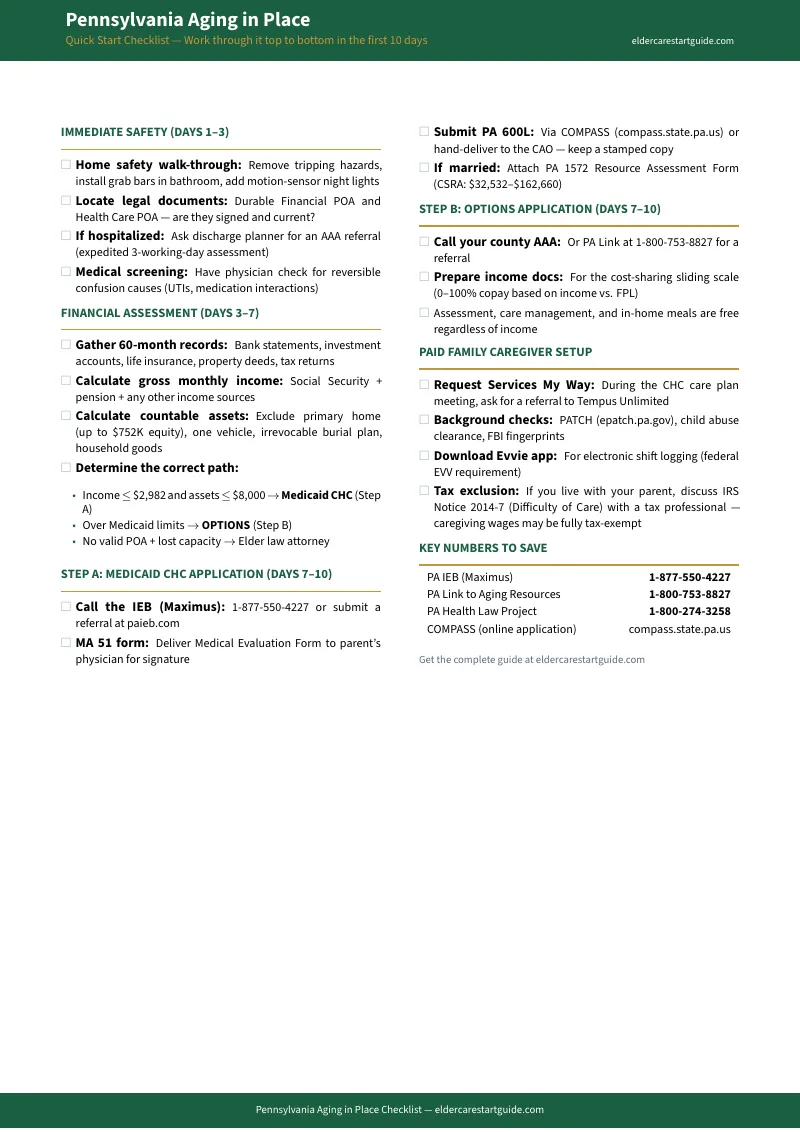
- Resource Checklist (Free Download) — a one-page action checklist covering the 20 critical first steps for keeping a parent safely at home in Pennsylvania.
Who This Is For
- Adult children in Pennsylvania helping an aging parent stay safely at home — whether it's a gradual decline or a sudden hospital discharge that changed everything
- Families navigating Medicaid CHC, the OPTIONS program, or the LIFE program for the first time and overwhelmed by conflicting information across state agencies
- Caregivers who want to get paid for the care they're already providing but can't figure out the Services My Way enrollment process
- Families approaching the Medicaid spend-down threshold who need to understand what assets are protected and what strategies are legal
- Siblings trying to coordinate care responsibilities and agree on a plan using an objective framework instead of arguments
Why Not Just Use Free Resources?
You can find pieces of this information across Pennsylvania's state websites. Medicaid eligibility rules are on the Department of Human Services site. The OPTIONS program is described on the Department of Aging page. The Independent Enrollment Broker has a separate portal for CHC plan selection. Caregiver payment rules are buried in the 55 Pa. Code.
The problem isn't that the information doesn't exist — it's that it's scattered across agencies that don't talk to each other, written in regulatory language, and organized by department function instead of by what a family actually needs to do next. When your parent needs help now and private care runs $30 to $40 an hour, spending three weeks reassembling that puzzle from scratch costs more than the guide.
National referral services like A Place for Mom will connect you with home care agencies for free — but they earn commissions from the agencies they recommend. They don't explain Medicaid waivers, paid family caregiving, or asset protection because there's no referral fee in it. This guide covers every path, including the ones nobody gets paid to tell you about.
Satisfaction Guarantee
If the guide doesn't help you navigate Pennsylvania's home care system more confidently, email us within 30 days for a full refund. No forms, no questions.
Get Started Now
Download the free Resource Checklist to see the 20 critical first steps at a glance. When you're ready for the full process — the Medicaid eligibility workbook, the CHC application walkthrough, the paid caregiver enrollment steps, and the home safety assessment — get the complete Pennsylvania Home Care Navigator.