
Your Parent Has Dementia. Pennsylvania's System Has Answers — Buried Across 14 Agencies.
You just got the diagnosis, or maybe you've known for a while and the situation is getting worse. Your parent is wandering, or they can't manage medications safely, or the private-pay memory care bills are draining the savings account at $6,000 a month. You know you need help — but Pennsylvania scatters its dementia care programs across the Department of Aging, the Department of Human Services, the Office of Long-Term Living, Community HealthChoices managed care organizations, 52 separate Area Agencies on Aging, and county Orphans' Courts. Nobody connects the dots for you.
Meanwhile, the capacity window is closing. Every month your parent loses more cognitive function, and once they can't understand what a power of attorney means, your only option is a court-supervised guardianship that costs $3,000 to $8,000 in legal fees and puts your family's private affairs into public record.
The Keystone Care Navigation System
This guide is built around one principle: Pennsylvania families shouldn't need an elder law retainer to understand their own state's programs. The Keystone Care Navigation System walks you through every major decision in sequence — legal authority first (while your parent can still sign), then safety and facility evaluation, then the financial qualification maze — so you make each move at the right time instead of scrambling to catch up after a crisis.
Where free government portals give you fragments and referral directories steer you toward facilities that pay them commissions, this guide gives you the complete picture with no financial conflicts. Every recommendation is based on Pennsylvania's actual regulatory framework, not national averages or sponsored placements.
What's Inside
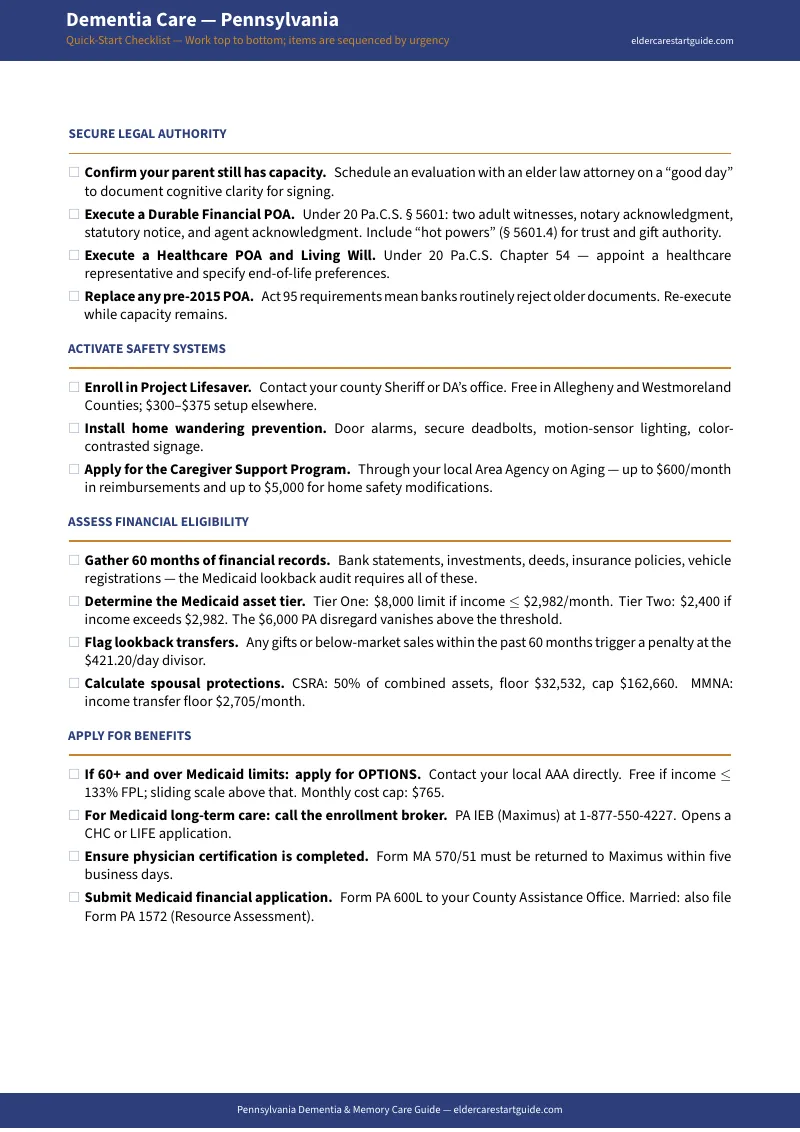
- Legal Authority Roadmap — Step-by-step instructions for executing a durable financial POA (20 Pa. C.S. § 5604) and healthcare POA (§ 5401) while your parent still has capacity, including the "good day" execution strategy and Pennsylvania's strict two-witness-plus-notary requirements
- Memory Care Facility Audit Checklist — A touring tool built on Pennsylvania's own licensing standards (55 Pa. Code §§ 2600/2800) so you can verify staffing ratios, dementia-specific training records, and physical safety features at any Personal Care Home or Assisted Living Residence
- Two-Tier Medicaid Asset Calculator — Pennsylvania's eligibility rules are unlike any other state. If your parent's gross monthly income is at or below $2,982, the countable asset limit is $8,000. If income exceeds that threshold, the limit drops to $2,400. This worksheet walks you through both tiers so you know exactly where your parent stands
- Family Caregiver Agreement Template — A contract-grade template that meets Pennsylvania DHS requirements for classifying payments as compensated transfers, protecting your family from Medicaid look-back penalties and reducing sibling disputes over caregiving compensation
- Community HealthChoices MCO Comparison — A side-by-side breakdown of how AmeriHealth Caritas, PA Health & Wellness, and UPMC implement the new Assisted Living "In Lieu of Service" benefit, plus room-and-board calculations for each
- OPTIONS Program Eligibility Worksheet — For families who don't qualify for Medicaid but can't afford full private-pay care. OPTIONS has no asset cap — this worksheet maps your parent's income to the sliding-scale co-payment schedule
- Irrevocable Burial Reserve Strategy — How to use Pennsylvania's 125% extraordinary cost rule to shelter additional assets in a pre-paid funeral contract, with step-by-step instructions for funding the reserve before a Medicaid application
- Wandering Safety Protocol — How to register your parent with local police, what Pennsylvania's Missing Endangered Person Advisory (MEPA) system covers, and a home safety audit designed to reduce wandering risk before a crisis
Who This Is For
- Pre-crisis planners — Your parent just received a diagnosis and you want to lock in legal authority and understand the financial landscape before the capacity window closes
- Safety-critical caregivers — Your parent is wandering, making dangerous medication errors, or can no longer safely live alone, and you need to evaluate secured memory care options quickly
- Families facing asset depletion — Private-pay care is draining your parent's savings and you need to understand Medicaid qualification, legitimate spend-down strategies, and spousal protection rules before the money runs out
Why Not Free Resources?
Pennsylvania publishes its Medicaid manuals, licensing databases, and program descriptions online. All of it is free. But it's scattered across disconnected portals that don't link to each other, written in statutory language, and organized by bureau rather than by the decisions families actually face. During a caregiving crisis, you don't have dozens of hours to search through unlinked state websites, decode regulatory jargon, and call offices that put you on hold for 45 minutes.
National referral directories like A Place for Mom will happily walk you through your options — and then sell your contact information to the facilities that pay them the highest commissions. They won't mention the OPTIONS program, because there's no commission in a state-funded service. They won't explain Pennsylvania's two-tier asset rules, because that knowledge doesn't generate a facility placement.
This guide gathers the exact rules from the Bureau of Human Services Licensing, the Office of Long-Term Living, and all 52 Area Agencies on Aging into one sequential system. No commissions, no upsells to legal retainers, no information held behind a phone screening.
Your Purchase Is Protected
If the guide doesn't help you navigate your parent's care more confidently, email us and we'll make it right. We read every message.
You'll get immediate access to the complete guide (45 pages), the resource checklist, and all 8 worksheets and templates — everything you need to take the next step with clarity instead of confusion.
Get the Pennsylvania Dementia & Memory Care Guide — and stop losing weeks to bureaucratic dead ends while the capacity window closes and the private-pay bills keep coming.
Already have the free checklist? The full guide goes deeper — with the legal templates, facility audit tools, and Medicaid calculation worksheets the checklist points you toward but can't include.