Your Parent Pays $202.90 a Month for Medicare Part B. Oregon Might Pay It for Them.
If your parent is on a fixed income in Oregon, Medicare premiums and medical bills are eating into their Social Security check every single month. The Medicare Savings Programs — QMB, SMB, and SMF (Oregon's names for the federal SLMB and QI categories) — exist specifically to stop this. Oregon can pay your parent's Part B premium, and if they qualify for QMB, wipe out deductibles and coinsurance too. But the process has traps. The ONE portal drops applications. Phone queues run past two hours. National websites show asset limits that Oregon eliminated years ago. And half the state's providers still send illegal bills to QMB enrollees. One wrong turn can delay approval by months — or keep your parent from applying at all.
The Oregon Medicare Cost Relief System
This is a step-by-step process guide built specifically for Oregon — not a generic Medicare overview and not an insurance sales pitch. It covers the Medicare Savings Programs (QMB, SMB, SMF) and Extra Help (the Part D Low-Income Subsidy) the way Oregon actually administers them: the ONE portal and the local ODHS/APD office alternative, the income disregard calculation that published limits leave out, Oregon's program names mapped to federal terminology, and what to do after approval when the premium keeps coming out of the Social Security check for weeks while CMS catches up.
Every figure is dated to the 2026 benefit year. Every office reference, phone number, and portal instruction has been verified against current Oregon ODHS records.
What's Inside the Guide
- Oregon's Zero-Asset Rule Explained — Unlike regular Medicaid, the Medicare Savings Programs in Oregon have no asset test. Bank accounts, home equity, vehicles, retirement funds — none of it is counted. National sites like Medicare.gov still display the federal default limits ($9,950 individual / $14,910 couple), which causes eligible Oregonians with modest savings to abandon applications. The guide provides the Oregon Administrative Rule citations so you can shut down the "your parent has too much in savings" objection from anyone, including caseworkers who confuse MSP rules with Long-Term Care Medicaid.
- ONE Portal Navigation and the Local Office Bypass — Oregon's integrated ONE system (one.oregon.gov) handles MSP applications alongside OHP, SNAP, and TANF — and it is known for technical errors, dropped data, and phone queues that regularly exceed two hours. The guide details both application routes: the online portal steps for when it works, and the in-person ODHS/APD or Area Agency on Aging intake that creates a case record immediately and bypasses the portal entirely.
- Income Disregard Worksheets — Published income limits ($1,350/month QMB, $1,616 SMB, $1,816 SMF for an individual in 2026) are gross figures. Oregon subtracts a mandatory $20 general income disregard before comparing. The guide includes calculation worksheets so you know which program tier your parent actually falls into — not which one the raw numbers suggest.
- Oregon Program Names Decoder — Oregon calls its MSP tiers QMB, SMB, and SMF, and uses benefit codes like MED, BMM, SMB, and SMF on determination notices. Other states use SLMB and QI. National resources use both sets of terms interchangeably. The guide maps every Oregon name and system code to the federal equivalent, so you can decode your parent's notice and confirm they received the right level of coverage.
- QMB Balance-Billing Dispute Protocol — Federal law prohibits providers from billing QMB enrollees for Medicare deductibles and coinsurance. Oregon providers do it anyway. The guide includes a dispute protocol with the specific federal citations (42 U.S.C. § 1396a(n)(3)(B), 42 C.F.R. § 447.15) and a letter framework to stop illegal bills before they go to collections.
- Part A Buy-In Without Waiting — Oregon is a buy-in state for Part A. If your parent lacks premium-free Part A because they have fewer than 40 work quarters, they can apply for QMB at any time of year — no General Enrollment Period restriction. The guide scripts the Conditional Part A filing with Social Security and the coordination with Oregon's MSP application so both approvals happen together.
- Extra Help Auto-Conferral and ArrayRx Distinction — MSP approval in Oregon triggers automatic Extra Help (Part D Low-Income Subsidy) — no separate SSA-1020 application needed. The guide also distinguishes the Oregon Prescription Drug Program and its ArrayRx discount card from true pharmaceutical assistance, since the two serve completely different purposes and confusing them can cost your parent thousands in unnecessary drug costs.
- Renewal Tracking, COLA Traps, and Fair Hearing Deadlines — Oregon conducts annual redetermination. The January Social Security COLA increase can push your parent's gross income above the MSP limit even though their real purchasing power hasn't changed — the guide covers the timing of Oregon's COLA disregard and how the January–February gap works. It also covers the fair hearing process and continuing benefits (aid paid pending) if a renewal is denied.
- Remote Caregiver Filing Blueprint — If you live out of state and your parent is in Oregon, the guide covers how to establish Authorized Representative status, file through the ONE portal or by mail, and manage the process remotely — including which consent forms Oregon requires before ODHS will discuss your parent's case with you.
Who This Guide Is For
- Adult children helping a parent in Oregon who is paying the full Medicare Part B premium on a fixed income
- Seniors in Oregon whose Social Security check is shrinking because of Medicare costs and who want to find out if the state will cover some or all of it
- Families who have been told their parent doesn't qualify because of savings or assets — and want to verify that against Oregon's actual rules
- Caregivers managing a parent's benefits from out of state who need a clear filing path through Oregon's ODHS system
- Anyone helping a QMB enrollee in Oregon fight an illegal medical bill
- Younger disability-based Medicare beneficiaries in Oregon navigating MSP eligibility alongside SSDI
Why Not Just Use the Free Information?
Oregon publishes the ONE portal as an online intake tool — without a guide to navigating its quirks. The ODHS website explains MSP eligibility — while the ONE system routing sends applicants through OHP, SNAP, and TANF questions that have nothing to do with Medicare. Medicare.gov confirms that some states eliminated asset limits — while displaying $9,950/$14,910 on the same page, convincing Oregon residents with a $15,000 savings account that they don't qualify. SHIBA counselors provide excellent free guidance — but they cannot complete applications on your behalf, organize your documents, or draft a balance-billing dispute letter.
The information is scattered across one.oregon.gov, Medicare.gov, SSA policy manuals, Oregon Administrative Rules, and Reddit threads where people piece together conflicting advice. This guide puts the Oregon-specific process in one place, in the order you need it, with the calculations already set up and the common traps flagged.
What's Not in This Guide
This guide does not recommend Medicare Advantage plans, Medigap policies, Part D drug plans, or insurance brokers. It does not provide legal advice. It is not affiliated with CMS, SSA, Oregon ODHS, OHA, or any state agency. It is process navigation — the steps to get your parent's Medicare costs covered by programs that already exist, explained in plain language with Oregon-specific procedures.
For insurance plan comparisons, the guide directs families to Oregon SHIBA (1-800-722-4134), which provides free, unbiased counseling. For complex situations involving significant assets, Miller Trusts, or Long-Term Care Medicaid, the guide recommends consulting an Oregon elder law attorney.
Satisfaction Guarantee
If the guide doesn't deliver what you expected, email [email protected] for a full refund. No time limit, no conditions.
Get Started
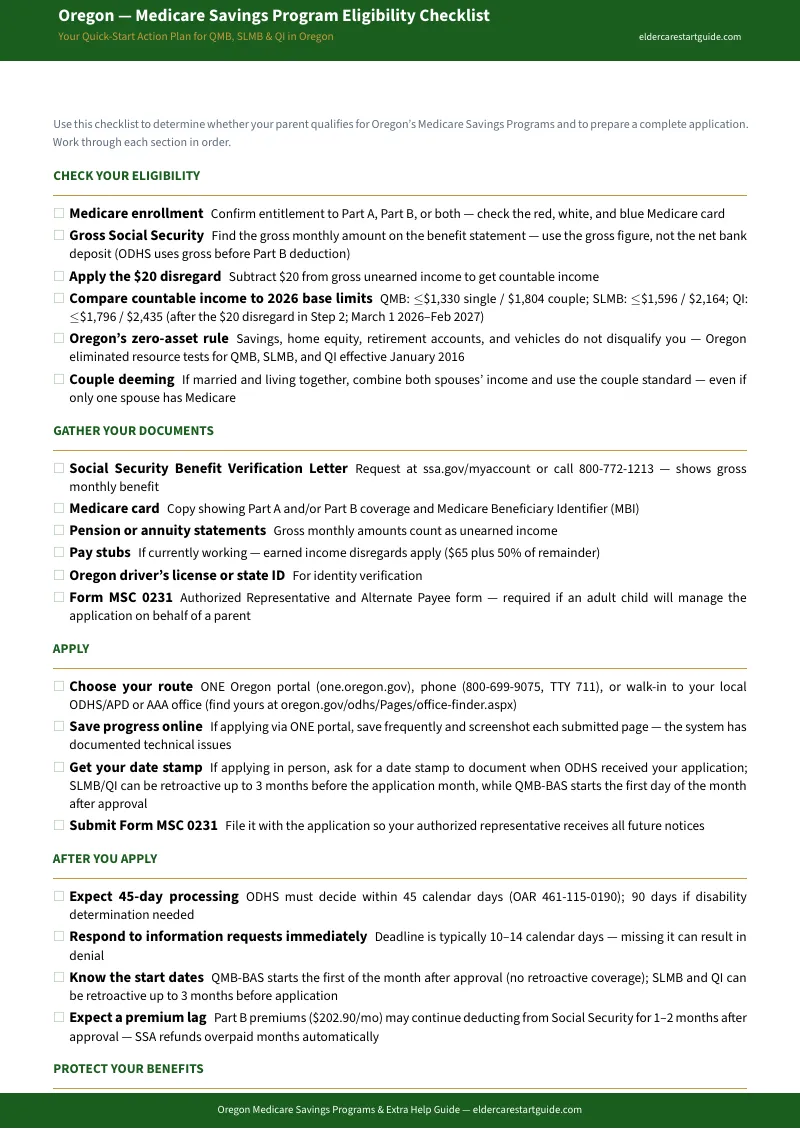
Download the free Oregon Medicare Savings Program Eligibility Checklist to see if your parent qualifies. If the numbers look right, the full guide gives you everything you need to file, follow up, and protect your parent's benefits after approval.
The full Oregon Medicare Savings Programs & Extra Help Guide is — less than a single month's Part B premium, for a process that can save over $2,400 a year.
Frequently Asked Questions
What if the rules change after I buy?
We update the guide when the rules change. Email us any time, even years later, and we'll send you the current edition free.