
Your parent needs help. Oregon law says you're a stranger.
The bank won't let you access their account. The hospital won't discuss the care plan with you. The APD caseworker needs a signature on the CAPS assessment paperwork and you don't have the legal standing to provide one. You've been coordinating your parent's daily care for months — but without the right documents, Oregon treats you like any other member of the public.
Getting legal authority in Oregon isn't one document. It's a system of interlocking instruments — a Durable Financial Power of Attorney under ORS 127.005, a Healthcare Advance Directive under ORS 127.505–127.660, and potentially a guardianship or conservatorship petition under ORS Chapter 125 if capacity is already gone. Miss the wrong detail and your bank rejects the POA under their ORS 708A.675 elder-abuse immunity shield. Skip the explicit Miller Trust authority and your parent's K Plan application stalls. File for the Spousal Pay Program without documenting four of six ADLs and the whole family gets disqualified from the program that would pay a spouse to provide care.
The Oregon Legal Authority Navigator
This kit replaces the scattered, contradictory information with a single system built around Oregon's actual statutes and administrative processes. It's the difference between guessing which forms apply and knowing exactly which documents to execute, in what order, with the precise language Oregon's banks, hospitals, and state agencies require.
What's Inside
- Durable Financial POA Walkthrough — the exact durability language under ORS 127.005, the high-stakes clauses that must be explicitly granted (Income Cap Trust creation, real estate transactions, beneficiary changes, HIPAA personal representative designation), notarization blocks to satisfy ORS 93.670 recording requirements, and the institutional-acceptance checklist that prevents bank rejections
- Advance Directive Packet — the full post-SB 199 statutory form (updated January 2022), healthcare representative appointment and acceptance signatures, end-of-life instructions including tube feeding and life support preferences, and the dual-witness execution option under ORS 127.515
- Capacity Assessment Protocol — how to evaluate cognitive capacity during lucid intervals, what the ORS 125.005(5) "receive and evaluate information" standard means in practice, when supported decision-making is sufficient, and the boundary where self-help options end and court petitions begin
- ORS 125 Guardianship & Conservatorship Filing Roadmap — petition requirements, the mandatory Court Visitor investigation under ORS 125.150, county-by-county Court Visitor fees ($300–$750), the fiduciary bond calculation under ORS 125.410, the 90-day financial inventory deadline, annual reporting obligations, and Oregon's strong preference for limited guardianship under ORS 125.300(1)
- Emergency Guardianship Procedures — the ORS 125.600 temporary appointment process, the 30-day term limit, the 2-day personal service deadline, and the compressed objection hearing timeline
- Bank Compliance Toolkit — the ORS 127.025 anti-rejection citation, the ORS 708A.675 immunity analysis so you understand what banks can and cannot refuse, escalation procedures for compliance departments, and a checklist for presenting your POA to financial institutions
- K Plan & Medicaid Enrollment Guide — the 2026 income threshold ($2,982/month), the $2,000 asset limit, the CAPS assessment scoring system (SPL 1–13 for K Plan eligibility), how to document ADL limitations to align with service priority levels, and the Income Cap Trust (Miller Trust) setup when income exceeds the threshold
- Spousal Pay & Caregiver Programs — K Plan Consumer Employer Program registration, the ODHS Background Check Unit audit, Carewell SEIU 503 mandatory orientation, the Provider Time Capture payroll system, and spousal impoverishment protections including the $162,660 Community Spouse Resource Allowance
- OPI-M Bridge Program — the expanded eligibility rules under the Section 1115(a) waiver ($5,320/month income, $103,645 asset limit, SPL 1–18), and when this program can replace the extreme spenddown that standard Medicaid requires
- Planning Worksheets & Contacts Directory — asset inventory tracking, spend-down expense logs, caregiver hour records for APD audits, and direct contact information for every Oregon agency referenced in the guide
Who This Kit Is For
- You're in crisis. Your parent was just hospitalized or diagnosed, and you need to establish legal authority within days. The kit gives you the exact filing sequence so nothing gets missed under pressure.
- You're planning ahead. Your parent is declining but still has capacity. You have a window to execute voluntary documents — and the kit shows you every clause that matters before that window closes.
- You're managing from out of state. Your parent lives in Oregon but you don't. You need to understand remote notarization options, how local AAA offices handle assessments, and what legal framework lets you manage Oregon-based assets from another state.
- You want to get paid to provide care. You need to know exactly how to structure the legal documents and K Plan enrollment so your family doesn't accidentally disqualify itself from the Spousal Pay or Consumer Employer programs.
Why Not Just Use Free Forms?
Oregon's official Advance Directive form — available from the Oregon Health Authority — covers the healthcare side. But Oregon does not publish a standard fill-in-the-blank form for financial powers of attorney, unlike its statutory health care form. And the generic templates on eForms or LegalZoom use national templates that routinely omit the explicit statutory riders Oregon institutions require. A financial POA without express Miller Trust authority cannot redirect excess income for Medicaid eligibility. A document without the notary acknowledgment block that satisfies ORS 93.670 gets flagged by bank compliance departments operating under their ORS 708A.675 elder-abuse immunity.
Free forms give you a document. This kit gives you a system — the right documents, executed correctly, with every clause Oregon's banks, hospitals, and state agencies actually require.
What You're Getting
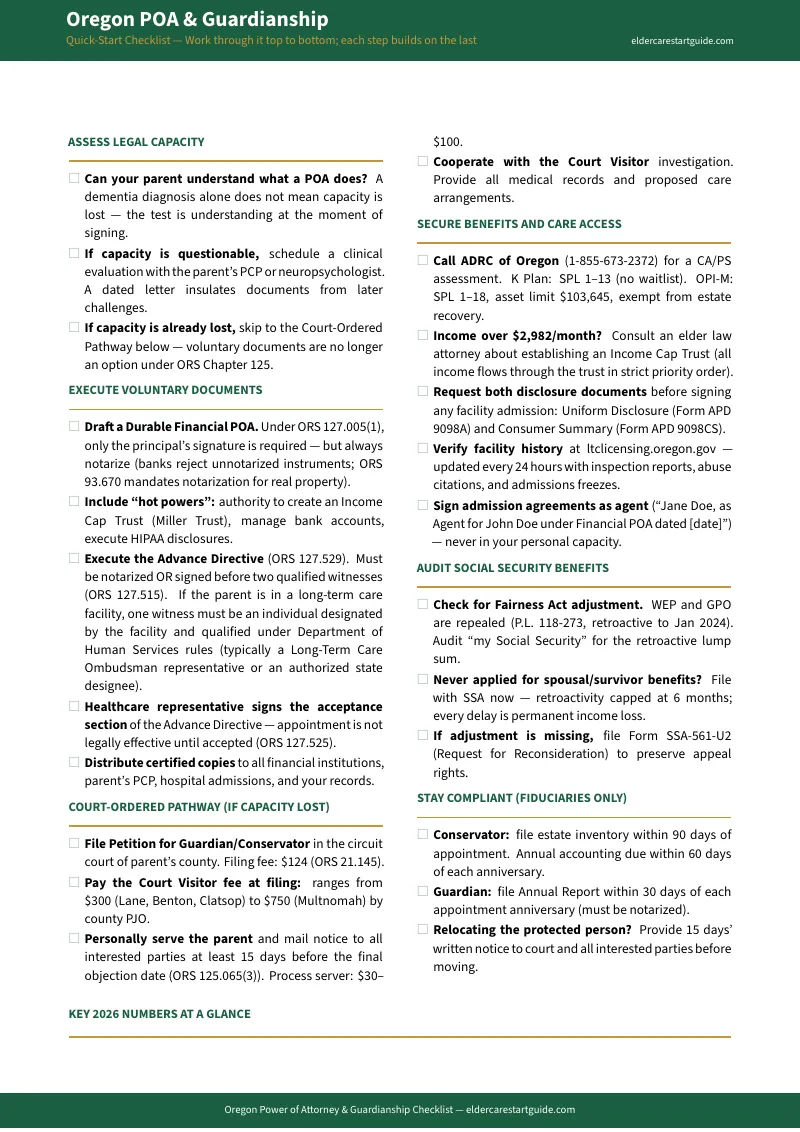
A 43-page guide covering every legal instrument, worked examples with real cost breakdowns and penalty calculations, plus 8 standalone printable worksheets — bank compliance checklist, capacity assessment protocol, POA execution tracker, court filing tracker, care facility comparison, Medicaid financial inventory, agency communication log, and a 72-hour crisis workflow. The full kit (10 PDFs) is available for , and a free quick-start checklist is available if you want to see the approach before committing.
Satisfaction Guarantee
If the kit doesn't give you a clearer path to legal authority than what you've found on your own, reply to the download email and we'll refund your purchase — no forms to fill out, no hoops.