
Your Parent Needs Help at Home. Oregon Has Programs That Will Pay for It — If You Know How to Navigate the System.
Your parent can't manage alone anymore. Maybe it was a fall. Maybe it was the third time they left the stove on. Maybe it was the slow realization that they haven't been eating properly, haven't been bathing, haven't been taking their medications correctly. Whatever triggered it, you're the one who noticed — and now you're the one trying to figure out what comes next.
You Googled "home care Oregon" and discovered there are state programs that fund in-home caregivers. You called your local APD office and got transferred three times. You found something called the K Plan but couldn't figure out whether your parent qualifies. Someone mentioned OPI-M but nobody explained the difference between that and regular Medicaid. And the CAPS assessment — the evaluation that determines how many care hours your parent receives — uses a scoring system that nobody translates into plain English.
Meanwhile, you priced out private home care. $33 per hour. Over $7,000 per month for just 8 hours a day. And your parent's savings won't cover that for long.
The Oregon Home Care Navigation System
This is not a list of eligibility rules you can find on the ODHS website. It is the process around the rules — the part that $300–$500/hour elder law attorneys explain in billable consultations and that county APD caseworkers never have time to walk you through.
The guide covers every step from the first warning signs to securing state-funded home care: establishing legal authority before your parent loses capacity, auditing finances against Oregon's specific program thresholds, choosing between the K Plan and OPI-M, navigating the CAPS functional assessment to maximize authorized care hours, getting paid as a family caregiver through the Home Care Commission, protecting the family home from Medicaid estate recovery, and accessing community supports like meals, transportation, and respite care.
Oregon has a structural advantage most families never learn about: the K Plan (Community First Choice) is a state plan entitlement with no waiting list. If your parent qualifies, services are authorized and care begins. No lottery, no multi-year queue. But qualifying requires documenting functional limitations precisely enough to score well on the CAPS assessment, meeting financial limits that are stricter than most families expect, and understanding the Income Cap Trust (Miller Trust) workaround for seniors whose income is slightly over the threshold.
What's Inside
- Crisis Response Framework — Your parent is being discharged from the hospital and you've been told to "arrange care at home." This section tells you exactly who to call (ADRC helpline: 1-855-673-2372), what to request from the hospital social worker, how to fast-track a CAPS functional assessment through your local APD or AAA office, and how to establish legal authority with an Oregon Advance Directive and Durable Power of Attorney before your parent's capacity declines further.
- K Plan Application Walkthrough — The complete Community First Choice process in plain language. How to apply through ONE.Oregon.gov, what the automated Asset Verification System requires, how the CAPS assessment assigns a Service Priority Level (SPL 1–13 for K Plan), and the specific strategies for documenting functional needs when your parent minimizes their limitations during the face-to-face evaluation. No waiting lists — but a denial costs weeks.
- OPI-M Middle-Income Pathway — Oregon's unique expansion under the Section 1115 demonstration waiver (approved through January 2029). Income limit of $5,320/month and asset limit of $103,645 — dramatically higher than traditional Medicaid. Up to 40 hours of in-home care every two weeks. And the critical detail most families miss: OPI-M services are completely exempt from Medicaid estate recovery. The state cannot place a claim against your parent's home for care received through this program.
- Financial Eligibility Audit — Oregon counts retirement accounts (IRAs, 401(k)s) as assets, which surprises many families. The guide walks through the 2026 thresholds for every program — K Plan ($2,982 income / $2,000 assets), OPI-M ($5,320 / $103,645), and SPPC ($994 / $2,000). It covers the Income Cap Trust (Miller Trust) for seniors above the K Plan limit, spousal income and asset protections, and the exact documents required for the automated bank verification that takes 14 to 45 days.
- CAPS Assessment Preparation — The state's functional assessment determines everything: which program your parent enters, how many care hours are authorized, and what services appear on the care plan. The guide translates Oregon's 18 Service Priority Levels and the five-tier scoring system (0–40 points = Tier 1 through 107+ points = Tier 5) into plain language. It includes a pre-scoring grid so you can estimate your parent's tier before the caseworker visit, plus a 14-day daily care log template to document the assistance you're already providing.
- Consumer-Directed Care — Getting Paid as a Family Caregiver — Oregon allows adult children to serve as paid homecare workers through the Consumer-Employed Provider Program under the K Plan. The guide covers Home Care Commission enrollment, Background Check Unit screening, required training hours, the OHCC caregiver registry, and the Spousal Pay Program (OAR 411-030-0080) — including its strict clinical eligibility requirement that the care recipient need full assistance in at least four of six ADLs.
- Estate Recovery Shield — Oregon's Medicaid Estate Recovery Program (MERP) recovers costs from the estates of deceased Medicaid recipients. The guide details the $752,000 home equity exemption, the Caregiver Child Exemption (which requires two continuous years of co-residence), ownership structures that bypass probate, OPI-M's complete exemption from recovery, and the documentation templates you need to establish the caregiver child transfer before your parent enters a facility.
- Home Safety Modifications and Funding — A room-by-room safety assessment checklist, plus every funding source: K Plan environmental modifications, OPI-M's $5,000 lifetime cap for home modifications, AAA community programs, and Veterans Affairs HISA grants. The caseworker or occupational therapist must verify that each modification is necessary to prevent institutional placement.
- Community Resources Chapter — How to connect with your local AAA, the Aging and Disability Resource Connection (ADRC), Oregon Care Partners free training for caregivers, Meals on Wheels and Medicaid Home Delivered Meals (different eligibility rules), Non-Emergency Medical Transportation through your CCO, non-medical community transportation (8 rides per pay period), respite care options under K Plan and OPI-M, and adult day health services.
- County-by-County Directory — APD office contact information, AAA service areas, and regional resources for Oregon's major counties — including Multnomah, Washington, Clackamas, Lane, Marion, Jackson, Deschutes, and Linn-Benton.
Plus: Printable Worksheets and References
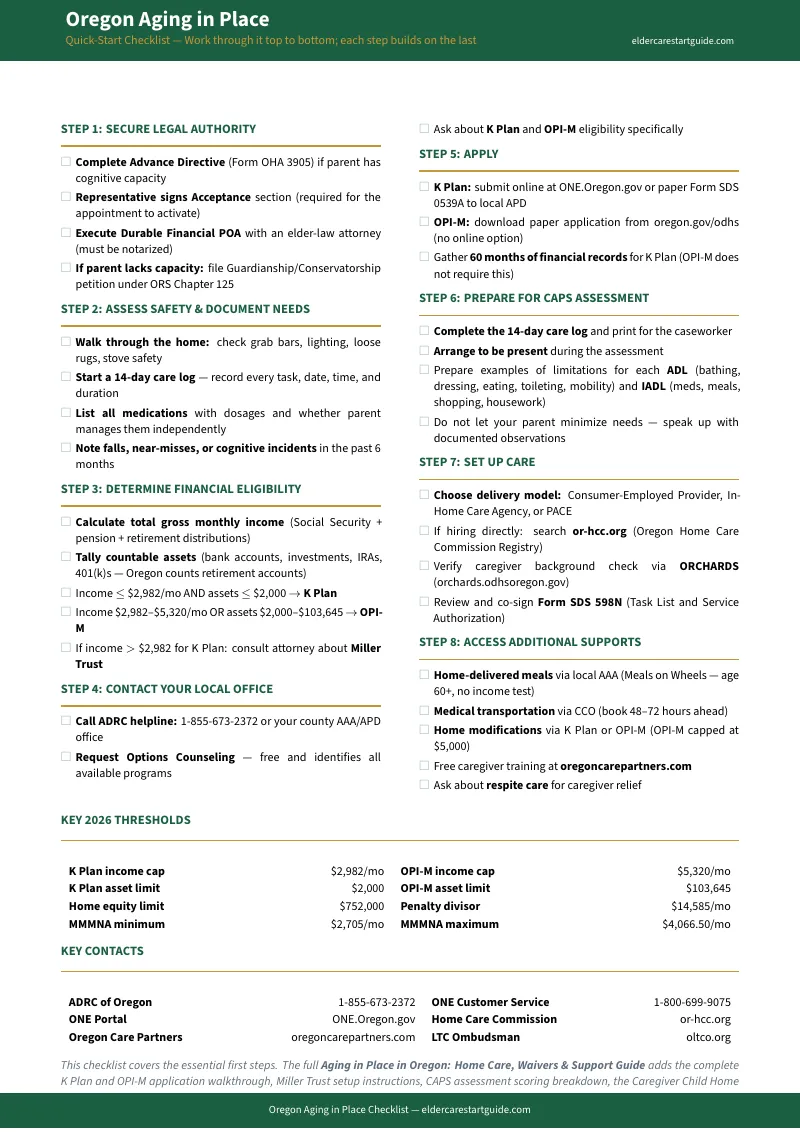
- Oregon Aging in Place Resource Checklist — An 8-step, 30-item action list organized by timeline: legal authority (Days 1–7), safety assessment and care logging (Days 7–14), financial eligibility check (Days 14–30), program application, care setup, and community resource connections.
- Financial Eligibility Self-Assessment — Tally every countable asset against Oregon's 2026 limits for K Plan, OPI-M, and SPPC, with exempt/countable status and Miller Trust eligibility check.
- 14-Day Care Log Template — Printable daily tracker for documenting every instance of assistance — the single most important piece of evidence for the CAPS assessment.
- CAPS Assessment Preparation Checklist — Pre-scoring grid aligned to Oregon's Service Priority Levels and five-tier payment structure.
- Home Safety Assessment Checklist — Room-by-room evaluation with Oregon-specific modification funding sources.
- Document Preparation Checklist — Every form, statement, and record needed for the ONE.Oregon.gov application and automated bank verification.
Who This Is For
- Adult children whose parent is being discharged from the hospital and someone needs to figure out how to pay for home care that costs over $7,000 a month
- Families who need to qualify a parent for K Plan services but don't understand how the CAPS assessment scoring determines authorized care hours — or how to prepare for the face-to-face evaluation
- "Forgotten middle" families whose parent earns too much for standard Medicaid but too little to sustain private-pay care — and who have never heard of OPI-M
- Caregivers who want to get paid through the Consumer-Employed Provider Program but don't know how to handle the Home Care Commission enrollment, background check, or training requirements
- Anyone terrified that Oregon Medicaid will seize their parent's home after death — and who wants to understand what estate recovery actually reaches and which programs are completely exempt
- Out-of-state siblings coordinating Oregon home care applications remotely with no idea which county office to contact
Why Not Free Government Resources?
The ODHS publishes eligibility limits. The ADRC has a helpline. County APD offices have application forms you can access through ONE.Oregon.gov.
Here is what none of them provide:
- A step-by-step CAPS assessment preparation strategy showing you how the five-tier scoring system actually works and how to document your parent's functional limitations precisely enough to maximize authorized care hours — not just "call your local office and schedule an evaluation"
- A side-by-side comparison of the K Plan, OPI-M, traditional OPI, and SPPC with the exact financial thresholds, service limits, and estate recovery implications for each — not 200 pages of Oregon Administrative Rules spread across OAR Chapter 411
- An OPI-M eligibility analysis explaining why families earning up to $5,320/month should apply for this program first — because it's completely exempt from estate recovery, unlike the K Plan
- An estate recovery analysis detailing which ownership structures survive probate in Oregon and how to use the Caregiver Child Exemption with proper documentation — not a "consult an attorney" footnote
- A complete caregiver employment framework for enrolling as a Consumer-Employed Provider through the Home Care Commission, including background check requirements, training hours, and the Spousal Pay Program's strict eligibility criteria
Government sites publish regulations. This guide translates fragmented state policies — scattered across ODHS, APD, AAA, OHCC, and CCO systems — into a single, sequential process you can follow from crisis to stable home care.
Your Parent's Safety Net
Every week you spend researching is a week your parent goes without the funded care they may already be entitled to. K Plan services are retroactive to the date of application — but only if you apply.
Get the Oregon Home Care Guide →
The free checklist gives you the 30-item action list to start immediately. The full guide gives you every chapter, every program comparison, every assessment preparation strategy, and the complete caregiver employment framework.