
Your parent needs a different level of care. Oregon's system has answers — but nobody is putting them in order for you.
The state website has hundreds of pages of rules. The referral agency tours are free because facilities pay finder's fees. The elder law attorney charges $300–$500 an hour just to explain how the Income Cap Trust works. And the hospital discharge planner is giving you 48 hours to figure it out.
Meanwhile, you're trying to answer questions that feel impossible: Is home care enough, or is Mom safer in a facility? What's the actual difference between an assisted living facility and a residential care facility? Can Dad qualify for Medicaid if his income is $200 above the limit? Will the state take the house after he dies?
You don't need more information. You need a Care-Level Decision System — a structured, step-by-step process that uses the same clinical criteria Oregon's own case managers use, so you can match your parent to the right care setting, qualify for the right financial programs, and protect your family's assets in the right order.
What's Inside the Full Guide
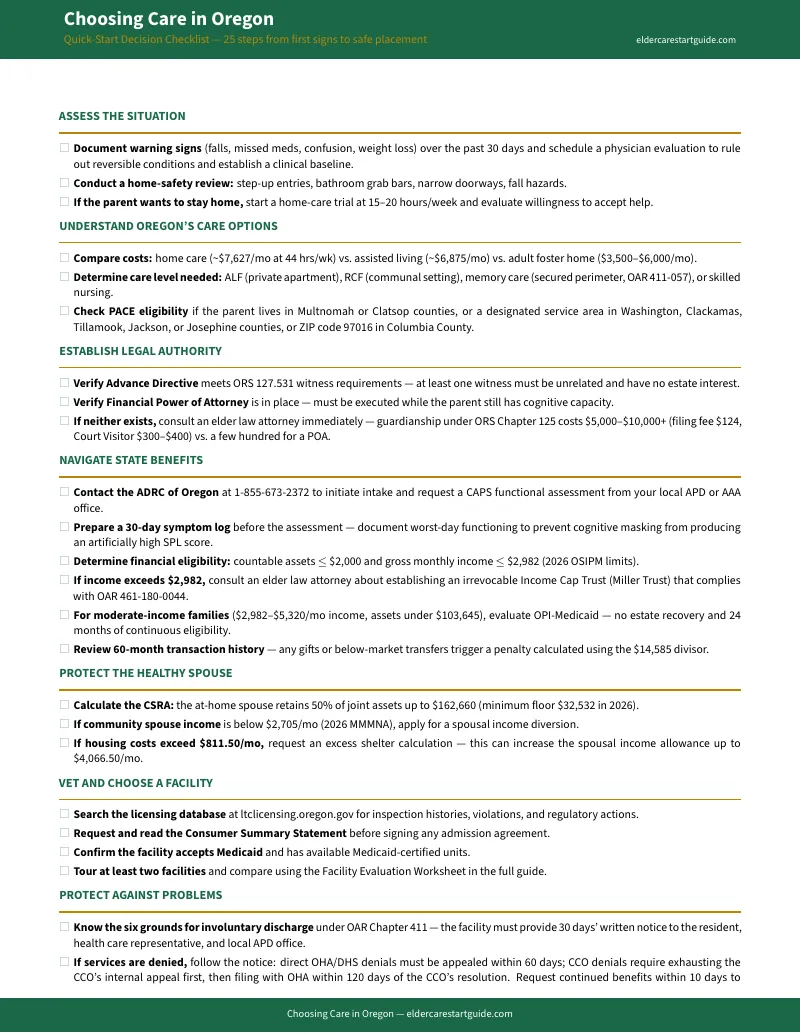
The Oregon Care Decision Toolkit is a 49-page guide, a 25-item decision checklist, and five printable planning worksheets built around Oregon's specific administrative structure — the CAPS assessment, the K Plan, OSIPM Medicaid, and the state licensing portal. Every chapter maps to one decision your family needs to make, in the order you need to make it.
- The Care-Setting Comparison Framework — a side-by-side breakdown of Oregon's six licensed care settings (home care, adult day services, assisted living, residential care, adult foster homes, and skilled nursing) with median monthly costs, what each one actually provides, and the clinical thresholds that determine which setting fits your parent's needs
- CAPS Assessment Preparation — how the Client Assessment and Planning System works, what the Service Priority Level score means, why a score above 13 disqualifies your parent from state-funded services, and how to document your parent's worst-day functioning so cognitive masking doesn't produce an artificially high score
- K Plan Eligibility Walkthrough — Oregon's Community First Choice program funds in-home and community care as an entitlement with no waitlist and no enrollment cap. The guide explains the financial thresholds ($2,982 monthly gross income, $2,000 countable assets for a single applicant), what counts as a countable asset, and how the K Plan interacts with the 1915(c) APD Waiver
- Income Cap Trust Setup — when gross income exceeds $2,982, an Income Cap Trust is the only way to qualify for OSIPM. The guide walks through the trust structure, which income sources get deposited, the disbursement rules including the $81.28 personal needs allowance, and what documents to bring to the bank
- Spousal Protection Calculations — the Community Spouse Resource Allowance (up to $162,660 in 2026), the Minimum Monthly Maintenance Needs Allowance, and the specific math Oregon uses to determine what the healthy spouse keeps
- Facility Vetting Protocol — how to use ltclicensing.oregon.gov to review five years of inspection histories, what "substantiated" versus "inconclusive" means in licensing reports, and how to read the Consumer Summary Statement mandated under SB 815 before signing any admission agreement
- Estate Recovery Rules — what Oregon's Medicaid Estate Recovery Program can and cannot claim, the exemptions that protect the family home while a surviving spouse or disabled child resides there, and how these rules interact with asset planning
- Emergency Decision Path — for families dealing with a hospital discharge, a post-acute rehab transfer, or a sudden safety crisis that requires placement within days, not weeks
Who This Is For
- Adult children in Oregon who are deciding whether a parent can stay at home or needs to move to a care facility
- Families facing a hospital discharge with 48–72 hours to arrange a safe placement
- Families whose parent's private-pay savings are running out and who need to understand OSIPM Medicaid eligibility before the money is gone
- Spouses trying to protect their own retirement assets while qualifying a partner for state-funded care
- Out-of-state adult children coordinating care for a parent in Oregon without knowing the local system
Why Not Just Use Free Resources?
The state provides the rules, not the roadmap. The ADRC of Oregon can tell you which offices to contact. The DHS website has the eligibility thresholds. The licensing portal has the inspection reports. But none of these sources puts the information in sequence — they don't tell you what to do first, what depends on what, or how the pieces connect.
Local referral agencies like A Place for Mom and OSRAA provide helpful facility tours, but they're compensated by finder's fees from the facilities they recommend. They cannot refer you to state-funded K Plan in-home care, non-contracted adult foster homes, or independent providers — because those options don't pay them. This guide is completely unbiased because we accept zero commissions from any facility or provider.
An elder law attorney is essential for drafting an Income Cap Trust or handling a contested guardianship. But at $300–$500 an hour, you shouldn't be using their billable time to learn what OSIPM stands for or organize your parent's financial records. Families who walk into that meeting prepared — with their parent's care needs documented, their financial records organized, and a clear understanding of the eligibility rules — save hours of billable time.
The Guarantee
Full refund, no time limit. If the guide doesn't help your family navigate the decision, email [email protected] and we'll refund the full amount — no questions, no time window.
Start With the Free Checklist or Get the Full Toolkit
The free checklist gives you the critical action items at a glance — which agencies to contact, what documents to gather, and the key financial thresholds. The full Oregon Care Decision Toolkit goes deeper into every item on that list, with the CAPS preparation framework, the Income Cap Trust walkthrough, the facility vetting protocol, and the spousal protection calculations. Download the checklist to start tonight, or get the complete toolkit for the full decision system.