
The Bank Said No. The Hospital Needs a Decision-Maker. And Your Parent Can't Sign Anything.
Your parent fell, or the cognitive test came back, or the bank teller just told you they cannot discuss your mother's mortgage — even though you are the one paying it. You searched "power of attorney Oklahoma" and found a free PDF on oklaw.org. You printed it. And then you realized it does not explain which signatures go where, whether you need a notary or witnesses or both, or what happens when the bank rejects it anyway.
That gap — between having a form and actually getting authority that institutions accept — is where families lose weeks, sometimes months, while a parent's care needs do not wait.
The Oklahoma Authority Navigation System
This kit is not another legal overview you can find on a government website. It is the operational bridge between knowing that a durable power of attorney exists under Title 58 and actually getting a bank branch in Oklahoma City, a nursing home in Tulsa, or an OKDHS caseworker to recognize your authority and let you act.
The kit covers both documents you need — the durable financial power of attorney and the healthcare advance directive — plus the guardianship fallback when capacity is already gone, the SoonerCare long-term care application that requires legal authority at nearly every step, and the specific institutional friction points where Oklahoma families get stuck.
What's Inside
- Oklahoma's Two-Track Authority System — Financial authority and healthcare authority run on separate statutes with different signing rules. The financial POA under Title 58 needs notarization for presumptive validity but no witnesses. The advance directive under Title 63 needs two non-inheriting adult witnesses but no notary. Confuse them and the document is vulnerable to challenge. The guide explains which you need, when you need both, and exactly how each one must be executed.
- The "Hot Powers" Strategy — Oklahoma requires your parent to separately initial specific high-impact powers like gifting, trust modification, and beneficiary changes (58 O.S. § 3024). If those initials are missing, those powers are not granted — even if the document says "all powers." The guide identifies every hot power, explains when each one matters, and flags the ones critical for Medicaid planning.
- Bank Acceptance Protocol — Since November 1, 2021, Oklahoma law (58 O.S. § 3020) prohibits banks from rejecting a properly notarized statutory POA in favor of their own forms. They have 7 business days to accept or request an Agent Certification. If they refuse, they face court orders and liability for your attorney fees. The kit includes the Agent Certification form (§ 3042) and a pre-drafted demand letter that cites these exact statutes — because knowing the law and having a letter that proves you know it are two different things at a bank branch window.
- Capacity Assessment and Lucid Interval Documentation — A dementia diagnosis does not close the door on voluntary POA in Oklahoma. Under the standard from Robertson v. Robertson (654 P.2d 600), your parent needs contract-level capacity at the moment of signing. The guide shows you how to schedule a physician capacity letter, time the signing for your parent's best hours, and document the process so it holds up if challenged.
- The Guardianship Walkthrough — When capacity is already gone, neither a POA nor an advance directive can be signed. The guide walks through the full District Court guardianship petition under Title 30: required forms, OSBI background check, physician evaluation, the 10-day notice requirement, what happens at the hearing, and the ongoing annual reporting and accounting obligations. Filing fees run $204 to $220 — but attorney fees for the same process typically cost $1,500 to $10,000.
- Emergency Guardianship — When a parent is in immediate danger — financial exploitation, unsafe discharge from hospital, active self-neglect — the court can appoint a Special Guardian without prior notice under 30 O.S. § 3-115. Valid for 30 days. The guide covers the filing standard, evidence requirements, and the transition to general guardianship.
- SoonerCare Long-Term Care Navigation — Oklahoma's Medicaid system runs on two parallel tracks that must complete simultaneously. The financial track (OKDHS Adult and Family Services) verifies income under $2,982/month and assets under $2,000. The clinical track (OKDHS Aging Services) evaluates nursing facility level of care through the UCAT III assessment. A delay on either track stalls the entire application. The guide explains both tracks, the Qualified Income Trust (Miller Trust) required when income exceeds the cap, and how the ADvantage Waiver funds in-home care as an alternative to nursing home placement.
- The Five-Year Lookback Decoded — Medicaid reviews five years of financial transactions before the application date. Any uncompensated transfer during that window creates a penalty period where your parent is ineligible for benefits. The guide explains what counts as a transfer, what the exceptions are (including the caretaker child exemption), and how the penalty math works.
- Care Settings and Costs in Oklahoma — Nursing home care averages over $7,500/month in Oklahoma. The guide covers the full spectrum: in-home care through the ADvantage Waiver, assisted living, memory care, adult day programs, and skilled nursing — with the operational details families actually need about each setting.
Plus: Printable Standalone Tools
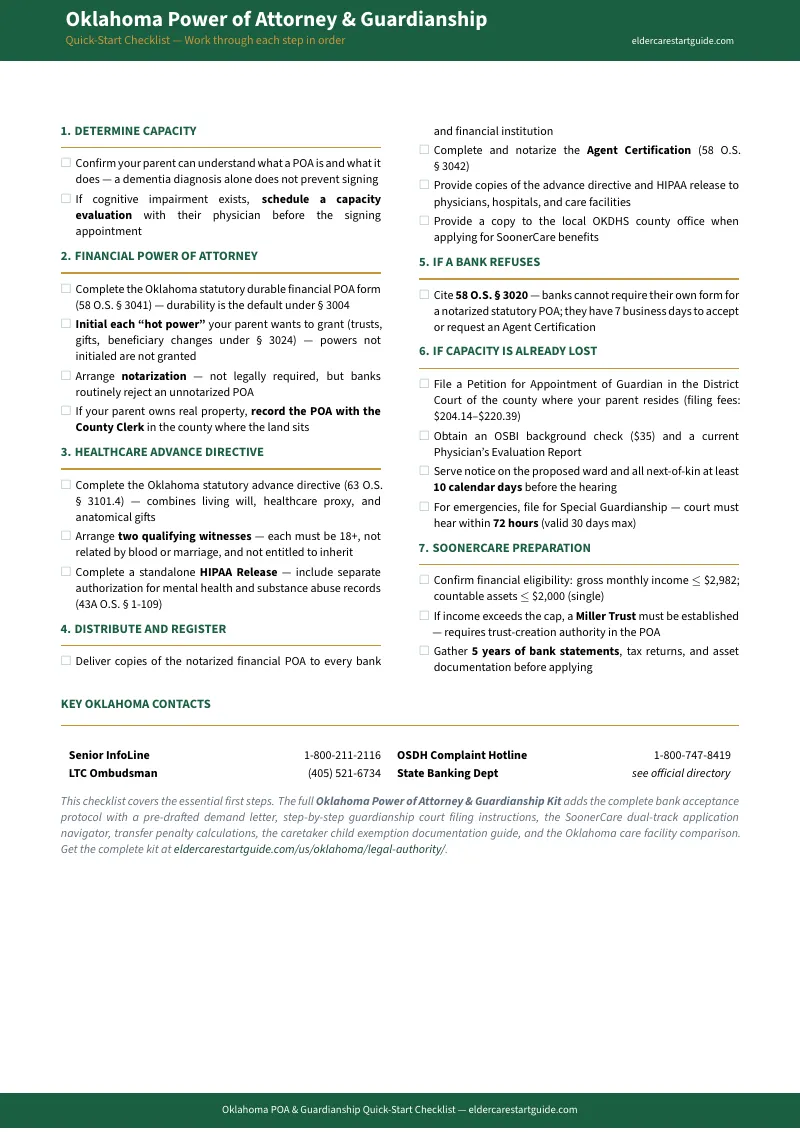
- Quick-Start Checklist — The 21 most critical action items from capacity assessment through bank registration, SoonerCare application, and guardianship filing — on one printable page
- Bank Acceptance Demand Letter — Pre-drafted letter citing 58 O.S. § 3020 and § 3042, ready to present when a financial institution refuses your POA
- Guardianship Filing Checklist — Step-by-step District Court filing checklist covering the petition, OSBI check, physician evaluation, notice service, hearing, and post-appointment obligations
- SoonerCare Eligibility Worksheet — Side-by-side financial and clinical track tracker so you can prepare both applications simultaneously and avoid delays
- Capacity Assessment Protocol — Practical assessment checklist, signing-day protocol, and documentation guide for lucid interval POA execution
- Hot Powers Reference Card — Every power under 58 O.S. § 3024 that must be individually initialed, with notes on when each one matters for Medicaid planning
- Transfer Penalty Calculator — Fill-in worksheet for calculating the 5-year lookback penalty period and estimating out-of-pocket costs during the penalty
- Care Settings Comparison — Oklahoma facility types, what each provides, SoonerCare coverage, and decision factors — all on one printable page
- Document Signing Tracker — Track the execution of both the financial POA and advance directive, plus a distribution log for every institution that receives copies
Who This Is For
- Adult children whose parent is still competent but declining, and who need to get financial and healthcare authority in place before capacity is lost
- Families whose parent's bank has frozen accounts or is demanding its own forms instead of accepting the statutory POA
- Caregivers navigating the SoonerCare application and discovering they cannot sign financial disclosures or establish a Miller Trust without legal authority
- Siblings trying to coordinate who serves as agent and how to structure accountability to prevent family conflict
- Adult children whose parent has already lost capacity and who need to understand the guardianship process before hiring an attorney
- Families facing an emergency — hospital discharge, financial exploitation, unsafe living conditions — who need a special guardian appointed within days
Why Not Free Government Resources?
Oklahoma's legal aid sites publish blank POA forms. The OBA publishes a guardianship handbook. OKDHS has SoonerCare eligibility pages. Each one is accurate within its scope.
Here is what none of them provide:
- The operational link between the financial POA, the advance directive, and the SoonerCare application — showing exactly where each document gets demanded and what stalls when you do not have it
- A bank acceptance strategy with a pre-drafted demand letter citing the specific statute that prohibits POA rejection — not a general note to "consult a lawyer"
- The complete guardianship process from petition through annual reporting, laid out for a non-lawyer who needs to understand what happens at each step before deciding whether to hire an attorney
- The dual-track SoonerCare application walkthrough that explains how to prepare financial and clinical documentation simultaneously, including the Miller Trust requirement that catches most families off guard
Government sites explain the rules. Law firms apply them for $257/hour. This guide bridges the gap — translating Oklahoma statutes, OKDHS processes, and bank compliance requirements into a sequence you can execute in an evening.
Satisfaction Guarantee
If the guide does not give you a clearer path forward, email [email protected] and we will make it right.
— Less Than One Hour of an Oklahoma Elder Law Attorney's Time
An initial consultation with an Oklahoma elder law attorney runs $250 to $500. A full guardianship through District Court can cost $3,000 to $10,000 in attorney fees, court costs, and bonds. Paying out of pocket for nursing home care because the SoonerCare application stalled costs over $7,500 every month.
This guide will not replace a lawyer for contested guardianship proceedings or complex trust litigation. But for the POA and advance directive setup, bank compliance, SoonerCare navigation, and guardianship walkthrough that most Oklahoma families need, it covers the work at a fraction of the cost — and if you do need a lawyer, you will arrive with organized documentation instead of scattered questions.
Start with the free checklist to see if the approach fits your situation. The full guide goes deeper — every statutory requirement, every institutional process, every escalation step.