
The Hospital Says Your Parent Is Going Home Tomorrow. Are You Ready?
You just got the call. Your parent fell, had a stroke, or came out of surgery — and now the discharge planner is pushing a timeline that feels impossible. The house isn't set up. Nobody's explained what "observation status" means for Medicare coverage. And you're not sure if the rehab facility the social worker recommended is the right one or just the one with open beds.
Meanwhile, the clock is running. Oklahoma's benefit system splits financial and clinical decisions between two different agencies, each with its own application, its own deadlines, and its own definition of "eligible." Miss the wrong window and your parent loses access to thousands of dollars in home care funding.
The Discharge Command Center — Your Complete Oklahoma Transition System
This isn't a pamphlet of general tips. The Hospital-to-Home in Oklahoma guide is a 56-page system built specifically around Oklahoma's regulatory framework — the CARE Act, the ADvantage Waiver's dual-track eligibility process, SoonerCare's income and asset thresholds, and the QIO fast-appeal procedure that most families don't know exists until it's too late to use it.
It replaces the fragmented advice you'd get from a hospital social worker, three government websites, and a stack of pamphlets from agencies that don't coordinate with each other.
What's Inside
- The QIO Fast-Appeal Playbook — Step-by-step instructions for filing a discharge appeal with Acentra Health before the midnight deadline, including the phone number, fax line, and exactly what information to have ready. Filing freezes the discharge and prevents billing while the review is pending.
- Observation Status Defense — How to check whether your parent is classified as inpatient or observation, why that distinction can erase Medicare's coverage for skilled nursing rehab, and the specific questions to ask the attending physician to advocate for reclassification before discharge.
- The ADvantage Waiver Navigator — A walkthrough of Oklahoma's dual-track system where OKDHS Aging Services handles the clinical assessment (UCAT III) while Adult and Family Services handles the financial review separately. The guide covers what each track evaluates, the documents you need for each, and how to avoid the coordination gaps that delay most applications.
- SoonerCare Financial Worksheets — Pre-built worksheets for calculating your parent's countable resources against Oklahoma's limits, determining whether a Qualified Income Trust is needed, and documenting spousal impoverishment protections — so you walk into the eligibility interview prepared instead of guessing.
- SNF Inspection and Selection Tools — How to use the OSDH Long Term Care Survey Portal to pull inspection histories, read deficiency reports, and compare facilities on staffing ratios and complaint records — instead of picking the first bed the discharge planner offers.
- The MERP Protection Checklist — Oklahoma's Medicaid Estate Recovery Program can file claims against your parent's estate after death. The guide covers which exemptions apply, how the caregiver child exception works, and what to discuss with an elder law attorney before assets are exposed.
- CD-PASS Self-Directed Care Setup — If your parent qualifies for the ADvantage Waiver, the CD-PASS option lets them hire family members as paid caregivers. The guide explains who can and cannot be hired, how the spousal caregiver exception works, and how to set up payroll through the Financial Management Service.
- Home Readiness and Equipment Guide — A room-by-room safety audit, the full list of durable medical equipment available through OKDMERP at no cost, and which items require a physician's prescription versus a clinical evaluation report.
Who This Is For
This guide is built for adult children in Oklahoma who are managing a parent's hospital discharge — whether that's a sudden crisis or a planned transition. It's especially valuable if:
- Your parent is being discharged and you're not confident the home is ready or the care plan is adequate
- You need to understand the financial difference between inpatient and observation status before it's too late to act
- You're navigating SoonerCare or the ADvantage Waiver for the first time and don't know which agency handles what
- Your parent's income exceeds the Medicaid cap and you need to understand how a Qualified Income Trust works in Oklahoma
- You want to compare rehab facilities using actual state inspection data instead of marketing brochures
- You're considering hiring a family member as a paid caregiver and need to know the rules
Why Not Free Resources?
Oklahoma's government portals — OKDHS, OHCA, the OSDH licensing database — are accurate but dense. They publish rules, forms, and policy manuals written for caseworkers, not for a stressed adult child making decisions at a hospital bedside. Community nonprofits like LIFE Senior Services and the Area Agencies on Aging offer excellent support, but they're constrained by geographic coverage and waitlists that don't match crisis timelines.
Elder law attorneys can navigate this system expertly — at $300 to $500 per hour. This guide gives you the same procedural knowledge in a format you can use immediately, for a fraction of a single consultation hour. It won't replace legal advice for complex estate planning, but it will make sure you know which questions to ask and which deadlines to hit before you need that appointment.
Our Guarantee
If you open the guide and it doesn't help you feel more prepared for your parent's transition, email us and we'll refund you — no forms, no timeline, no questions. We'd rather you have money back than a PDF you didn't use.
Start With the Free Checklist
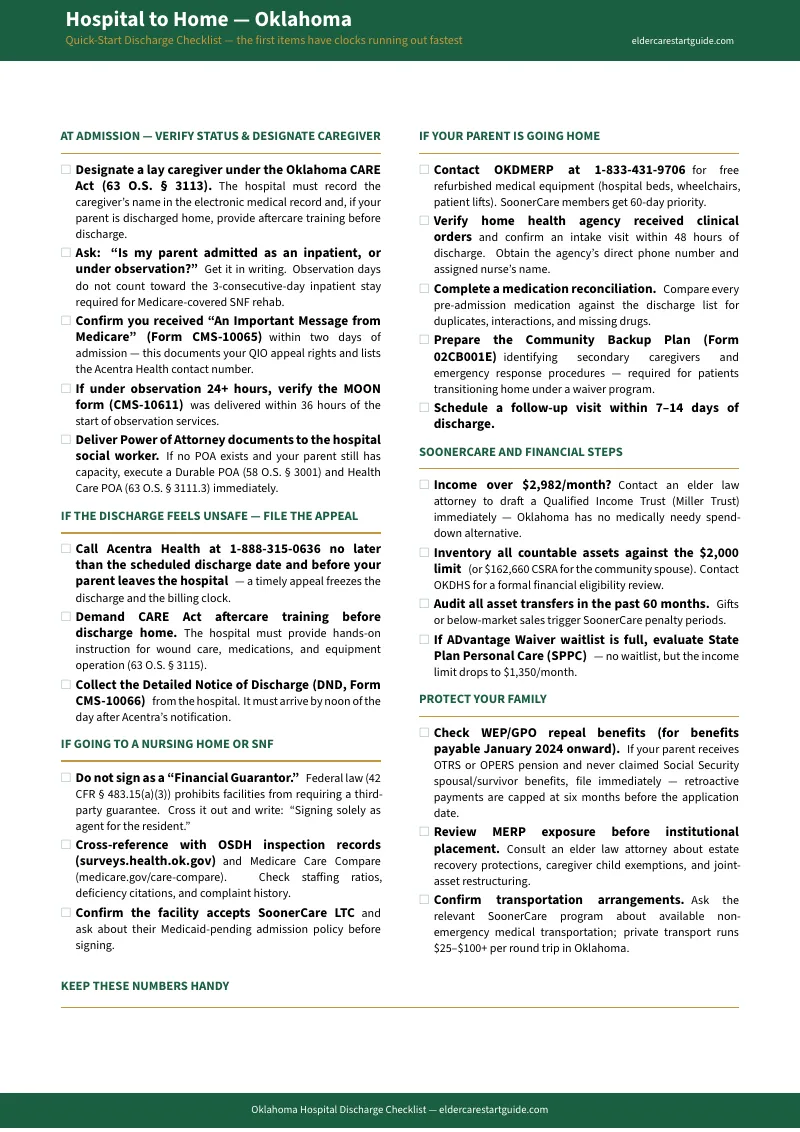
Not ready for the full guide? Download the Oklahoma Hospital Discharge Checklist — a printable, one-page action list covering the critical steps from admission through the first week at home. Use it at the hospital bedside to make sure nothing gets missed. If you need the deeper walkthroughs, worksheets, and Oklahoma-specific procedures, the full guide is waiting.