
Your parent fell again. The hospital says pick a facility by Monday.
The discharge planner just handed you a list of three assisted living communities. You have 72 hours to decide — and you don't know whether your parent needs home care, assisted living, or a nursing home. You don't know what SoonerCare covers, how the ADvantage Waiver works, or whether the family home is at risk from estate recovery. Your siblings are calling with opinions. You don't have power of attorney. And the one "free" referral service you called is already pushing a facility that charges $6,100 a month.
Meanwhile, an elder law attorney in Oklahoma charges $300 to $500 per hour. A private geriatric care manager bills $150 to $300 per hour. And the free placement services — A Place for Mom, Next Level Senior Advisors — are paid commissions by the facilities they recommend, sometimes 50% to 100% of the first month's rent. Their recommendations follow the commission, not your parent's clinical needs.
You don't need a referral service picking facilities for you. You need to know how to assess your parent's actual care level, compare every option available in Oklahoma, navigate the financial rules, and protect your family's assets — before you sign anything.
The Oklahoma Care Transition System
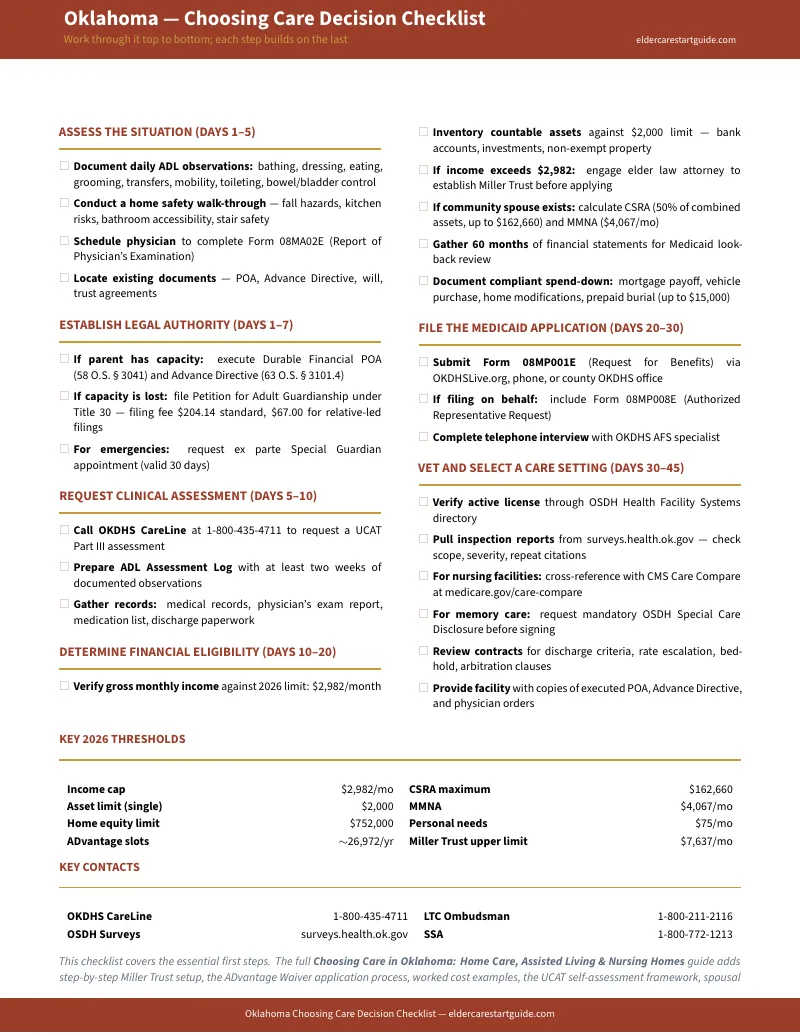
This is a 14-chapter guide built specifically for the Oklahoma elder care system — where the clinical gate, the financial gate, and the legal authority gate must all open in the right order or nothing moves. It does not place your parent in a facility or provide legal representation. It is the decision framework, financial analysis, and facility vetting system that the hospital discharge planner, the free referral service, and the state website all leave out.
At its core is the Oklahoma Care Transition System — a structured method that walks you from "I think my parent needs help but I don't know what kind" through to a fully vetted care arrangement with the legal authority, financial protections, and facility due diligence completed in the right order. It handles the part everyone gets wrong: understanding that Oklahoma is an income-cap state with no spend-down option, that the ADvantage Waiver has a statewide enrollment cap with a waitlist, that a Miller Trust is required if your parent earns even one dollar over the income limit, and that the state will pursue estate recovery against the family home after a Medicaid recipient dies.
What's inside — 14 chapters, 9 printable worksheets, and the complete Oklahoma care system
- UCAT III Self-Assessment Framework — the same clinical assessment tool that OKDHS nurses use to determine whether your parent qualifies for state-funded care, translated into a plain-language worksheet. Score your parent across the eight ADL domains before the state's formal home visit so you can document decline accurately and avoid the single most common reason for denial: an assessment that doesn't reflect the parent's worst days.
- Every Oklahoma Care Setting Compared Side by Side — nonmedical home care, State Plan personal care, the ADvantage Waiver package, CD-PASS self-directed care, adult day health, residential care homes, assisted living centers, memory care, skilled nursing, and PACE. Real 2026 costs: approximately $33/hour for home care, $6,150/month median for assisted living, $7,026/month for a semi-private nursing home room. What each setting can legally provide, what it costs, and where each one falls short.
- The SoonerCare and ADvantage Waiver Eligibility Roadmap — how the income cap works, the $2,982 monthly threshold, the $2,000 asset limit, spousal protections (CSRA up to $162,660, MMMNA up to $4,067), and the Miller Trust setup process. Plus the ADvantage Waiver's enrollment cap — approximately 26,972 slots statewide — so you know to file early rather than learning about the waitlist after a crisis.
- Facility Vetting Through OSDH — how to search the Protective Health Services inspection database at surveys.health.ok.gov, how to interpret scope-and-severity codes, the difference between licensing surveys and complaint investigations, and how to cross-reference state findings with the federal CMS Care Compare database. Because the facility brochure never mentions the corrective action plan from last quarter.
- CD-PASS Spousal Exception Toolkit — the step-by-step roadmap for Oklahoma's Consumer-Directed Personal Assistance Services and Supports program, including the spousal exception that allows a legally responsible spouse to be authorized as a paid caregiver. Covers the three eligibility conditions, the back-up care plan requirement, and the monthly case-manager monitoring visits.
- Legal Authority Checklist — Oklahoma Durable Financial Power of Attorney under Title 58, Oklahoma Advance Directive for Healthcare, Health Care Power of Attorney, and the guardianship threshold (filing fees of $204 for standard adult petitions, $67 for relative-only filings). Without these documents, you cannot sign an admission contract, access medical records, or manage a bank account — no matter how much caregiving work you're doing.
- 60-Month Look-Back and Estate Recovery Protection — how the look-back audit works, the penalty calculation, compliant spend-down strategies (prepaying irrevocable funeral trusts up to $15,000, vehicle purchases, home modifications), and Oklahoma's estate recovery rules. Organized as a preparation checklist for your attorney meeting so you walk in with the financial documentation ready.
- The Social Security Fairness Act — WEP and GPO are repealed as of January 2025. If your parent was previously offset by a government pension, the guide explains what they need to do now to verify SSA's retroactive adjustment — and how the income change affects Medicaid eligibility and Miller Trust calculations.
Who this is for
The adult child in Oklahoma who just realized their parent can't live alone safely anymore — and is drowning in conflicting information from hospital social workers, facility sales teams, free referral services, and siblings. The family comparing home care agencies against assisted living communities without any framework for deciding. The spouse trying to figure out whether SoonerCare will cover the monthly bill — and learning that Oklahoma has an income cap that blocks most applicants unless they establish a Miller Trust. And the caregiver doing all the coordination work without power of attorney, one medical emergency away from a guardianship court proceeding.
Why not use the free resources?
Because the free resources are designed for different purposes — and none of them does what this guide does.
The Oklahoma Department of Human Services website (oklahoma.gov/okdhs) has the ADvantage Waiver program pages and the SoonerCare application portal. They're written for regulators and case managers, not for a family member sitting in a hospital waiting room trying to make a decision before discharge. The UCAT Assessor Manual alone is 200-plus pages of clinical procedure.
The Oklahoma State Department of Health runs the Protective Health Services inspection database at surveys.health.ok.gov. The search interface is unintuitive, the violation codes are unexplained, and there is no guidance on how to interpret what you find. The database tells you a facility had a "scope and severity" rating of G — it doesn't tell you what that means for your parent's safety.
A Place for Mom and Next Level Senior Advisors provide free facility matching — funded by commissions from the facilities they recommend. Facilities that accept SoonerCare generally do not pay referral commissions, so the platform's recommendations systematically exclude the most affordable options. Their advisors are incentivized to steer families toward higher-cost network partners and away from home care, adult day programs, or the ADvantage Waiver.
This guide has no facility affiliations, no placement commissions, and no referral agreements. It helps you evaluate any facility in Oklahoma — including those that accept SoonerCare — using the state's own inspection data.
An honest guarantee
Work through the Oklahoma Care Transition System. If the guide does not make the Oklahoma elder care system clearer and more navigable than any combination of free websites, referral services, or initial professional consultations — email us within 30 days for a full refund. The risk of trying it is a fraction of one elder law attorney billable hour. The risk of choosing the wrong care level, missing the ADvantage Waiver filing window, or losing the family home to estate recovery is measured in tens of thousands of dollars and years of regret.
For — less than fifteen minutes of attorney time — you get the 14-chapter guide, the complete decision checklist, and the structured system that the free resources leave out.
Stop guessing which care option fits. Get the guide, follow the system, and make this decision with the full picture — not a hospital discharge printout.