Your Parent Has Dementia. North Dakota's Care System Has No Instruction Manual. This Guide Is the Next Best Thing.
Memory care in North Dakota runs between $4,500 and $7,000 a month. Skilled nursing can top $11,500. You just found out those numbers are real, and now you need to figure out how to pay for this without bankrupting your family.
Here is the part nobody tells you on the first phone call: North Dakota funds a program called Service Payments for the Elderly and Disabled — SPED — that lets your parent keep up to $50,000 in assets while receiving in-home care, including care from family members who get paid up to $48 a day. That is a completely different financial universe from Medicaid's $3,000 limit. But SPED does not appear in the national guides, the lead-gen directories, or most elder law firm websites. If you do not know it exists, you skip straight to the Medicaid spend-down and lose tens of thousands of dollars you did not need to spend.
The North Dakota Dementia Care Navigator maps every program, every legal document, and every facility rule into a single step-by-step system — organized in the order families actually encounter these decisions, not the order a government manual was written.
What the Guide Covers
- Legal protection before the window closes — North Dakota's General Durable Power of Attorney and Health Care Directive are two separate documents with different execution requirements. If your parent loses capacity before both are signed, the only path is a court guardianship under Administrative Rule 59 — background checks, mandatory online training, a Guardian ad Litem, and annual court reporting. The guide walks through both the voluntary and the court-ordered path.
- The SPED bridge that most families miss — SPED's $50,000 asset threshold, the sliding-fee client share, medical expense deductions that lower the copay, and Expanded SPED for families already on Medicaid. The guide includes a worked client-share calculation so you can estimate costs before the intake appointment.
- Medicaid qualification without a Miller Trust — North Dakota is one of eleven 209(b) states, which means it uses a medically needy spend-down instead of a Qualified Income Trust. The guide explains what this means in plain terms: your parent pays excess income directly to the facility, and Medicaid covers the rest. Families who follow advice written for Miller Trust states pursue unnecessary and expensive legal planning.
- Spousal protections that prevent financial ruin — the Community Spouse Resource Allowance (up to $162,660 in protected assets), the Minimum Monthly Maintenance Needs Allowance, and the rules for keeping the family home off the Medicaid countable-asset list.
- Memory care facility licensing — what the brochure does not say — North Dakota does not issue a separate "memory care" license. The guide explains how the basic care facility license works, the 24-hour awake-staff requirement, the dementia-specific training mandates (8 hours at hire, 4 hours annually), the self-preservation discharge rule, and what questions to ask on a tour to separate genuine clinical programs from a locked hallway with a marketing budget.
- Discharge protection and the BCAP safety net — the Basic Care Assistance Program supplements facility costs when private funds run out. The guide explains the eligibility pathway and the $153 monthly personal needs allowance, so you can plan the transition from private-pay to state assistance before the money runs out, not after.
- Wandering, Silver Alert, and winter-specific safety planning — how Silver Alert activation works through law enforcement (not 911), the 48-hour expiration, how to build an emergency profile for county sheriff dispatchers, and practical home-safety modifications for North Dakota's subzero conditions.
- Estate recovery — what happens after your parent passes — how North Dakota recovers Medicaid costs from a deceased recipient's estate, the exemptions that protect the family home while a surviving spouse or dependent child lives there, and the timelines for filing an undue hardship waiver.
Who This Guide Is For
This guide is for adult children in North Dakota — usually in Fargo, Bismarck, Grand Forks, Minot, or the rural and frontier counties between them — who are coordinating care for a parent with dementia. It is written for the person who is managing the logistics: the one making the phone calls, filling out the applications, and trying to keep the family on the same page while the system moves in every direction.
- You are comparing memory care facilities and cannot tell which ones are actually licensed for specialized dementia care versus which ones have a locked door and a marketing team
- You just learned that Medicaid's asset limit is $3,000 and you are wondering whether there is any alternative before your parent has to spend down everything
- Your parent can no longer sign a Power of Attorney and you are facing a guardianship petition with no idea what Rule 59 requires
- You are in a rural county, the nearest memory care facility is two hours away, and you need to understand what in-home care programs North Dakota actually funds
- You are trying to figure out whether a family member can legally be hired and paid to provide care at home
Why Free Resources Are Not Enough
North Dakota Health and Human Services publishes detailed program manuals — hundreds of pages of eligibility criteria, service definitions, and administrative procedures. The information is accurate. It is also scattered across multiple PDFs, written for caseworkers rather than families, and nearly impossible to navigate when you are in the middle of a crisis.
National directories like A Place for Mom and Caring.com aggregate cost data and facility listings, but their business model is lead generation — they sell your contact information to facility networks. Their content systematically steers families toward residential placement because that is where the referral fees come from. In-home care programs like SPED, which keep families out of facilities, do not generate referral revenue and receive minimal coverage.
Elder law attorneys in North Dakota charge $300 to $500 per hour. A guardianship petition alone can run $3,000 to $8,000 in legal fees. Many families use the guide to organize their financial records, understand the program structures, and prepare a focused list of questions — then spend one or two billable hours with an attorney instead of ten.
What You Receive
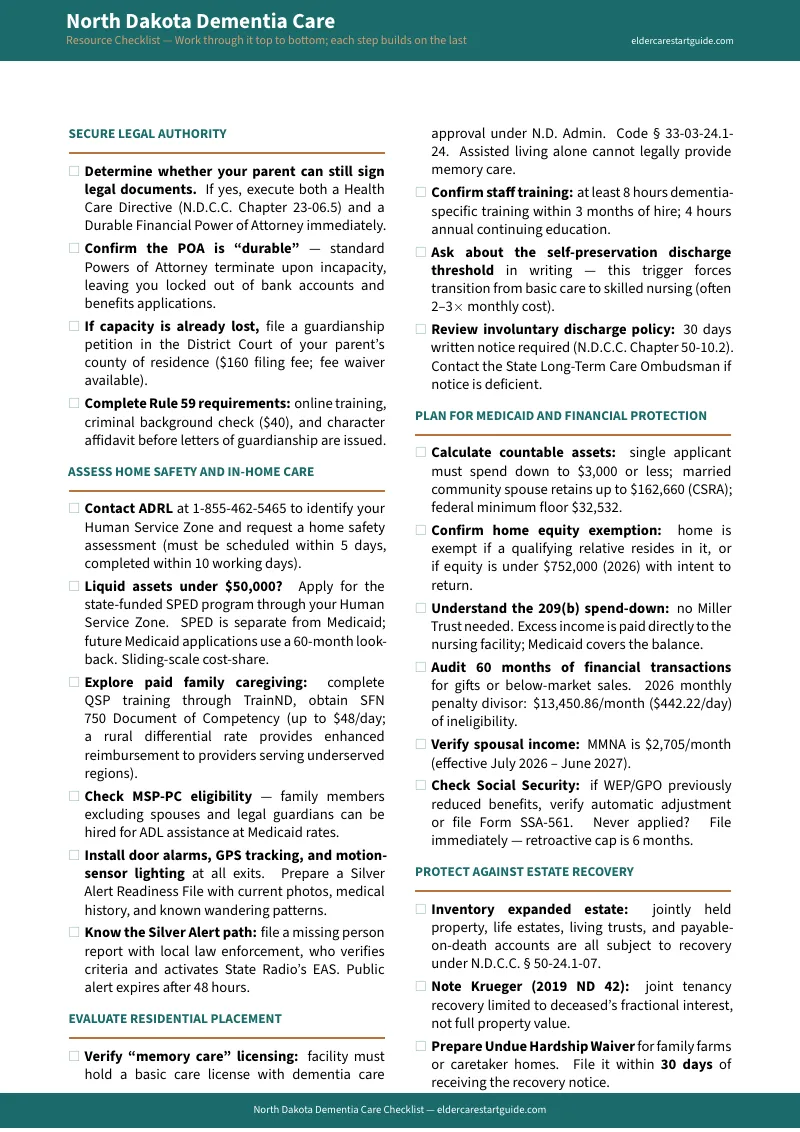
Your purchase includes 8 PDFs: a comprehensive 14-chapter guide (51 pages) covering every phase of North Dakota's dementia care system, a 23-item companion checklist, and 6 standalone planning tools — a Medicaid spend-down tracker, an agency communication log, a legal authority checklist, a Silver Alert readiness file, a facility evaluation scorecard, and a five-year look-back worksheet. The guide includes worked examples — a Medicaid spend-down calculation and a SPED client-share computation — along with callout boxes highlighting regulatory requirements and common mistakes.
Start with the checklist to see the full sequence of actions. Print the planning tools that match your current situation. Open the relevant chapter in the guide when you need to understand how a step works, what the eligibility rules are, and what can go wrong.
100% Satisfaction Guarantee
If the guide does not help you navigate your parent's care situation, email us and we will refund your purchase — no questions, no hoops.
Get Started
Download the free checklist to see the full action sequence, or get the complete North Dakota Dementia Care Navigator for the full 14-chapter guide with program details, financial calculations, and legal procedures. Your download is available immediately — start tonight.