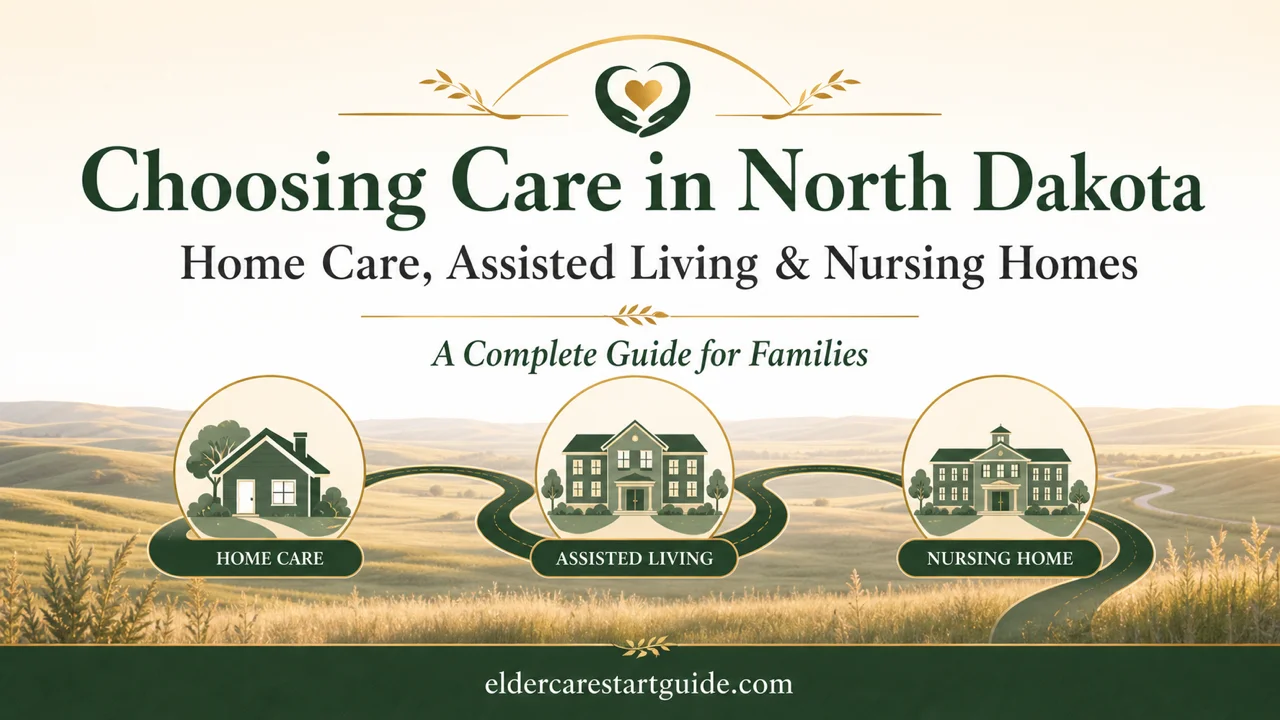
Your Parent Is Declining. The System Isn't Designed to Help You Figure Out What Comes Next.
Maybe it was a fall that landed your father in the hospital. Maybe it was the expired food in the fridge, the unpaid heating bills in January, or the moment you realized your mother can't manage her medications anymore. Whatever the trigger, you're now facing a series of decisions that will affect your parent's safety, your family's finances, and your own peace of mind for years.
So you start researching. And you immediately hit the wall: the state's policy manuals read like legal code, the "free" placement sites want your phone number before showing you anything, the elder law attorneys charge $280–$500 per hour just to tell you where to start, and none of them explain how North Dakota's programs actually fit together.
The North Dakota Care Decision System
This is a structured decision framework built specifically for North Dakota families choosing what level of care an aging parent needs. It doesn't hand you a list of facilities and wish you luck. It walks you through each decision in order — clinical assessment, care level comparison, facility vetting, financial qualification, legal documentation, and asset protection — using North Dakota's own regulatory framework, cost data, and program rules.
North Dakota's care infrastructure works differently from most states. The state runs its own SPED program with a $50,000 liquid asset limit and an explicit farmland exemption — a lifeline for agricultural families who would otherwise lose everything to Medicaid's standard $3,000 threshold. It uses a "Basic Care Facility" designation (Types I, II, and III) that doesn't exist in other states. And it operates as a Section 209(b) state, which means a medically needy spend-down path instead of a hard income cap. Following generic national advice in North Dakota doesn't just miss these programs — it can trigger penalties and denials that take months to undo.
What's Inside
- Clinical Assessment Framework — A self-scoring ADL and IADL worksheet modeled on the state's own functional assessment instrument. It breaks the case manager's evaluation criteria into clear questions so you can gauge whether your parent meets the threshold for SPED, the HCBS Waiver, or nursing facility placement before the official visit. Includes a two-week behavior log template designed to capture your parent's worst days in the clinical language state assessors use.
- Care Setting Comparison Engine — Side-by-side breakdowns of every care level available in North Dakota: in-home care through Qualified Service Providers, adult day care, Basic Care Facilities, assisted living, memory care, and skilled nursing. Each comparison uses current North Dakota cost data and maps exactly which state programs can pay for which settings — because SPED covers home care but not nursing homes, and BCAP covers Basic Care Facilities but requires full Medicaid eligibility.
- SPED and HCBS Eligibility Roadmap — The complete qualification path for North Dakota's two primary community care programs. SPED has a $50,000 liquid asset limit with primary residence and agricultural land exempt; the HCBS Waiver uses the standard Medicaid $3,000 threshold but covers a broader range of services including adult day care, memory care, and adult foster care. This section maps which program fits your parent's financial and functional profile, covers the transition rules when SPED costs exceed $241 per month and trigger a mandatory Medicaid application, and explains the paid family caregiver option under both programs.
- Facility Vetting Toolkit — Step-by-step instructions for searching inspection reports through both the ND HHS Food and Lodging Unit portal (for assisted living and Basic Care Facilities) and the Health Facilities Unit certification database (for skilled nursing homes). Includes a facility tour scorecard with 15 questions designed to expose hidden care-tier charges, Medicaid transition policies, and staffing ratios — the things the sales brochure never mentions.
- QSP Registration and Paid Family Caregiver Guide — North Dakota allows family members to register as Qualified Service Providers and receive payment for authorized care. This section covers the registration process, the five-year revalidation cycle, billing procedures using SFN 1730, and the critical rule that failing to revalidate by the exact expiration date permanently closes your billing account for retroactive claims.
- Legal Authority Audit — A checklist of the legal documents your family needs to execute while your parent still has cognitive capacity: financial power of attorney, healthcare power of attorney, and advance directives. Covers the emergency alternatives when capacity is already diminished, the guardianship process as a last resort, and the specific statutory requirements under North Dakota law.
- Medicaid Estate Recovery Protection — North Dakota's MERP program recovers Medicaid costs from a deceased recipient's estate. This section covers the spousal and child deferrals, the sibling and caregiver exemptions, and the 30-day hardship waiver application window that most families don't learn about until it's too late.
- Hospital Discharge Crisis Protocol — A step-by-step action plan for when your parent is in the hospital and the discharge planner says "we need the bed." Covers discharge coordination, the state assessment process while your parent is still hospitalized, your appeal rights, and how to use the ADRL intake line to accelerate community service enrollment.
- Essential Contacts Directory — Every phone number, mailing address, and portal URL you need: the ADRL toll-free line, the Long-Term Care Ombudsman program, the QSP Hub, the ND HHS inspection portals, the Medicaid Customer Support Center, and the estate recovery unit. Designed to print and keep on the fridge.
- Decision Worksheets — Nine standalone printable worksheets including a two-week behavior log, asset inventory with SPED and Medicaid thresholds, facility comparison scorecard, monthly cost calculator, care setting comparison reference card, legal authority checklist, facility tour scorecard, and estate recovery protection worksheet. Fill them in once and you have the organized intake file that every state case manager, attorney, and facility admissions coordinator will ask for.
Who This Is For
- Adult children in North Dakota who can see their parent declining but don't know whether home care, a Basic Care Facility, assisted living, or a nursing home is the right level
- Families facing a sudden care crisis — a fall, a stroke, a hospitalization — who need to make placement decisions under pressure
- Caregivers burning out from providing care alone and evaluating whether transitioning to professional help is the right call
- Anyone navigating SPED or Medicaid eligibility who wants to avoid the financial and documentation mistakes that cause denials
- Agricultural families working to protect farmland and property from Medicaid estate recovery while qualifying for state-funded care
Why Not Just Use Free Resources?
The ND HHS website has the policy manuals — scattered across the Food and Lodging Unit, the Health Facilities Unit, the Medical Services Division, and the Aging Services pages. The SPED eligibility rules are published in administrative code written for caseworkers, not families. Medicare.gov has nursing home ratings but doesn't cover Basic Care Facilities or assisted living. And none of these sources tell you what to do first, how the programs connect to each other, or which mistakes trigger a 60-month penalty period on your parent's Medicaid application.
The "free" placement services — A Place for Mom, Caring.com, and similar referral networks — earn $3,000–$8,000 in commission from every facility placement they recommend. They have zero financial incentive to tell you about SPED, the paid family caregiver option, or the state-funded home care programs that could keep your parent at home for a fraction of the cost. They're showing you the options that pay them, not the options that fit your family.
This guide consolidates North Dakota's fragmented regulatory landscape into a single decision sequence you can follow under pressure — from the first signs of decline through assessment, placement, financial qualification, and legal protection.
The Alternative Is Expensive
An elder law attorney in North Dakota charges $280–$500 per hour, with full Medicaid planning engagements running $3,000–$8,000. A private geriatric care manager charges $100–$250 for an initial assessment. This guide doesn't replace legal counsel for complex trust or estate planning — but it prevents the intake mistakes that make legal counsel necessary, and gives you the structure to handle the assessment, comparison, and application process yourself.
Satisfaction Guarantee
If the guide doesn't give you a clearer decision framework within 24 hours of downloading it, email us for a full refund. No forms, no hoops.
— Less Than One Hour With a Care Manager
For a fraction of what a single professional consultation costs, you get the complete decision system: clinical assessment framework, care level comparisons with North Dakota cost data, facility vetting tools, SPED and HCBS eligibility instructions, estate recovery protection strategies, legal document checklists, and every template and contact directory you need to navigate your parent's care transition safely.
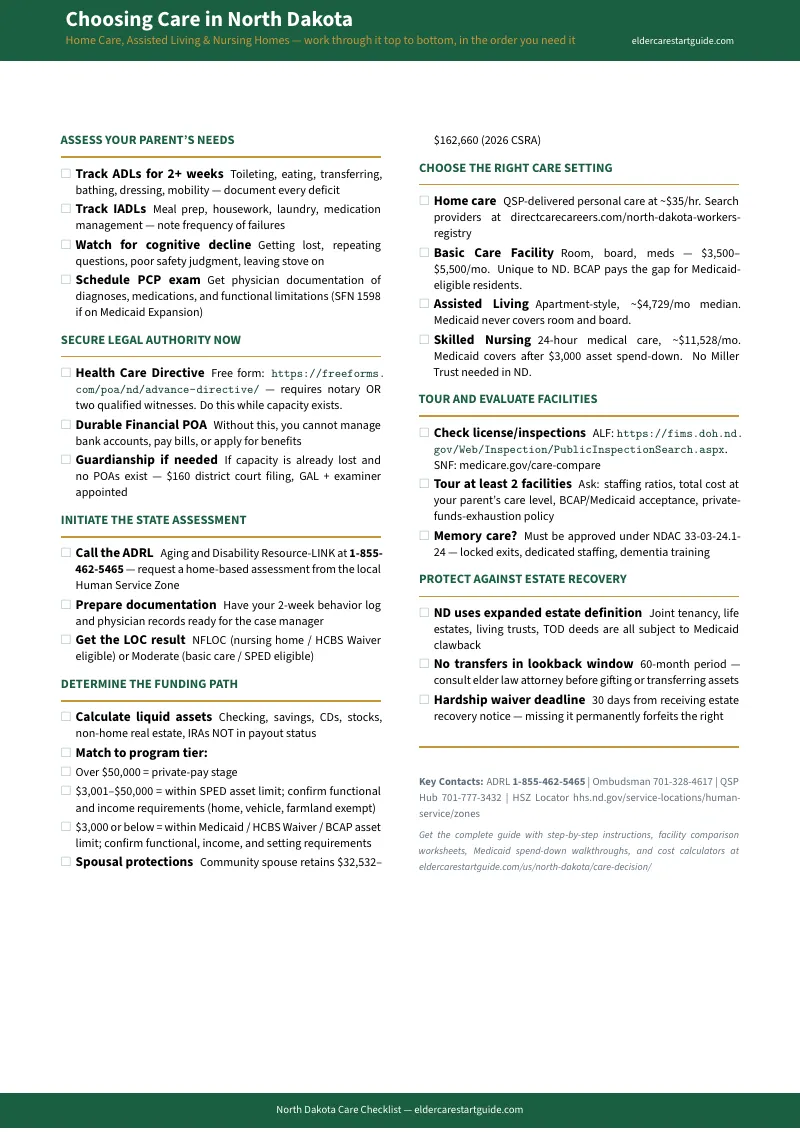
Download the free decision checklist to see the framework, or get the full guide with all 12 chapters, appendix worksheets, and the essential contacts directory.