
The Hospital Says Your Parent Is "Ready for Discharge." You're Not Ready.
Your mom or dad is in a North Carolina hospital — a fall, a stroke, a sudden decline. A discharge planner you met five minutes ago tells you they need the bed, hands you a list of facilities, and asks where your parent is going. You have days — sometimes hours — to make decisions that affect their safety and your family's finances for years.
The hospital's job is to move your parent out efficiently. Your job is to make sure they leave safely, into the right care, without you signing paperwork that makes you personally liable for a six-figure nursing home bill.
Those are not the same job. Nobody at the hospital works for you.
The Discharge Defense System
This is not a stack of government brochures. It's an independent, North Carolina-specific playbook that walks you through the discharge in the order it actually happens — from the first "Important Message from Medicare" notice to the day your parent is safely settled and the bills are correctly routed.
Every rule in it is the real one: the actual statutes, the actual phone numbers, the actual 2026 dollar figures — including the ones most families (and some discharge planners) get wrong.
What's Inside
The Unsafe-Discharge Appeal, Step by Step
You can legally halt a discharge you believe is unsafe — but only if you act before midnight on discharge day. The guide gives you the exact sequence: call Acentra Health, North Carolina's Medicare QIO, at 888-317-0751, what to say, and what happens next. Filing suspends the discharge and locks Medicare coverage in place while a physician reviews the records. (Kepro and Livanta merged and rebranded — searching for them wastes precious hours; the current contact is in the guide.)
Observation Status — the Trap That Cancels Rehab Coverage
A parent "under observation" is an outpatient — even in a hospital bed for three nights. That kills Medicare's coverage of skilled nursing rehab, because Part A requires a 3-day inpatient stay first. The guide shows you how to verify the true status with the billing office in the first 24 hours, when to push for a status change, and which waiver exceptions may apply.
Medicare SNF Math, in Plain Numbers
Days 1–20 covered at 100%. Day 21 onward, $217 per day coinsurance (2026 rate). Day 101, zero. Plus the 60-day benefit-period reset most families never hear about until it's too late. You'll know exactly what each week of rehab costs before your parent is admitted — not after the bill arrives.
Choosing a Facility Under Time Pressure
How to read NCDHHS DHSR star ratings and Form 2567 inspection reports in ten minutes, the difference between Type A and Type B violations, and the exact questions to ask an admissions coordinator — including the ones about weekend therapy staffing that facilities hope you won't ask.
Medicaid Pending and the Patient Monthly Liability
If your parent is heading to a nursing home with a Medicaid application in progress: what the facility can and cannot demand, why you should not pay the full private rate while the application is pending, and how the monthly liability is actually calculated (income minus the $70 personal needs allowance, minus premiums, minus the spousal allowance — the rest goes to the facility).
The CAP/DA Waiver — Bringing Your Parent Home Instead
North Carolina's Medicaid waiver can fund nursing-home-level care at home — but it's a three-headed system (county DSS, local Lead Agency, Acentra Health assessments) with a capped waitlist. The guide maps who does what, the exact application sequence, and how to plan around the waitlist during an acute discharge — including CAP/Choice, which lets family members be hired as paid caregivers.
Legal Authority — Before You Hit the Wall
Being "next of kin" gives you no automatic authority in North Carolina. A health care power of attorney usually only activates when a physician formally finds your parent lacks capacity — and with nothing in place, you're looking at a Chapter 35A guardianship petition that moves far slower than any discharge timeline. The guide shows you what to verify, what to sign now, and what to do if you're already stuck.
Protecting Your Own Money — the Responsible-Party Trap
Nursing home admission packets routinely include clauses that make the signing adult child a personal financial guarantor — a voluntary signature that waives protections you already have under North Carolina's Filial Debt Fairness Act. The guide shows you exactly which paragraphs to strike, what to write instead, and what NC's filial responsibility law actually does and doesn't require of you.
The Master Registry
Every form (FL-2, PASRR, HCPOA), every portal (ePASS, DHSR Star Ratings, Care Compare), and every phone number — organized so you can find the right one in seconds at 9pm on a Sunday, with a "verify before you rely" section for the figures that change every year.
The Printable Toolkit — 10 Fillable Worksheets
Beyond the 12-chapter guide, you get ten print-and-use tools built for the moments when you're standing at a nursing station or sitting across from an admissions coordinator:
- Unsafe-Discharge Appeal Call Card — the word-for-word Acentra Health script with your parent's details pre-filled, built for the midnight deadline
- Discharge-Day Checklist — everything that must be true before your parent leaves the hospital
- Medication Reconciliation Worksheet — pre-hospital vs. discharge prescriptions side by side, with a prior-authorization tracker
- Facility Comparison Worksheet — score three candidates side by side, with the tour questions admissions coordinators hope you won't ask
- Home Safety & DME Checklist — the equipment ordering rules plus a room-by-room safety walk, with a DME order tracker
- Patient Monthly Liability Worksheet — the Medicaid-pending math ($70 personal needs allowance, premiums, spousal allowance) worked line by line
- CAP/DA Waiver Application Tracker — the three-agency process with dates, deadlines, and your local contacts
- Admission Agreement Review Worksheet — the clauses to hunt and strike, plus the exact protective language to write next to your signature
- Hospital Paper Trail Log — every call and conversation dated and named, ready to become appeal evidence
- Key Contacts Fridge Sheet — every NC phone number, portal, and form on one page, with blanks for your local numbers
The Free Checklist
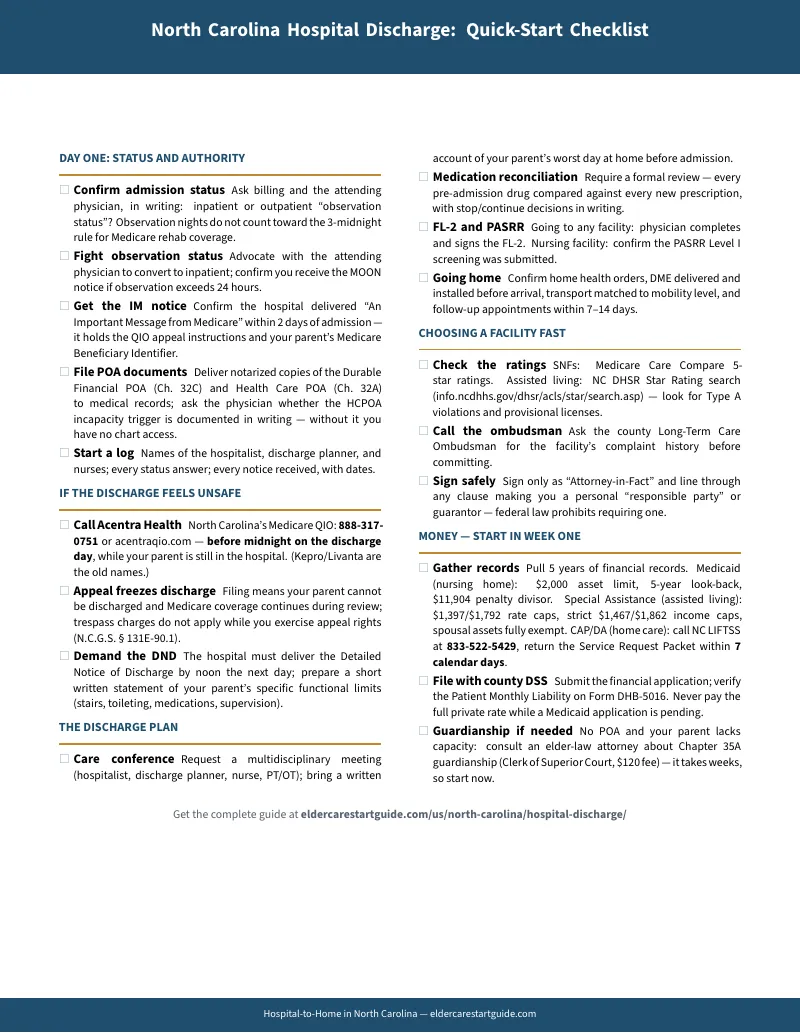
Not ready for the full guide? Download the free 18-item North Carolina quick-start checklist — the critical moves from day one in the hospital through the first week after discharge. Print it, bring it to the discharge meeting, and work through it in order.
Who This Is For
- Adult children whose parent is in a North Carolina hospital and discharge is days away
- Families told their parent is "medically stable" before safe care is arranged
- Anyone coordinating a parent's care from hours away — Raleigh to the coast, Charlotte to the mountains
- Siblings disagreeing about home vs. rehab vs. nursing home who need the actual rules, not opinions
- Families facing observation-status surprises, Medicaid applications, or pressure to sign admission paperwork fast
Why Not Just Use Free Resources?
County DSS offices, the Area Agency on Aging, and state websites each hold one piece of the puzzle — spread across dozens of pages, written for professionals, with nothing about what to do when the pieces collide with a 48-hour deadline.
Placement agencies that seem "free" — A Place for Mom and similar — earn commissions of 50–100% of the first month's rent from the facilities they recommend. Their business model only works if your parent ends up in a partner facility paying privately. They have no incentive to explain the CAP/DA waiver, the QIO appeal, or the clause you shouldn't sign.
Elder law attorneys are excellent — at $300–$450 for a consultation and $2,000–$10,000 for Medicaid planning, they should be. This guide is independent, earns no commissions, and costs less than a single attorney consultation — so you arrive at professional help with the rules already understood and the right questions ready.
100% Satisfaction Guarantee
If the guide doesn't help you navigate your parent's discharge with more confidence, email us and we'll refund you — no questions, no time limit.
Get Started Now
Download the free checklist and take it to your next discharge meeting — or get the complete Discharge Defense System for and stop guessing your way through the highest-stakes week your family has faced.