Your Parent's Dementia Diagnosis Came With Questions — Not a Roadmap
You left the doctor's office with a diagnosis and a handful of brochures. Since then, you've spent evenings Googling acronyms — CAP/DA, SCU, HCPOA, FL-2 — and getting bounced between state websites that explain rules but never tell you what to do first. The county DSS office says they handle finances. Acentra says they handle clinical eligibility. The Area Agency on Aging gives you a phone number that rings to voicemail. And meanwhile, your parent is losing capacity a little more each week.
Nobody is coordinating this for you. That is the problem this guide solves.
The Split-Navigation System — Why North Carolina Is Harder Than Most States
Most states run long-term care through a single agency. North Carolina splits it into two parallel tracks — clinical eligibility through NCLIFTSS and Acentra Health, and financial eligibility through your county DSS — and the two sides do not automatically communicate. A delay on one track stalls the entire process without anyone notifying you. Families who don't understand this split lose weeks waiting for answers that were never coming.
This guide maps both tracks on one timeline so you can push both sides forward simultaneously. We call it the Dual-Track Navigation System — the step-by-step sequence for coordinating clinical assessments, county financial applications, and facility placements without letting any of the three fall through the cracks.
What's Inside the Guide
- The FL-2 Gateway Form walkthrough — the single medical document that controls which facilities will accept your parent and which programs they qualify for. The guide covers who can sign it, the 90-day validity window for planned admissions, and the 72-hour emergency deadline
- CAP/DA waiver dual-track blueprint — the Service Request Form (SRF) through e-CAP, the physician's worksheet, the Case Management Entity assessment, and the separate county DSS financial application, all sequenced so neither track stalls the other. Includes how to check your waitlist position and authorize Medicaid Personal Care Services as an immediate bridge while you wait
- Special Assistance eligibility for memory care — the income and asset thresholds for locked Special Care Units, the spousal exemption that lets you transfer 100% of joint assets to the well spouse, and the 36-month look-back rules that are shorter than standard Medicaid's 60-month window
- Medicaid spend-down strategies — legally permissible ways to convert countable resources into exempt ones: prepaid burial contracts, home safety modifications, vehicle purchases, and Medically Needy deductible calculations with a worked example
- Estate recovery protection — how Enhanced Life Estate Deeds (Lady Bird Deeds) transfer real property outside the probate process, shielding the family home from Medicaid estate recovery liens
- Legal authority documents — the Durable Power of Attorney under G.S. Chapter 32C, the Health Care Power of Attorney, and what happens when the capacity window closes: guardianship under Chapter 35A, court costs, GAL appointments, and Session Law 2023-124's Less Restrictive Alternatives requirement
- Safety enrollment — Silver Alert registration (updated for the July 2025 age-65 rule), Project Lifesaver RF wristband enrollment through your county Sheriff, and Project C.A.R.E. for family consultant access and respite vouchers
- Facility comparison framework — Family Care Homes, Adult Care Homes, Special Care Units, Skilled Nursing Facilities, and PACE, with licensing requirements, cost ranges, and which public programs pay for each
Who This Guide Is For
You are an adult child in North Carolina — or your parent lives in North Carolina — and you are dealing with one of these situations:
- Your parent was recently diagnosed with dementia or Alzheimer's and you need to secure legal documents before capacity is lost
- Your parent's in-home care costs are unsustainable and you need to understand the CAP/DA waiver, PCS, and Special Assistance options
- A safety crisis happened — wandering, a fall, a medication error — and you need to evaluate memory care placement quickly without relying on referral agencies that steer you toward their paying partners
- You're preparing for a Medicaid application and need to understand North Carolina's asset limits, spend-down rules, and transfer penalties before making expensive mistakes
Why Free Resources Won't Get You There
The information exists across state websites, county offices, and legal handbooks. The problem is not availability — it's coordination. State government sites explain the rules for one program at a time without showing you how programs interact or what order to pursue them. The NCDHHS portal describes CAP/DA eligibility. Your county DSS site explains Special Assistance. Neither tells you that applying for both simultaneously requires coordinating separate paperwork on separate timelines through separate caseworkers — or that a mistake on one track triggers a denial that delays the other.
Free senior placement services like A Place for Mom operate on a commission model, collecting one month's rent from participating facilities when you move in. Because they're paid by facilities, they don't mention public programs — CAP/DA, Special Assistance, PCS, or Project C.A.R.E. — that could save your family thousands of dollars per month.
Elder law attorneys charge $320–$500 per hour. A geriatric care manager costs $100–$250 per hour. This guide does not replace either professional for complex estate planning — but it gives you the foundational knowledge to walk into a professional consultation already understanding the asset limits, the spend-down rules, and the program options. That turns a three-hour education session into a one-hour strategy session.
What You Get
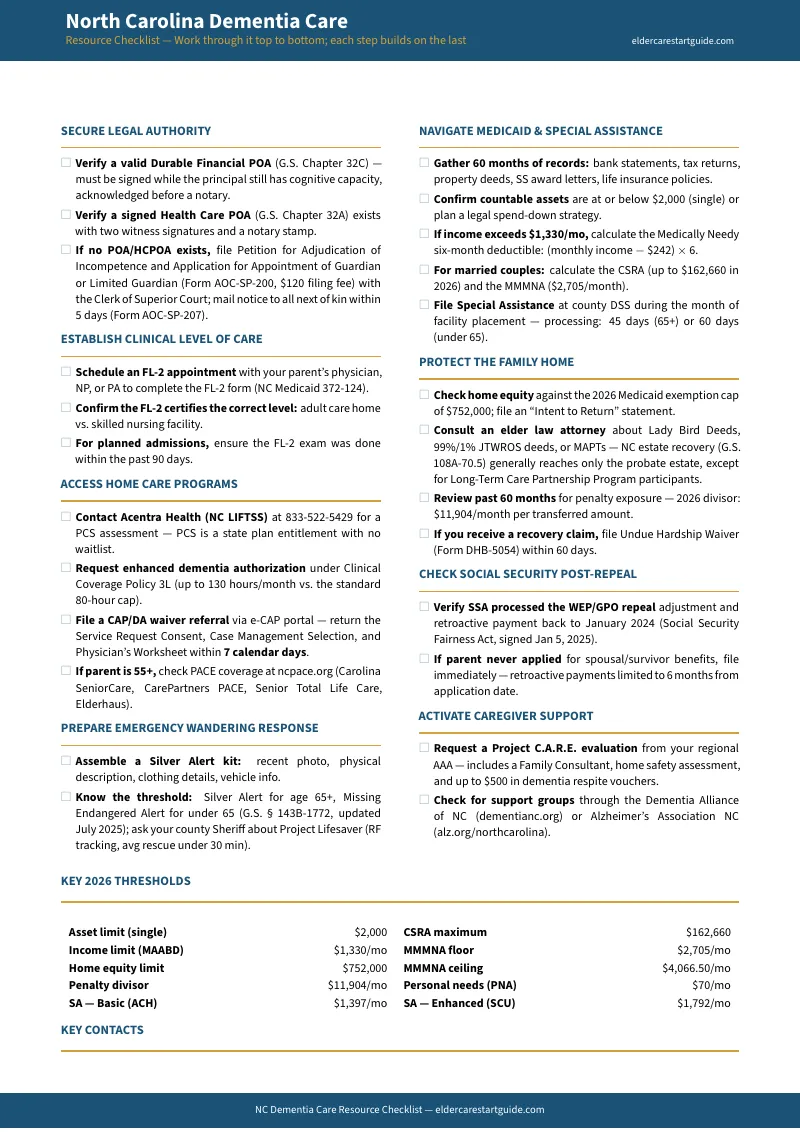
The full toolkit includes the main guide, a quick-reference checklist covering every program and deadline, and seven standalone worksheets — a Medicaid financial calculator, CAP/DA dual-track application tracker, facility comparison sheet, legal authority audit, estate protection planner, agency communication log, and an emergency wandering response card. The checklist alone — the free version — gives you the essential contacts and program names. The full guide and worksheets show you how to use them in sequence.
Download the free checklist to see if the guide covers what you need. If it does, the full toolkit gives you the step-by-step playbook — for less than the cost of thirty minutes with any professional in this space.