Your Parent's Care Just Changed. North Carolina's System Won't Walk You Through What Comes Next.
The hospital says your parent can't go back home. Or maybe the falls are piling up, the stove keeps getting left on, and you found three months of unopened mail behind the couch. Either way, something has shifted — and North Carolina's care system is not going to hand you a roadmap.
Medicaid eligibility runs through your county DSS. The clinical level-of-care assessment is handled by Acentra Health, a separate state contractor. The CAP/DA waiver that could keep your parent at home goes through a different Local Lead Agency. Facility licensing, star ratings, and inspection reports are spread across two divisions of DHSR. If you want to know whether your parent qualifies for Special Assistance to help pay for an adult care home, that's a third county-level application with its own rules.
You could spend dozens of hours on state websites trying to piece the process together. Or you could pay an elder law attorney $346 an hour to explain it. Neither option works when the discharge planner wants a decision by Thursday.
— The NC Care Navigation System
This is the NC Care Navigation System — a step-by-step guide that maps North Carolina's fragmented care bureaucracy into a single, sequential process you can follow from "something is wrong" to "my parent is in the right place, and we know how to pay for it."
It's not a directory of facilities with a referral hotline at the bottom. It's not a generic "how to choose care" article. It's the specific regulatory, financial, and clinical process for North Carolina — the FL-2 forms, the Acentra assessments, the Medicaid spend-down math, the CAP/DA waiver workflow — organized in the order you'll actually encounter them.
What's Inside
- Warning Sign Assessment Framework — a structured ADL/IADL evaluation tool to objectively measure whether your parent's needs have moved beyond what safe home care can handle, using the same clinical scales North Carolina's system uses to determine level of care.
- FL-2 Physician Coordination Guide — step-by-step instructions for getting the state-mandated FL-2 form (DMA-372-124) completed correctly by your parent's physician. This form determines whether your parent is classified as "Domiciliary" or "Nursing" level — the designation that controls which facilities, programs, and funding sources are available.
- CAP/DA Waiver Application Workbook — the complete workflow for applying to the Community Alternatives Program for Disabled Adults through your Local Lead Agency or the NC LIFTSS portal, including clinical screening by Acentra Health, financial eligibility through county DSS, and waiver slot allocation. Covers the Choice Option for legally hiring and paying family members as caregivers.
- Medicaid Spend-Down Worksheet — because North Carolina is a "medically needy" state, your parent may qualify for Medicaid even if their income exceeds the limit. This worksheet walks you through the six-month deductible calculation so you can estimate eligibility before your DSS appointment. Includes the $2,000 asset cap, the $752,000 home equity exemption, and Community Spouse Resource Allowance protections up to $162,660.
- State/County Special Assistance Checklist — a step-by-step application guide for the monthly cash supplement that helps low-income seniors pay room and board in licensed adult care homes. Shows how to verify a facility's participation status and check financial limits.
- Care Setting Cost Comparison Worksheet — side-by-side comparison of home care ($5,720/month at 44 hours/week), adult day health care ($1,830/month), assisted living ($6,200/month statewide median), memory care ($7,150/month), and skilled nursing ($9,733/month semi-private) — with space to fill in quotes from local providers and identify your financial break-even point.
- DHSR Facility Investigation Checklist — how to check star ratings through the Adult Care Licensure database, read nursing home inspection reports (Form 2567 and F-tags), and contact your county DSS adult home specialist for quarterly monitoring records. Includes questions for facility tours on staffing ratios, retention policies, and discharge rules.
- Legal Authority Flowchart — explains the operational differences between Health Care Power of Attorney, General Durable Power of Attorney, and court-supervised guardianship under North Carolina law, so you can secure the authority to sign agreements and manage finances on your parent's behalf.
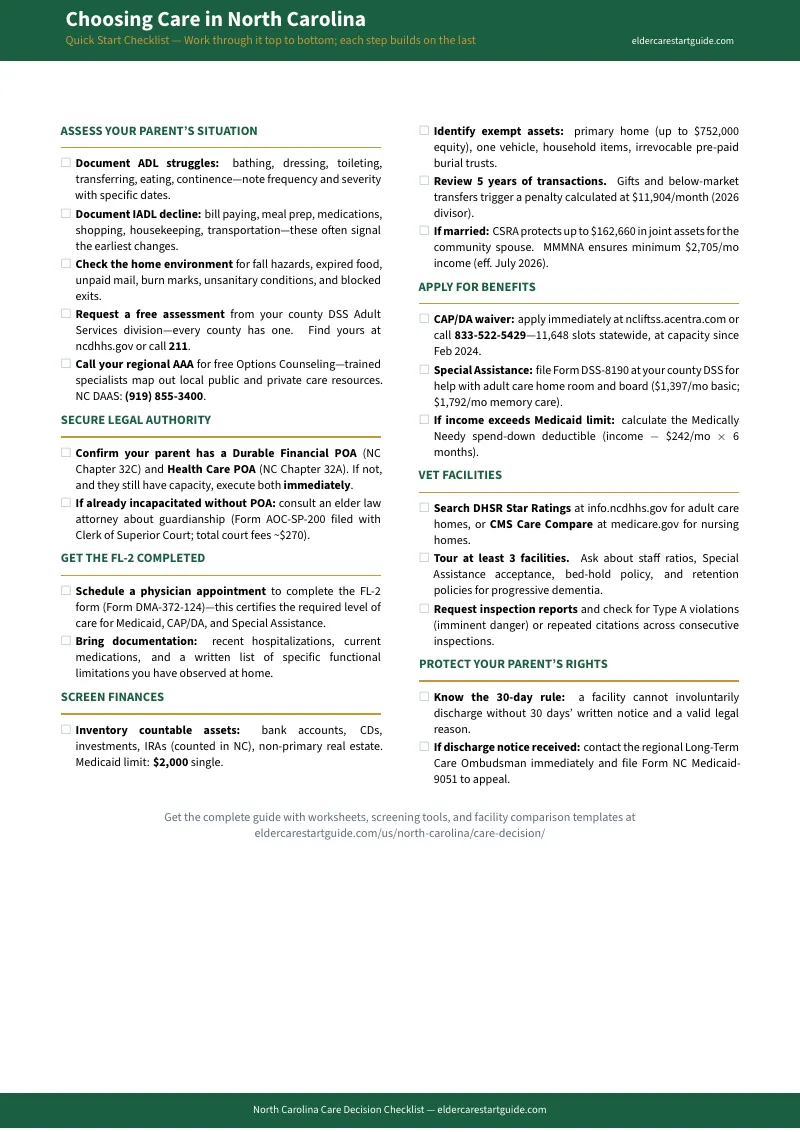
- Decision Checklist (Free Download) — a one-page, 20-item action checklist covering the critical steps from recognizing decline through facility placement and payment setup.
Who This Is For
- Adult children managing an aging parent's care transition in North Carolina — whether it's a sudden hospital discharge or gradual decline that's become unsustainable
- Families deciding between home care, assisted living, memory care, and nursing home placement
- Caregivers navigating North Carolina Medicaid eligibility, the CAP/DA waiver, or Special Assistance for the first time
- Siblings trying to agree on a care plan with objective criteria instead of arguments and guilt
Why Not Just Use Free Resources?
The information exists — scattered across NCDHHS, DHSR, Acentra Health, county DSS websites, and the NC LIFTSS portal. The problem isn't availability. It's that each agency publishes its own piece of the process in regulatory language, organized by bureaucratic function instead of by what you need to do next.
When your parent is being discharged and you need to figure out the CAP/DA waiver, the FL-2 form, and the Medicaid spend-down simultaneously — and they're managed by three different entities with three different timelines — reassembling that puzzle from scratch costs you days you may not have.
National referral services like A Place for Mom will find you a facility for free. But they earn commissions of 50% to 100% of the first month's rent from the facilities they recommend. They don't cover home-based care, Medicaid waivers, or Special Assistance because those options don't generate referral fees. This guide covers every option — including the ones nobody gets paid to tell you about.
Satisfaction Guarantee
If the guide doesn't help you navigate your parent's care decision with more clarity and confidence, email us within 30 days for a full refund. No forms, no questions.
Get Started Now
Download the free Decision Checklist to see the 20 critical steps at a glance. When you're ready for the full process — the FL-2 coordination, the CAP/DA application walkthrough, the Medicaid worksheets, and the facility investigation toolkit — get the complete NC Care Navigation System.