Your Parent Needs Care. The Nursing Home Costs $15,000 a Month. New York's Rules Have a Way Through — If You Know the Steps.
Your parent had a fall, a stroke, or a decline that happened faster than anyone expected. The rehabilitation facility says Medicare coverage is ending. The private-pay rate is $500 a day — $15,000 a month — and climbing. You need Medicaid, but their income is $2,200 a month, which is $364 over New York's limit. In most states, that means a Miller Trust. In New York, Miller Trusts don't exist.
You searched online and found ten different answers. The elder law firm wants $5,000 just to start. The government website links to a 47-page policy directive last updated before the CDPAP transition. The out-of-state article says to set up a Qualified Income Trust — which New York explicitly does not recognize. And nobody mentioned that the community Medicaid lookback period authorized in 2020 still hasn't been implemented, meaning there's a window right now that most families don't know about.
The New York Medicaid Asset Protection Playbook
This is not a summary of eligibility limits you can find on the Department of Health website. It is the process around the limits — the part that $350-to-$650/hour elder law attorneys explain in billable consultations and that free government portals never cover.
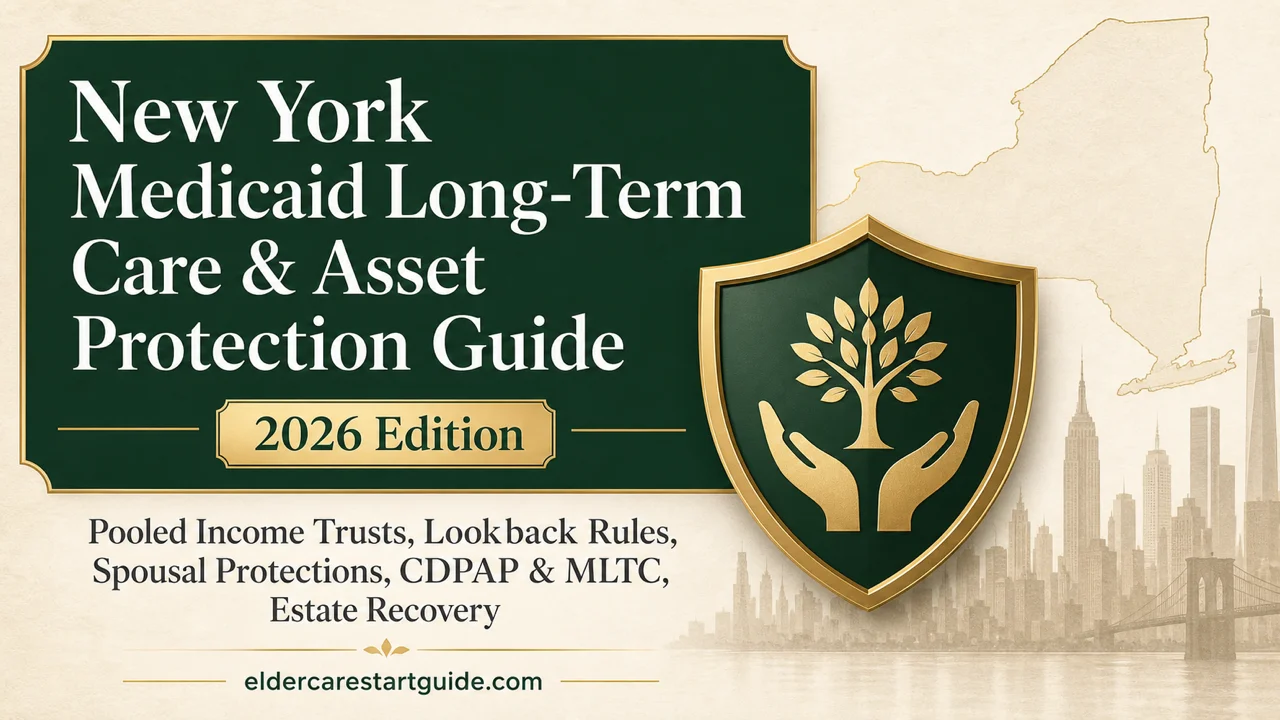
The guide covers every financial threshold, every legal instrument, every care program, and every asset protection strategy available under New York law — organized in the order you actually need them, from the first hospital discharge notice through Medicaid approval to estate recovery after your parent passes.
What's Inside
- Pooled Income Trust Setup — Step by Step — New York does not use Qualified Income Trusts or Miller Trusts. If your parent's income exceeds $1,836/month, the only option is a nonprofit-administered Pooled Income Trust. The guide walks through the major trust administrators (NYSARC, Life's WORC, Center for Disability Rights, KTS), their setup fees and monthly costs, the monthly deposit-and-bill-pay cycle, and the critical rule that any balance left at death stays with the nonprofit — so you spend it down to zero every month.
- The Lookback Period — What's Enforced and What's Not — The nursing home lookback is 60 months with penalties calculated using regional rates ($15,282/month in NYC, $15,193 on Long Island, $15,024 in Westchester). But the 30-month community Medicaid lookback authorized in 2020 remains unimplemented. The guide explains exactly what this means for home care eligibility, how families can use this window to transfer assets and qualify for MLTC or CDPAP without penalty, and what changes when the lookback finally takes effect.
- Protecting the Family Home — The primary residence is exempt up to $1,130,000 in equity during your parent's lifetime, dropping to a flat $1,000,000 on January 1, 2028. After death, New York enforces probate-only estate recovery — assets that bypass probate are completely shielded. The guide covers life estates, living trusts, TOD designations, Medicaid Asset Protection Trusts, and exactly how to title property so the family home stays in the family.
- Spousal Refusal — New York's Strongest Protection — Under Social Services Law § 366, the community spouse can formally refuse to make their assets available. Once the refusal letter is filed, Medicaid must evaluate the applicant based only on their individual resources. The guide includes the letter requirements, the Community Spouse Resource Allowance calculation ($74,820 to $162,660), and the income maintenance allowance ($4,066.50/month).
- The CDPAP Transition and Minimum Needs — The Consumer Directed Personal Assistance Program lets eligible seniors hire family members as paid caregivers through Medicaid. Since September 2025, new applicants face stricter ADL requirements. The guide covers the assessment criteria, the legacy grandfathering rules, and navigating the single Fiscal Intermediary (PPL) — including what to do when timekeeping and payment issues arise.
- Immediate Need Fast-Track — When a parent faces unsafe discharge, the 12-day expedited pathway can start Medicaid services within two weeks. The guide provides the exact forms (DOH-5779, DOH-5786), the day-by-day timeline, and the documentation package needed to trigger the fast-track clock.
- The Full Application Walkthrough — From gathering 60 months of bank statements through the DOH-4220 and Supplement A submission, filing through ACCESS HRA in NYC or county LDSS offices upstate, responding to documentation requests without triggering administrative denial, and the 45-to-90-day processing timeline.
- Legal Authority Chapter — The New York Statutory Short-Form POA with the specific Modifications clause granting gifting authority for Medicaid planning. The Health Care Proxy. The critical difference between the two. And the full Article 81 guardianship process when capacity is already gone — emergency temporary guardianship, bond requirements, and annual reporting.
Plus: Printable Worksheets and Checklists
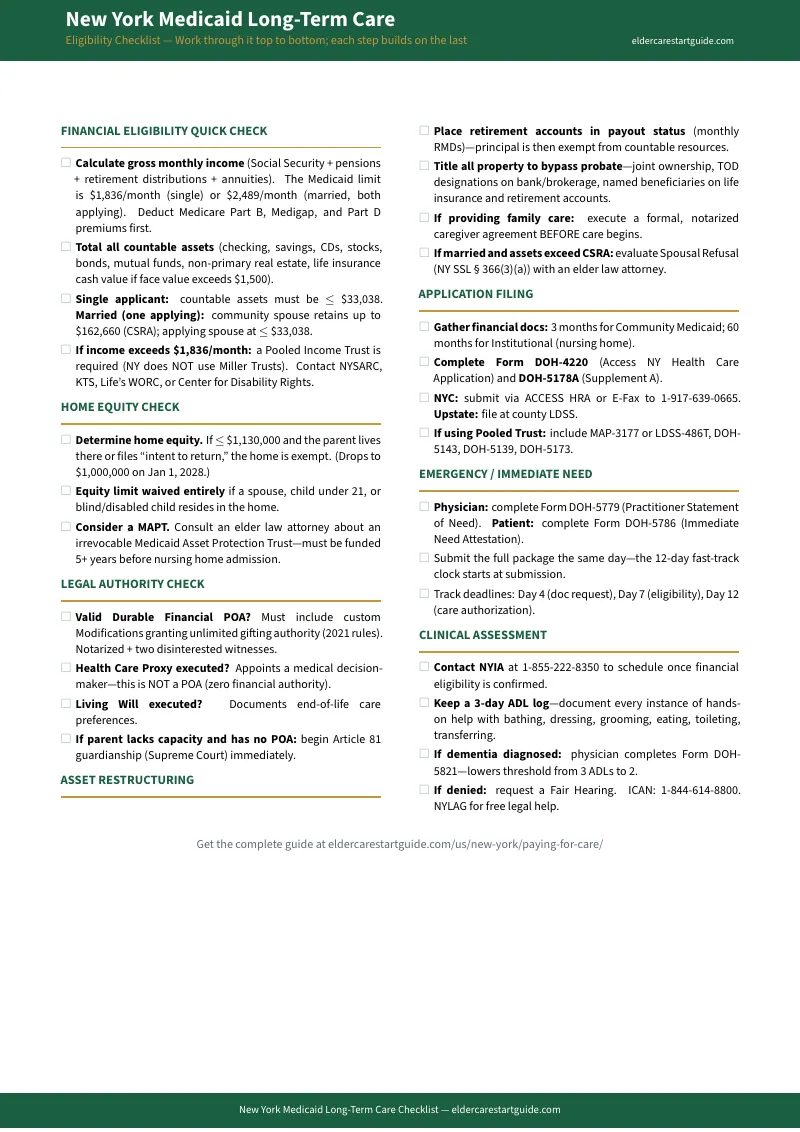
- Medicaid Eligibility Checklist — 20-item action list: income calculation, asset inventory, Pooled Trust selection, ADL documentation, application filing. Every threshold, phone number, and deadline at a glance.
- Asset Inventory Worksheet — Map every account, property, vehicle, and insurance policy with countable-vs-exempt status against New York's $33,038 threshold
- Pooled Income Trust Comparison Matrix — Side-by-side comparison of the major nonprofit trust administrators with fees, bill-pay turnaround, and enrollment steps
- Spousal Protection Calculator — CSRA and MMMNA calculation worksheet for married couples
- Five-Year Lookback Audit — 60-month transfer log with regional penalty rate calculations
- 3-Day ADL Log — Daily diary template documenting bathing, dressing, grooming, eating, toileting, and transfer assistance for the clinical assessment
- Application Document Checklist — Every document needed before filing, organized by category
- Fair Hearing Request Guide — Steps to contest a denial or reduction in hours, including Aid Continuing procedures
Who This Is For
- Adult children whose parent is being discharged from the hospital and someone needs to figure out who is paying $15,000 a month
- Families whose parent's income exceeds $1,836/month and they need a Pooled Income Trust — not a Miller Trust template from an out-of-state website
- Spouses trying to protect their home and savings when one partner enters a nursing home
- Families who made gifts or transfers in the past five years and need to understand the lookback penalty before it is calculated for them
- Caregivers trying to get a parent onto MLTC or CDPAP while navigating the PPL transition and the new Minimum Needs requirements
- Out-of-state siblings coordinating a New York Medicaid application remotely
- Anyone planning ahead — a parent just turned 65, or received an early dementia diagnosis — and needs to start the asset protection clock
Why Not Free Government Resources?
The Department of Health publishes eligibility limits. NY Health Access tracks policy changes. Your local Area Agency on Aging offers options counseling. Brevy and Medicaid Planning Assistance list state-specific thresholds.
Here is what none of them provide:
- A step-by-step Pooled Income Trust comparison and setup process — not a generic "contact a nonprofit" note
- The specific asset protection strategies that work under New York's probate-only estate recovery, with the titling structures that shield the family home
- A clear explanation of what's enforced and what's not in the lookback period — community vs. institutional — with the transfer strategies families can actually use right now
- The full spousal refusal process with the letter requirements, CSRA calculation, and the practical reality of state reimbursement claims
- The immediate need fast-track pathway with exact forms, day-by-day deadlines, and the documentation package
Government sites administer rules. Elder law firms explain them for $350 to $650 per hour. This guide bridges the gap — translating hundreds of pages of state policy, GIS directives, and administrative procedures into a sequence you can execute in an evening.
Satisfaction Guarantee
If the guide doesn't give you a clearer path forward, email [email protected] and we'll make it right.
— Less Than One Hour of a New York Elder Law Attorney's Time
An initial consultation with a New York elder law attorney runs $350 to $650. A full Medicaid planning engagement costs $5,000 to $15,000. A guardianship proceeding adds $5,000 or more in court costs and legal representation.
This guide won't replace an attorney for complex trust litigation or multi-million-dollar estate disputes. But for the Pooled Income Trust setup, asset mapping, spousal protection calculations, and Medicaid application process that most New York families need, it covers 90% of the work at a fraction of the cost — and if you do need an attorney, you'll walk in with a fully organized file instead of a box of unsorted bank statements.
Start with the free checklist to see if the approach fits your situation. The full guide goes deeper — every threshold, every strategy, every form, every phone number.