
Your Parent Is Being Discharged Tomorrow. The Plan Feels Wrong.
The discharge planner says your parent is "medically stable." But you can see they're not ready — they can't stand without help, the medication list has changed twice this week, and nobody has explained who's going to manage wound care or medication schedules at home. You're in a hallway at Mount Sinai or Northwell or a regional hospital upstate, and someone is asking you to sign paperwork you've never seen before.
You have less than 24 hours. The hospital wants the bed. And everything you find online is either a 200-page DOH policy manual, a lead-gen site trying to sell you a nursing home placement, or an elder-law firm's blog post designed to funnel you into a $5,000 retainer.
The New York Discharge Navigator
This isn't a generic pamphlet about "planning ahead." It's a structured system for the 48-to-72-hour window when you're in the middle of a discharge crisis — built specifically for New York law, the Department of Health regulations, MLTC plan enrollment, the CDPAP fiscal intermediary transition, and the New York agencies you'll actually be calling.
The guide gives you the legal framework, decision sequences, and exact scripts to advocate for your parent's safety during every transition: hospital to home, hospital to rehab, rehab to skilled nursing, and the MLTC/CDPAP pathway that lets your parent receive long-term care at home — or lets you get paid as their caregiver through Medicaid.
What's Inside
- The 48-Hour Discharge Protocol — A step-by-step sequence for the first two days after you hear "we're discharging your parent." Covers who to call, what to document, and which forms to request before you leave the hospital — including your rights under federal discharge planning regulations (42 CFR § 482.43) and New York's own mandate (10 NYCRR § 405.9) requiring a written discharge plan before any patient leaves.
- Discharge Appeal Scripts — Pre-written language for filing a fast-track appeal with Commence Health (New York's BFCC-QIO) at 1-866-815-5440. Medicaid patients appeal through IPRO at 1-800-648-4776. Hospitals cannot charge your parent extra or force them out while the appeal is active — but most families don't know this right exists.
- Observation Status Decision Tree — If your parent was classified "outpatient under observation," Medicare won't cover SNF rehab. This section explains New York's stricter 24-hour observation notice requirement (Public Health Law § 2805-w), how to advocate for an inpatient reclassification, and how to file a prospective appeal under the Alexander v. Azar class action ruling — while your parent is still in the hospital.
- New York's Dual Home Care System — Short-term Medicare-funded care through Certified Home Health Agencies (CHHAs) vs. long-term Medicaid-funded personal care through Licensed Home Care Services Agencies (LHCSAs) contracted with Managed Long Term Care (MLTC) plans. The guide maps both pathways, explains the NYIAP clinical assessment using the UAS-NY tool, and shows how to prepare for the evaluation that determines your parent's authorized service hours.
- CDPAP Enrollment Roadmap — New York's Consumer Directed Personal Assistance Program lets family members (excluding spouses) serve as paid caregivers who can perform skilled nursing tasks like medication administration. The guide covers the complete enrollment pathway through Public Partnerships LLC (PPL), health clearance requirements, training, and how CDPAP interacts with MLTC plan enrollment.
- SNF Vetting Scorecard — A structured comparison framework with the specific questions to ask New York facilities about staffing ratios, therapy schedules, discharge timelines, and Medicare coverage policies. Explains how to use the NYS Nursing Home Profile tool and CMS Care Compare, and includes red flags that signal a facility will rush your parent out at day 20.
- Medicaid Financial Planning — Spousal Refusal, Look-Back, and Pooled Trusts — Private-pay nursing home care in New York runs $12,000–$18,000 per month. This section covers the 2026 Medicaid asset limit ($33,038), the income cap ($1,836), the Community Spouse Resource Allowance, and New York's unique spousal refusal strategy under Social Services Law § 366(3)(a) — a legal mechanism that can protect hundreds of thousands in family assets without requiring a divorce. Includes the five-year look-back, penalty divisor calculations, and pooled income trust options for excess income.
- The "Responsible Party" Contract Reviewer — The nursing home admissions coordinator will ask you to sign as "Responsible Party." Federal law prohibits requiring a personal financial guarantee — but the contract language is designed to create one. The guide shows you which clauses to strike, how to sign safely as a representative, and which New York-specific contract terms create hidden personal liability.
- Legal Authority Gap Closer — Many New York families arrive at the hospital without a Health Care Proxy or durable Power of Attorney in place. The guide explains the Family Health Care Decisions Act (FHCDA) priority list for medical consent, the strict execution requirements for a New York POA, and when Article 81 guardianship through Supreme Court becomes the only option.
- Medicaid Pending and Retroactive Coverage — When a parent needs an immediate nursing home bed but Medicaid isn't approved yet, this section covers "Medicaid Pending" admission, New York's 90-day retroactive coverage window, and the critical danger of signing guarantor clauses.
- Assisted Living in New York — The ALP Pathway — New York's Assisted Living Program (ALP) is a Medicaid-funded service overlay on licensed Adult Homes or Enriched Housing Programs. The guide explains eligibility, what the resident pays vs. what Medicaid covers, and how ALP differs from standard adult care facilities.
- Medication Reconciliation Worksheet — A structured form for tracking every medication change during hospitalization, ensuring nothing is missed or duplicated at discharge.
- Call Scripts and Letter Templates — Pre-written language for conversations with discharge planners, attending physicians, MLTC plan coordinators, NYIAP assessors, SNF admissions staff, and the Long-Term Care Ombudsman (1-855-582-6769).
- Home Safety Setup Guide — Room-by-room preparation covering hospital bed placement, bathroom modifications, medication management stations, and fall-prevention priorities — with DME coordination and Medicare Part B coverage details.
Who This Is For
- Adult children in New York managing a parent's hospital discharge — especially if the timeline feels rushed or the plan feels incomplete
- Families who need to halt an unsafe discharge and don't know they have the right to appeal through Commence Health or IPRO
- Caregivers comparing rehab, skilled nursing, and home care — and unsure which Medicare or Medicaid programs apply in New York
- Anyone who wants to be paid as a family caregiver through CDPAP and needs to navigate PPL enrollment
- Families coordinating care from out of state who need New York-specific phone numbers, agencies, and deadlines
- Families trying to protect assets using spousal refusal or pooled trusts without a $5,000 attorney retainer
Why Not Just Use Free Resources?
The DOH website has the policy manuals. Medicare.gov has the forms. NY Health Access has the legal analysis. But during a medical crisis, you don't need raw policy — you need a decision framework that tells you what to do first, what to say when you call, and which mistakes will cost your family thousands.
Free resources don't tell you that hospitals are incentivized to discharge quickly, that observation status quietly eliminates your rehab coverage, or that a missing line on the UAS-NY assessment can delay home care by 90 days. They don't explain that the CDPAP fiscal intermediary transition to PPL has shifted enrollment timelines, or that one improper asset transfer during the five-year look-back can trigger months of Medicaid ineligibility — calculated at New York's nursing home penalty divisor — while your parent has already spent down to almost nothing.
This guide organizes New York-specific rules into actionable steps you can follow under pressure — from the first notification of discharge through MLTC enrollment, CDPAP activation, and beyond.
The Alternative Is Expensive
An elder-law attorney in New York charges $350–$650 per hour, with flat-fee Medicaid planning running $3,000–$15,000. A certified Medicaid planner charges $5,000–$10,000. A geriatric care manager charges $150–$300 per hour for initial assessment. This guide doesn't replace legal counsel for complex irrevocable trust work or a contested guardianship — but it prevents the common mistakes that make legal counsel necessary, and gives you the structure to handle the first 72 hours yourself.
Satisfaction Guarantee
If the guide doesn't give you a clearer path forward within the first 24 hours of your parent's discharge, email us for a full refund. No hoops, no forms.
— Less Than One Hour of Professional Advocacy
For a fraction of what a single consultation costs, you get the complete system: legal rights, appeal scripts, CDPAP enrollment roadmap, spousal refusal template, facility comparison tools, and every template you need to navigate your parent's transition safely.
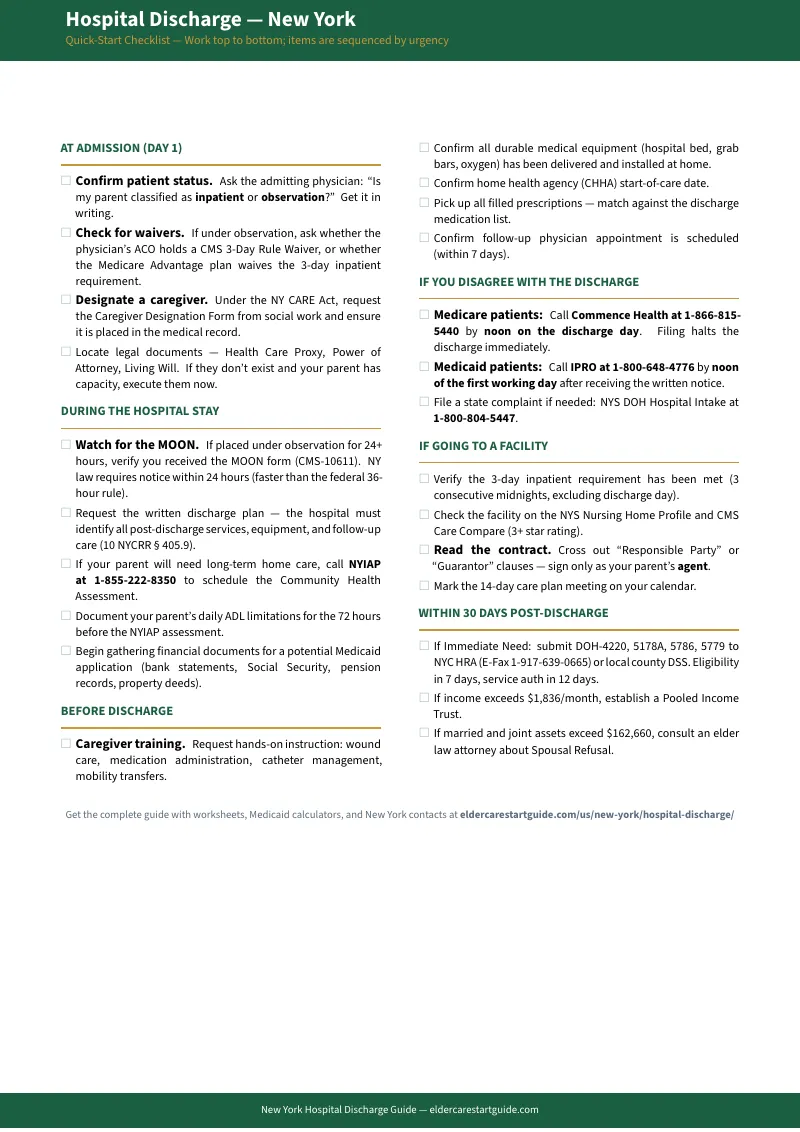
Download the free one-page checklist to see the framework, or get the full guide with all 15 chapters plus 10 standalone printable tools — the 48-hour discharge protocol, discharge appeal scripts, observation status decision tree, SNF vetting scorecard, CDPAP enrollment roadmap, spousal refusal worksheet, Medicaid eligibility worksheet, medication reconciliation worksheet, home safety setup guide, and emergency contacts fridge sheet.