Your parent needs care — and New York's system is designed for professionals, not families.
Private nursing home care in New York runs $165,000 to $188,000 per year depending on the region. Home health aides cost $25 to $50 an hour. Assisted living — if you can figure out which of the four different licensing tiers your parent actually qualifies for — averages $6,300 to $7,300 a month. An elder-law attorney bills $350 to $650 per hour to explain the Medicaid rules you've been trying to decode from government websites for a week.
Meanwhile, the free referral services that show up first on Google are paid commissions by the facilities they recommend. They'll never mention the Medicaid Assisted Living Program. They'll never explain CDPAP. They'll never tell you that the 30-month Community Medicaid lookback is still unenforced in 2026 — because knowing that could save your family tens of thousands of dollars that would otherwise go to the facilities paying their fees.
You need a system that works for your parent's situation. Not a directory. Not a sales pitch disguised as advice. A step-by-step plan that accounts for how New York actually works.
The New York Care Navigation System
The Choosing Care in New York Guide is a complete decision framework built specifically for New York's regulatory landscape. It maps every care setting, every funding pathway, every licensing distinction, and every financial threshold into a sequential plan — so you can evaluate your options clearly before a discharge deadline or a family crisis forces a decision you haven't researched.
This is not a generic overview repackaged with a New York label. It covers the specific programs, agencies, and eligibility rules that apply in this state — including the ones that national websites consistently get wrong.
What you get
The full care-setting comparison with New York costs and licensing — because "assisted living" in New York means four different things (ACF, ALR, EALR, SNALR), and placing your parent in the wrong tier means an involuntary discharge when their needs increase. The guide explains what each license authorizes, what it costs, and which ones accept Medicaid through the Assisted Living Program.
The MLTC enrollment walkthrough — because most Medicaid-funded home care in New York runs through a Managed Long-Term Care plan, not the state directly. The guide covers how to enroll, how the NYIA clinical assessment determines your parent's authorized hours, and how to appeal if the initial authorization doesn't match their actual needs.
The CDPAP eligibility and PPL transition guide — because the Consumer Directed Personal Assistance Program lets eligible families hire relatives as paid caregivers, but the 2025–2026 transition to Public Partnerships LLC has disrupted payroll and changed the eligibility criteria. The guide covers the current ADL thresholds, the EVV timekeeping system, and what to do if payments are interrupted.
The 2026 Medicaid financial roadmap — because New York's eligibility rules are built on specific numbers ($1,836 monthly income limit for Community Medicaid, $33,038 resource limit for institutional Medicaid) and specific mechanisms (income spend-down, Pooled Income Trusts, spousal impoverishment protections) that differ from every other state. The guide walks through both the Community and Institutional Medicaid pathways with current thresholds.
The lookback calculator with regional penalty divisors — because the 60-month institutional lookback uses seven different regional divisors across the state. A $150,000 transfer creates a very different penalty period in New York City than it does in Western New York. The guide shows each region's divisor, explains the calculation, and covers the exemptions that may apply.
The Pooled Income Trust setup guide — because if your parent's income exceeds the Medicaid limit, a Pooled Income Trust is how middle-class New Yorkers qualify for home care without losing their surplus income. The guide compares statewide administrators, explains the enrollment steps, and covers the ongoing fees.
The facility inspection vetting protocol — because the NYSDOH publishes detailed inspection histories for every licensed facility, and knowing how to read them means you tour facilities armed with data instead of marketing brochures. The guide shows you how to access Health Profiles, what the deficiency categories mean, and which patterns signal systemic problems.
The emergency pathways chapter — because if your parent is in the hospital right now and the discharge planner is pushing a placement, you need to know about Presumptive Eligibility, the Immediate Need Fast Track application, and your parent's discharge appeal rights — today, not after a week of research.
Plus: 9 standalone printable tools — a Care Cost Comparison Worksheet, Facility Evaluation Scorecard, Medicaid Eligibility Worksheet, Lookback Penalty Calculator with all seven regional divisors, Emergency Pathways Fridge Sheet, Official Forms Directory, Key Contacts Card, Legal Authority Checklist, and MLTC Enrollment Tracker. Print them, fill them in, and bring them to facility tours, attorney meetings, and Medicaid appointments.
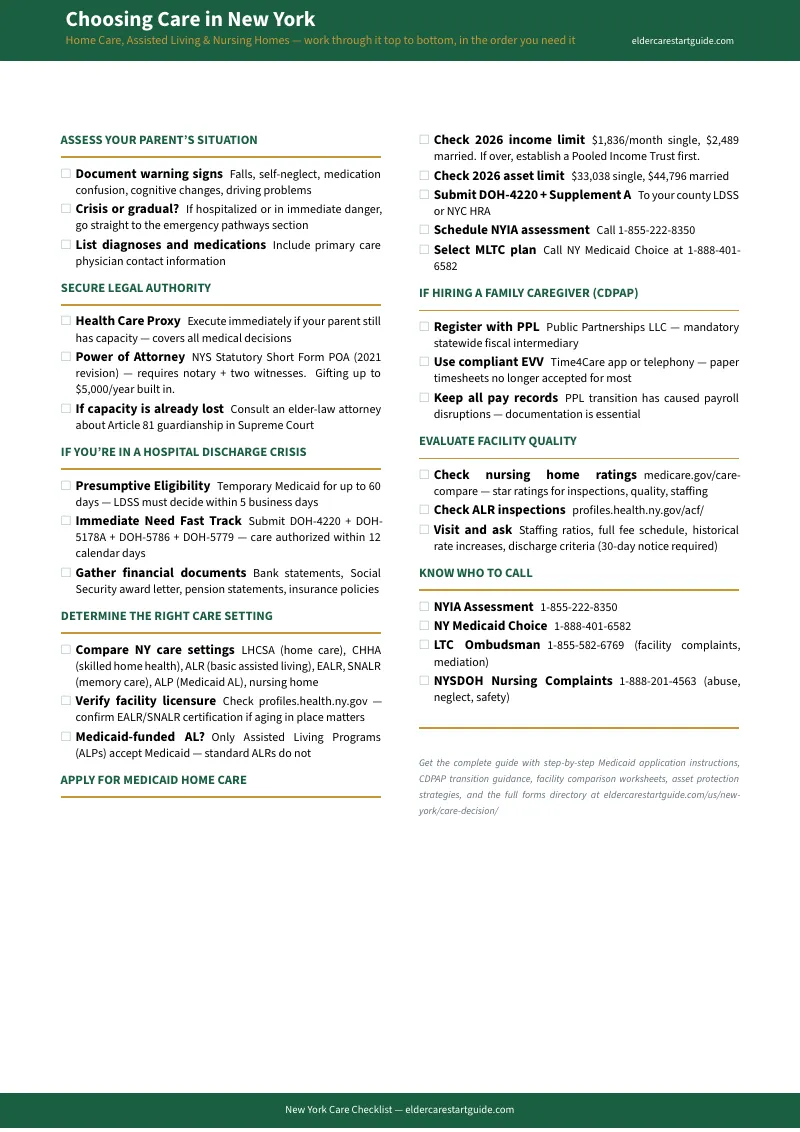
Plus: the one-page Decision Checklist — every critical action item, contact number, and deadline on a single printable sheet. This is also available as the free download.
Who this is for
- Adult children facing a hospital discharge deadline — your parent cannot go home and you need a care plan before the weekend
- Family caregivers approaching burnout — the home care arrangement is failing and you need to understand your transition options
- Families navigating Medicaid for the first time — your parent's private-pay savings are running low and you need the 2026 eligibility rules explained in plain language
- Sibling groups that cannot agree — you need an objective cost comparison and decision framework, not more opinions
- Long-distance adult children — your parent lives in New York and you're coordinating from another state
Why not the free tools?
NY Connects is a valuable state resource — and the guide explains how to use it effectively. But NY Connects is a directory, not a roadmap. It connects you with programs and agencies. It doesn't walk you through the MLTC enrollment sequence, explain how to calculate a lookback penalty, or tell you which facility inspection findings should disqualify a placement.
A Place for Mom and similar services are free because the facilities pay them. They have no financial incentive to mention CDPAP, the Medicaid ALP, or any option that doesn't generate a placement commission. This guide is 100% consumer-funded. No referral fees. No partner network. Every licensed care option covered.
Government websites have authoritative information scattered across dozens of pages — health.ny.gov, aging.ny.gov, nyconnects.ny.gov, medicaid.ny.gov — with no clear sequence for what to do first. This guide consolidates those sources into a single action plan organized in the order you actually need it.
Satisfaction guarantee
If the guide doesn't help you understand your parent's care options more clearly, email [email protected] for a full refund. No time limit, no questions.
Start with the free checklist — or get the full guide
The free Decision Checklist gives you the critical action items in priority order. If your parent is in a hospital right now, start there — it covers the discharge timeline and emergency Medicaid steps on a single printable page.
The full Choosing Care in New York Guide goes deeper: detailed cost comparisons, the complete Medicaid application walkthrough, the CDPAP enrollment process, the facility vetting protocol, and the financial planning strategies that the checklist can only summarize. Get the toolkit and have a clear plan before the next family conversation.