
Your Parent Needs Help at Home. New Mexico Has the Programs — If You Can Get Through the System.
Your parent left the stove on again. Or maybe they fell in the bathroom last Tuesday and didn't tell anyone until you noticed the bruise. Either way, you're the one Googling "home care New Mexico" at midnight, trying to figure out whether the state will help pay for a caregiver or whether you'll be draining your parent's savings at $30 an hour until there's nothing left.
You found something called Turquoise Care and a waitlist called the Central Registry. You called the ADRC and got transferred twice. You read about the Self-Directed Community Benefit and the New MexiCare program — but nobody explained which one your parent actually qualifies for, how to apply without triggering a 60-month penalty, or what happens to the family home after your parent passes.
Meanwhile, you priced out private home care. $5,720 per month for 44 hours a week. Nursing home care: $9,125 to $10,633 per month. Your parent's retirement savings won't survive 18 months at those rates.
The New Mexico Home Care Navigation System
This is not a summary of eligibility rules you can find scattered across aging.nm.gov and hca.nm.gov. It is the process around the rules — the part that $400/hour elder law attorneys explain in billable consultations and that the four Turquoise Care MCOs never have time to walk you through.
The guide covers every step from the first safety concern through securing state-funded home care: how the 2024 HCA reorganization changed who controls what, which of the four programs fits your parent's income and clinical profile, how to navigate the Central Registry waitlist (and how to get expedited allocation), how to prepare for the 200-question Comprehensive Needs Assessment so your parent is approved for the care hours they actually need, how to set up self-directed care through Palco payroll, and how to protect the family home from Medicaid Estate Recovery — organized in the order you will actually need them.
New Mexico has a structural advantage most families never discover: the New MexiCare program accepts incomes up to $3,387/month with no asset spend-down, no look-back period, and no waitlist — covering all 33 counties since September 2025. For families who exceed Medicaid's strict $2,982/month income cap, this program can fund paid family caregiving without the financial exposure of a Medicaid application. But most families don't learn about it until after they've already been denied by Medicaid.
What's Inside
- The 2024 Agency Map — New Mexico restructured its entire healthcare bureaucracy in July 2024, moving Medicaid under the new Health Care Authority while keeping the ALTSD in charge of senior advocacy and the ADRC. The guide explains who runs what now, which phone number actually reaches a person who can help, and how to avoid the three most common routing mistakes that cost families weeks of delay.
- Five-Program Eligibility Comparison — Turquoise Care ABCB, Turquoise Care SDCB, New MexiCare, InnovAge PACE, and Medicare Home Health compared side by side: income limits, asset tests, clinical criteria, paid family caregiver rules, waitlist status, and geographic restrictions. One table, five minutes, and you know exactly where to apply.
- The Income Cliff Strategy — New Mexico is an income cap state with no medically needy spend-down. Exceed $2,982/month by one dollar and you're denied outright. The guide walks through the Qualified Income Trust (QIT) — how to draft it, fund it, and structure the monthly distributions so the trustee avoids the compliance traps that trigger disqualification.
- Central Registry Waitlist Navigation — How to register through the ADRC, what the four allocation categories mean (Regular, Expedited, Community Reintegration, Exception), and exactly what documentation earns an expedited placement — including the vulnerability score threshold and ADL deficit count the screening requires.
- CNA Interview Preparation Script — The Comprehensive Needs Assessment is approximately 200 questions evaluating your parent's ADL capacity and cognitive function. The score directly determines how many weekly care hours the MCO authorizes. The guide includes a preparation framework showing how to document your parent's worst-day limitations rather than their best-day performance — because the assessment captures a snapshot, and the snapshot dictates the budget.
- Self-Directed Care Setup with Palco — The complete SDCB onboarding sequence: the mandatory 120-day ABCB enrollment period, MCO transfer request, Employer of Record designation, Support Broker selection, Service and Support Plan (SSP) drafting, Palco payroll enrollment, Electronic Visit Verification (EVV) compliance, and timesheet submission. One process, end to end.
- Spousal Impoverishment Protections — When one spouse needs long-term Medicaid care, the Community Spouse Resource Allowance preserves up to $162,660 in 2026. The guide walks through the CSRA calculation, the Minimum Monthly Maintenance Needs Allowance (MMMNA), the shelter standard excess, and the 90-day post-eligibility asset transfer window — so the healthy spouse keeps their financial independence.
- Estate Recovery Shield — New Mexico's Medicaid Estate Recovery Program targets only probate assets. The guide details which ownership structures pass outside probate and are protected, the spousal and caregiver-child exemptions, the undue hardship waiver process under 8.200.430.20 NMAC, and the specific protections for Native American tribal trust lands and reservation-adjacent properties.
- Paid Family Caregiver Pathways — Two routes to compensation: SDCB (Medicaid, family as Employer of Record through Palco) and New MexiCare (state-funded, no Medicaid required, incomes up to $3,387/month, all 33 counties, no waitlist). The guide covers each program's enrollment process, pay structure, and compliance requirements so you can choose the one that fits your parent's situation.
- When Things Go Wrong — Medicaid Fair Hearing appeal procedures, MCO grievance and complaint filing, care hour reduction challenges, Adult Protective Services reporting (self-neglect accounts for 61% of substantiated cases in New Mexico), Long-Term Care Ombudsman contact protocols, and the state's legal aid resources: the Senior Citizens Law Office, the Legal Resources for the Elderly Program, and New Mexico Legal Aid.
- Home Safety and Modifications — Room-by-room safety assessment checklist, plus every funding source: the SDCB environmental modifications benefit (up to $6,000 over five years under the 2024–2029 Section 1115 approval), Area Agency on Aging programs, Independent Living Center resources, and USDA Rural Housing Repair grants for families in New Mexico's rural counties.
- Community Resources Chapter — How to connect with your local Area Agency on Aging (including the Non-Metro AAA, the Indian Area Agency on Aging, and the Navajo Aging Services Department), the statewide network of 250 senior centers, home-delivered meals programs, non-emergency medical transportation booking through Turquoise Care MCOs, and the National Family Caregiver Support Program respite grants.
Plus: Printable Worksheets and Reference Sheets
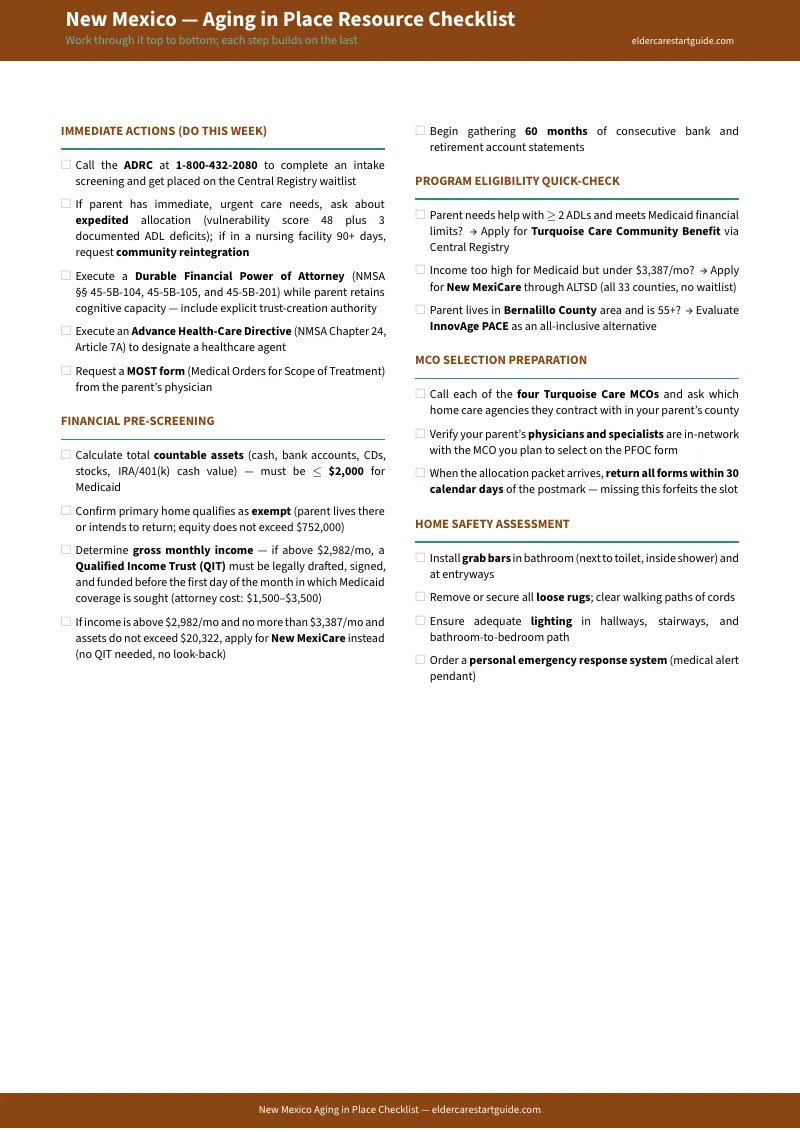
- New Mexico Aging in Place Resource Checklist — A prioritized action list organized by timeline: immediate legal authority steps, ADRC intake preparation, financial eligibility review, program applications, home safety assessment, and care binder assembly.
- Program Eligibility Comparison Worksheet — Fill in your parent's income, assets, and ADL needs to identify which programs they qualify for across all five pathways.
- Medicaid Asset and Spend-Down Tracker — Log every countable and exempt asset against the 2026 limits, with a QIT funding calculator and a look-back transfer audit.
- Spousal Protections Worksheet — CSRA and MMMNA calculations, shelter standard excess, and the 90-day post-eligibility transfer window tracker.
- CNA Preparation Guide — ADL-by-ADL documentation framework to prepare for the 200-question assessment, with space to record your parent's functional limitations.
- Home Safety Assessment — Room-by-room evaluation checklist with New Mexico modification funding sources.
- Emergency Care Binder Template — Five-tab organizer for medical records, legal documents, financial information, benefits applications, and daily care logs.
- Key Contacts Reference — State agency phone numbers, MCO service lines, AAA regional contacts, legal aid intake numbers, and local fill-in fields. Print and keep on the fridge.
Who This Is For
- Adult children whose parent is being discharged from the hospital and someone needs to figure out how to arrange home care that costs $5,720 per month privately — or find the state program that covers it
- Families who need to get their parent on the Central Registry but don't understand the vulnerability scoring, the allocation categories, or how to prepare for the ADRC intake call
- Caregivers who want to get paid through SDCB or New MexiCare but don't know how to set up the Employer of Record, manage Palco payroll, or handle EVV compliance
- Families whose parent's income exceeds $2,982/month and were told they don't qualify — but haven't explored the Qualified Income Trust or the New MexiCare alternative
- Anyone terrified that Medicaid Estate Recovery will take the family home — and who wants to understand exactly which asset structures survive probate and which don't
- Out-of-state siblings trying to coordinate New Mexico home care applications remotely with no idea where to start or which of the four MCOs to choose
Why Not Free Government Resources?
The HCA publishes eligibility limits. The ALTSD maintains a directory. The ADRC will take your call and give you a list of programs.
Here is what none of them provide:
- A CNA preparation strategy showing how the 200-question assessment actually determines authorized hours and how to document your parent's limitations precisely enough to get the care budget they need — not just "call the MCO and schedule an assessment"
- A side-by-side program comparison so you can decide between ABCB, SDCB, New MexiCare, and PACE based on your parent's actual income, assets, and clinical needs — not the state's enrollment brochures
- A QIT setup walkthrough that explains how to draft the trust, fund it each month, and distribute the proceeds without triggering a compliance error — not a "consult an attorney" referral
- An estate recovery analysis explaining which ownership structures pass outside probate and which expose the family home to MERP — not a generic warning about Medicaid liens
- A complete SDCB employer framework covering Palco enrollment, EVV requirements, Support Broker coordination, and the mandatory 120-day ABCB enrollment — because missing one step can delay paid caregiving by months
Government portals publish regulations. This guide compiles fragmented HCA, ALTSD, and federal data into a single, sequential process you can follow from crisis to stable home care — without paying an elder law attorney to explain things you can learn yourself.
Your Parent's Safety Net
Every week you spend researching is a week your parent goes without the funded care they may already be entitled to. ADRC intake calls are free. Central Registry registration starts the clock on your waitlist position. And New MexiCare — the program most families never hear about — has no waitlist at all.
Get the guide. File the forms. Start the clock.
Get the New Mexico Home Care Guide →
The free checklist gives you the prioritized action list and program eligibility overview to start immediately. The full guide gives you every chapter, every worksheet, every assessment preparation framework, and the complete SDCB setup sequence — .