
Your Parent's Dementia Is Progressing — And New Mexico's System Changed Last Year
The signs are impossible to ignore: your parent is wandering at night, leaving the stove on, asking the same question within minutes. You know they need more help than the family can provide. But when you start researching memory care options in New Mexico, you discover that the state restructured its entire Medicaid system on July 1, 2024. Centennial Care no longer exists. Something called Turquoise Care has replaced it — and nearly every guide, attorney handout, and facility brochure you find online still references the old program.
Meanwhile, the financial stakes are staggering. Memory care in New Mexico runs approximately $74,400 per year at private-pay rates. And New Mexico is an income cap state: if your parent's monthly income exceeds $2,982 by a single dollar, they are automatically disqualified from long-term care Medicaid — no spend-down option, no exceptions — unless you establish a specific legal trust that most families have never heard of.
The Turquoise Care Dementia Navigator — Every Program, Rule, and Decision Point in One Sequence
The New Mexico Dementia & Memory Care Guide translates the state's dementia care system — the Health Care Authority, the Division of Health Improvement, the Aging and Long-Term Services Department, the Turquoise Care Community Benefit, the Silver Alert system, and the court guardianship process — into a single step-by-step plan. It starts with getting the right clinical assessment and ends with protecting the family home from Medicaid estate recovery.
This is not a generic national overview or a facility directory that steers families toward commission-paying placements. Every threshold, program name, application form, and regulatory reference is specific to New Mexico's 2026 rules.
What's Inside
Clinical Assessment Protocol — the guide starts where every state program requires you to start: getting a physician diagnosis that satisfies the HCA's requirements. It explains which treatable conditions to rule out first (UTIs, medication interactions, thyroid disorders), which specific form to request (the Long Term Care Medical Assessment Abstract, Form MAD 378), and why this single document is the gatekeeper to every Medicaid program and facility admission.
The Income Diversion Trust Blueprint — New Mexico's $2,982 monthly income cap disqualifies thousands of families who assume their parent earns too much for Medicaid. The guide explains how to establish an Income Diversion Trust (the New Mexico term for a Miller Trust), name a trustee, open the restricted bank account, and route income through it monthly to maintain eligibility. For families with straightforward income situations, this replaces a $5,000–$10,000 Medicaid planning engagement with a step-by-step procedure.
Memory Care Licensing and Facility Vetting — New Mexico does not issue a standalone "memory care" license. Secured dementia units operate inside assisted living facilities under NMAC 8.370.14, licensed by the Division of Health Improvement. The guide shows you how to verify a facility's active DHI license, check staff against the Consolidated Online Employee Abuse Registry, confirm compliance with the 12-hour annual dementia training mandate under NMAC 8.370.11, and evaluate physical security features — before you schedule a single tour.
The 120-Day Community Benefit Transition Tracker — Turquoise Care's Community Benefit Program funds in-home personal care, respite, adult day services, and home modifications for eligible recipients. But New Mexico requires all new Community Benefit recipients to start with the Agency-Based model for at least 120 days before transitioning to the Self-Directed model, which lets families hire and manage caregivers directly — including paying family members. The guide maps each phase and the exact steps to prepare for self-direction.
Silver Alert Emergency Preparation Kit — the guide includes a pre-formatted template for compiling every detail required to activate New Mexico's Silver Alert under NM Stat § 29-15-3.2: photograph, physical description, vehicle details, blood type, dental record availability, and cognitive condition documentation. When a wandering crisis happens, you hand this file to responding officers in minutes, not hours.
2026 Medicaid Eligibility Walkthrough — $2,982 monthly income cap. $2,000 countable asset limit. 60-month look-back period for asset transfers. Community Spouse Resource Allowance protecting up to $162,660 for the healthy spouse. The guide walks through the complete application process: ADRC options counseling → Central Registry enrollment → Nursing Facility Level of Care assessment → YES New Mexico portal or paper HCA-100 → MCO assignment. It covers every step that, done out of sequence, triggers a denial and months of private-pay rates during an appeal.
Legal Authority Triage — if your parent still has capacity, the guide provides exact instructions for executing a valid Durable Financial Power of Attorney and Advance Health-Care Directive under New Mexico law, typically for under $10 in notarization fees. If capacity is already lost, it details the court-supervised guardianship process: filing steps, the $117 filing fee, required physician reports, surety bond and annual reporting deadlines, and typical costs ($3,600+ uncontested).
Estate Recovery Defense Strategy — New Mexico's Medicaid Estate Recovery program can claim the family home after the recipient's death. The guide identifies every available protection: surviving spouse residence, dependent child exceptions, the Caregiver Child Exemption, and prepaid funeral trust exemptions. It explains how to document each protection before Medicaid enrollment, not after.
Plus: 8 Standalone Planning Tools — a Medicaid Financial Pre-Screen Worksheet, Memory Care Facility Evaluation Scorecard, Income Diversion Trust Monthly Funding Log, Guardianship Filing Tracker, Caregiver Communication Log, Care Transition Planning Checklist, Silver Alert Emergency Profile, and a 120-Day Community Benefit Transition Tracker. Print each one separately and bring it to the meeting, tour, or agency call where you need it.
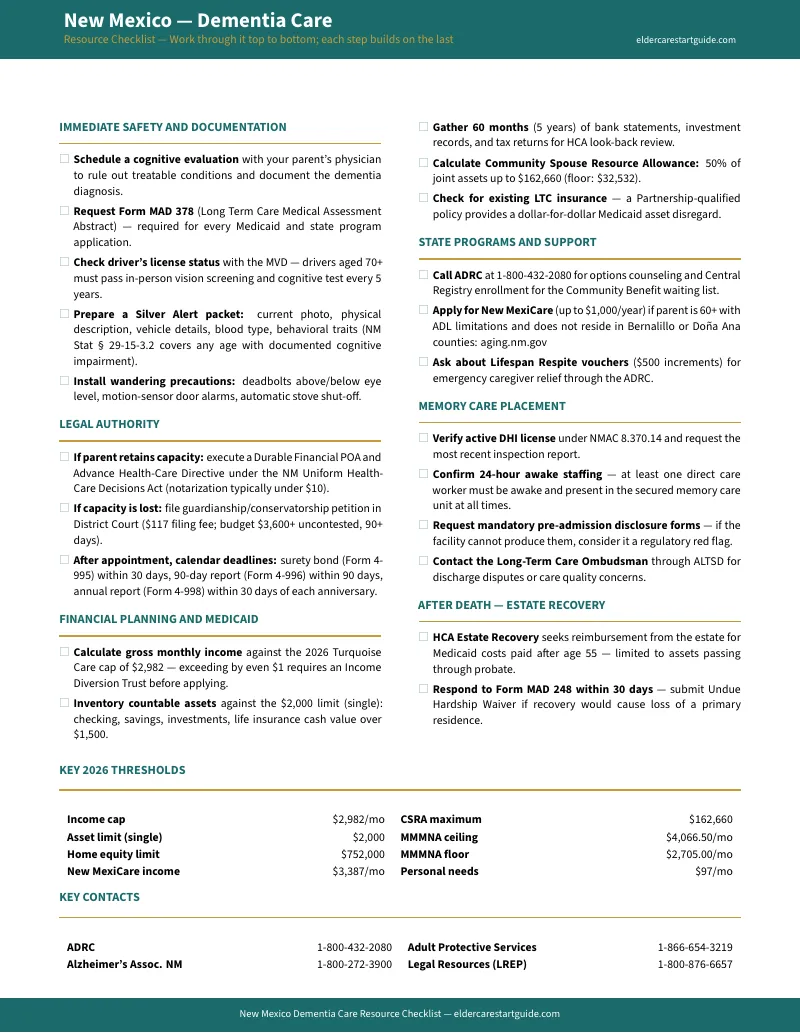
Plus: The Dementia Care Checklist — a one-page printable reference with every critical action item, contact number, filing deadline, and program threshold in priority order.
Who This Is For
- The adult child facing a sudden safety crisis — your parent wandered, had a fall, or was found unable to manage basic daily tasks, and you need to know your options in New Mexico this week, not after months of research
- The family trying to protect assets from catastrophic care costs — your parent's savings will be depleted within a year at private-pay rates, and you need to understand the Income Diversion Trust, the look-back period, and the Community Spouse protections before making irreversible financial moves
- The burned-out primary caregiver — you have been managing everything at home and you are running out of capacity, but you do not know how the Turquoise Care Community Benefit works or whether your parent qualifies for in-home support that could keep them out of a facility
- The sibling group that cannot agree on a care plan — you need an objective, regulatory-based framework to move the family from opinions and guilt to a structured decision grounded in what New Mexico's programs actually provide
- The long-distance coordinator — your parent lives in New Mexico and you are managing their care from another state, needing every state agency, program, and application step mapped in one place
Why Not Use Free Resources?
New Mexico publishes the rules. The Health Care Authority posts dense PDFs of program regulations. The Aging and Long-Term Services Department runs the ADRC helpline. The Division of Health Improvement maintains facility licensing records. The information exists — scattered across three state agencies, buried in administrative code citations like NMAC 8.370.14, and frequently outdated by the July 2024 Turquoise Care transition.
The ADRC helpline (1-800-432-2080) provides free options counseling, but counselors cannot advise on legal strategy, asset protection, or the specific sequence of applications that avoids a denial. They process intake. They do not tell you what to prepare before calling, what to do if your parent's income exceeds the cap, or how the 60-month look-back period could penalize transfers you made three years ago.
"Free" national referral services like A Place for Mom earn $3,000–$6,000 in placement commissions when your parent signs a lease at a partnered facility. They will not recommend community-based alternatives, facilities that accept Medicaid waivers, or any option that does not generate a referral fee.
Elder law attorneys in New Mexico charge $150–$400 per hour, with Medicaid planning packages running $5,000–$10,000. For families with complex estates, legal counsel is essential. But for families with straightforward finances, the guide lets you handle the standard application steps yourself — and for those who do need an attorney, it ensures you arrive at the first meeting with organized documentation rather than paying $300 an hour for basic data collection.
The New Mexico Dementia & Memory Care Guide is 100% independent — no placement commissions, no facility partnerships, no sponsored recommendations. It organizes the state's entire dementia care system into one clear action plan for .
100% Satisfaction Guarantee
If the guide does not help you navigate New Mexico's dementia care system more confidently, email us for a full refund. No conditions, no time limit.
Start with the free checklist or get the complete guide
Download the New Mexico — Dementia Care Resource Checklist at no cost — a one-page reference with every critical action item in priority order. If you need the full system mapped out, the complete guide covers every program, threshold, and decision point for .